Just published – The Curse of the Ship of Gold!

Aboard the SOG mission

I’m very happy to post a link to one of the most in-depth stories I’ve had published, the fascinating and tragic tale of Tommy Thompson, a brilliant scientist cursed by the grandeur of his discovery.

Please feel free to check out The Curse of the Ship of Gold here!!!

In 1988, Thompson and a crew of scientists and adventurers discovered the remains of the SS Central America, a ship that sank in a hurricane in 1857. The ship was carrying tons of gold from the Gold Rush, making it the dream quarry of treasure hunters. Thompson’s mission drew widespread acclaim as an example of classic American ingenuity, but he soon learned that he had also unleashed the wild specter of greed.

gold-04.jpggold-09-1320x743.jpg

From there, Thompson’s life was turned upside-down and would take him from court rooms to hoarded-out mansions to life on the run as a federal fugitive. He was ultimately captured after disappearing for almost two years and recently went on trial for allegedly making off with gold due to investors in the mission three decades before.

Thanks again to Narratively for taking on this piece and for the fantastic and classy look of the finished story!

Criminal conspiracies on the world’s foremost micronation

sealand-header_2580-1290x521

I am very pleased to announce that I recently had an adapted excerpt from my upcoming book on the Principality of Sealand and its remarkable 51-year history published by Narratively.

What happens when a gang of international criminals bootlegs passports from the country your family founded? Quite a bit, it turns out: bank fraud, gunrunning, and a connection to the murder of Gianni Versace.

The article can be found here.

Read on if you like intrigue, self-determination, kidnapping, and governments-in-exile!!

The locks and canals of the mighty Muskingum

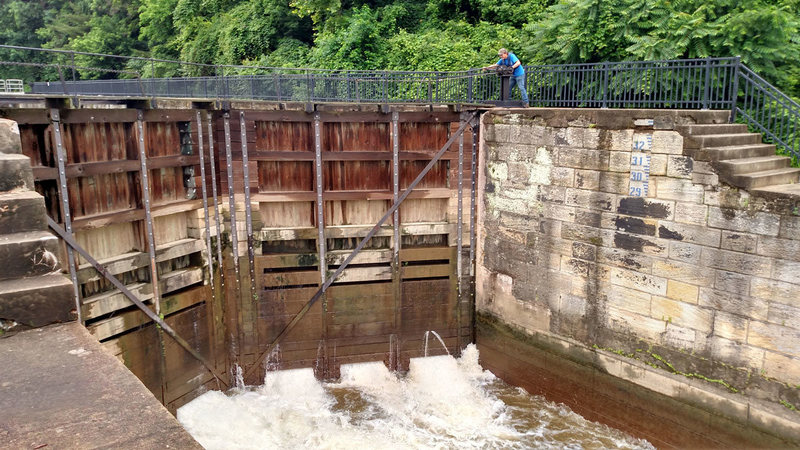
Lock #10 is unique in that it is a double-lock, with two chambers to raise and lower boats. At least half a million gallons are displaced in each step of the process.

Atlas Obscura recently published a piece I wrote about the old lock system still in use up and down the Muskingum River in southeastern Ohio. The locks are operated by hand and require the skills of a lockmaster, who stays on site to help the estimated 7,000 annual boaters traverse the dams that make the river navigable.

It’s always a pleasure to pore through dusty old archives and historical collections, and this certainly holds true when investigating the interesting history of my beautiful hometown! Thanks to the various historians and lock enthusiasts for talking to me, and to Tim Curtis for showing me how it all works!

The article can be found here. 

My book “Dance of the Trustees: On the Astonishing Concerns of a Small Ohio Township” is available now!

My book Dance of the Trustees: On the Astonishing Concerns of a Small Ohio Township was published on July 30 and is currently available through the publisher for 30% off. That makes it a mere $15.37!

Please feel free to buy a bunch of copies of this incredible tome so I can retire and only write books.

About the book:

“On September 9, 2015, in the quirky village of Yellow Springs, Ohio, the Miami Township Board of Trustees arbitrated a dispute concerning an area bed and breakfast that was apparently causing a lot of problems in the neighborhood where it was located. People were irate – the B&B was considered too loud or unfairly under attack, and the township officials were called incompetent by both sides for not ruling in their favor. The trustees looked amused, concerned, interested, annoyed, and baffled at the situation before them.

But this quaint debate was one of many fascinating problems the trustees deal with on a daily basis. While Miami Township is small, the concerns are myriad – cemeteries are filledwith unknown remains, there is a fire department to oversee, and they sometimes take legal action against properties clogged with junk. The responsibilities are doubly impressive considering no trustees have backgrounds in public office.

This book combines entertaining nonfiction vignettes with well-researched township history – including its history of religious cults and the possibility that Lee Harvey Oswald was once in town – and elucidates the processes behind an entire civic division. The book documents 21st century township life with humor, warmth and erudition, but also with the scholarship befitting an easy to read civics textbook.”

My Search for an Incredible Piece of Sci-Fi Trash

When I was a kid, I had this ridiculous sci-fi novel full of mutants, profanity, shoot-outs, and sex. Needless to say, I loved it. But when I was older, I couldn’t remember its title or author. And thus began a decade-long search to track down this incredible piece of sci-fi trash, leading me to bookstores around the country and into the vast annals of sci-fi. I just had an essay published at The Millions about my quest – read it!!

Medical waste: Who gets it, and what happens to it?

This article was originally published on April 9, 2018, in the El Paso Inc. Medical Section. The article was edited for length and slight stylistic reasons; the original version can be found below.

Autoclave

The Mediwaste autoclave, closed. Photo by Jorge Salgado.


Every day, box trucks pull up to a nondescript warehouse on the far-east side of El Paso to unload a fairly grotesque cargo. The trucks are carrying used catheters, bandages, diapers, syringes, and soiled gowns collected from around the city. The trucks belong to Mediwaste Disposal, a locally-owned company that handles the medical waste of more than five hundred clients in El Paso and New Mexico. If you’ve ever wondered what happens to the contents of those ominous red buckets in your doctor’s office, the Mediwaste fleet is the group to follow.

Companies that produce “regulated medical waste,” such as funeral homes, tattoo parlors, veterinarians, dialysis centers, and dentists, are required by law to dispose of it properly. While the waste eventually ends up in El Paso’s Clint Landfill, the process is not as simple as chucking it there. Texas law requires that a company fully licensed and vetted to treat medical waste pick it up and treat it.

“This is stuff you don’t want any Tom, Dick, and Harry handling,” said Mike Perez, one of the company’s co-founders. (There are other medical waste transporters in the city, but they take their loads elsewhere to be treated.)

To begin, Mediwaste supplies each business with containers that fit their needs. The containers are picked up as often as needed and loaded into the back of a box truck, which is legally required to have extra leak-proof capabilities. Labels are affixed denoting the containers’ provenance and are transported back to the warehouse. Each truck does approximately 35-40 pickups per day, Perez estimates.

The surprisingly innocuous Mediwaste facility is spare and clean-swept, with a few indistinct apparatuses in one corner and the smell of disinfectant lingering in the air. The day’s haul is taken off of the truck and dumped wholesale into what look like metal minecars.

MediwasteCart

A Mediwaste cart filled with…medical waste! Photo by Jorge Salgado.


Up to four of these carts are wheeled into a giant autoclave to begin the sterilization process. Superheated water from the adjacent boiler bathes the carts and their contents in steam for almost an hour. A sensor on the autoclave records the entire process to make sure that necessary temperatures are met, and these records are kept on file for five years. (If for some reason the autoclave goes down, the waste is stored in a refrigerated truck until it’s back online.)

Following their steam bath, the carts slide back out of the autoclave and their contents are dumped into a trash compactor, which crushes the assorted waste together in preparation for transport to the landfill. Though the prospect of dumping medical waste into a standard landfill seems questionable, Perez said that the autoclave process ensures that pathogens and other malicious contaminants are killed. In fact, he said, “our waste is probably the cleanest waste in the landfill.” Not only that, but it is an arguably cleaner way of dealing with the waste than earlier methods, such as incineration, which could release hazardous chemicals into the air.

Autoclave with Cart

The autoclave can hold up to four medical waste-bearing mine carts. Photo by Jorge Salgado.


Every aspect of the process is governed by stringent health and safety guidelines dictated by the Texas Commission on Environmental Quality, which Perez said are some of the strictest in the country. On top of the regulations governing transport and treatment, the facility is required to have security cameras and a fence running the length of its perimeter. At the end of each day, employees are required to patrol an area stretching two miles in any direction from the facility to make sure that no telltale red bags have dropped from any of the trucks.

When Perez began the arduous process of applying for permits and licenses to open the facility, many area residents expressed concern about seeing recognizable body parts. This kind of waste is called “pathological waste,” Perez explained, and as of yet Mediwaste does not have the equipment to appropriately process it.

However, those capabilities are forthcoming. Squeamish readers may want to proceed with caution – the company will be getting a shredder within the next month. True to its name, the shredder will allow them to render body parts “unrecognizable” before the pulp is treated along with the usual regulated medical waste. This is partly done on the behalf of landfill operators, who may not only get freaked out by finding an intact foot but would have to shut down operations in case the remains are evidence of a murder.

The homegrown company kicked off its operations when it picked up its first load from a pediatrician’s office in 2015 and is considering branching off into other unpleasant territories when the time is right, such as treating asbestos and chemical waste. Perez is as surprised as anyone that he finds himself running such a strange operation, but he is glad he is. In addition to appreciating the company’s success, Perez takes pride in the fact that the company can offer something positive to the community he grew up in. The facility is the first located in El Paso County, which means that tax revenue stays local and that trucks carrying hazardous waste don’t have to drive for hours to the next closest location to dispose of it.

“We took a chance and rolled the dice,” Perez said. “It’s not every a mom and pop operation shows up and says ‘Hey, I’m here to take your medical waste.'”

****

Sidebar: What happens to pharmaceuticals and similar waste?

Mediwaste is able to collect and process most pharmaceuticals for disposal. “As long as it’s non-hazardous, it can be run through the autoclave and taken to the landfill,” Perez said.

“Non-hazardous” in this context refers to pharmaceuticals whose components will be rendered inert in the autoclave process and thus won’t leach into groundwater or soil. However, certain medications must be incinerated in order to fully destroy them, as do items such as asthma inhalers, which can explode in the autoclave, and medications like warfarin, which contain explosive chemicals. Chemotherapy waste, such as canisters and related supplies, likewise must be incinerated.

Other options for disposing of pharmaceutical waste include treating it with chemicals, or in the case of pills, encasing them in concrete and burying them in a landfill.

Sidebar redux: How can I properly dispose of my household medications?

According to the El Paso Department of Health, disposing of most household medications is a fairly easy process. First, take an old plastic container with a screw-on lid and fill it with an unappetizing substance, such as dirt, coffee grounds, or kitty litter. Next, take pills, patches, syrups, etc. and put them in the plastic container. Put the lid back on and shake the contents. The moisture that collects in the container will dissolve the pills safely. The container and its contents can then be put out with the regular trash. Disposing of medications in this capacity instead of dumping them down the toilet reduces the amount of chemicals that pollute waterways and ecosystems.

However, such a method won’t work for items like syringes, home medical tools, and asthma inhalers (the latter of which can explode if punctured or heated). These items can be taken to hazardous waste collections sites around town. Some medical facilities or pharmacies are also equipped to take this waste as well as unused and expired medication. Fort Bliss also has collection points.

A €20,000 Monument to the Spanish Tortilla

Authentic Spanish tortilla - MAGDALENA BUJAK/ ALAMY

I was fortunate enough to spend a couple of years in Spain, and like most people who spend any amount of time there, I found the country very agreeable. This stemmed in part from the fact that that country likes to eat a lot. In fact, Spaniards are passionate their food, and it was often pointed out that their food was superior to all other world cuisine. But they have good reason to celebrate it, as some of the country’s simplest foods are truly incredible. This article linked below is about one of those dishes.

As a bonus to a much-appreciated visit to that country last fall, I ended up writing a story about a small town in southwestern Spain that is building a €20,000 monument to the tortilla de patatas, the country’s trademark dish and one said to foster among Spaniards “more cohesion than the constitution.” I spoke with representatives of the town of Villanueva de la Serena about the plans for the monument, as well as the artist who won the contest to design it. I also learned a lot of truly interesting things about the history of the potato and how people responded to seeing the tuber for the first time. I’m really happy with the way this article turned out because I got to include a bunch of this niche history.

I am still attempting to perfect my own version of the tortilla, which has gone from crumbling disappointingly out of the pan to something that bears more than a passing resemblance to the dish I’m trying to emulate.

This article was originally published on Gastro Obscura on February 13, 2018.


Meet the Super-Serious Sasquatch Chasers of America’s Premier Bigfoot Conference

As luck would have it, one of the largest Bigfoot conferences in the United States is held thirty minutes from the town where I grew up. Each May, Marc DeWerth hosts the Ohio Bigfoot Conference, located in Salt Fork State Park in southeastern Ohio. The area is known for its high level of Bigfoot sightings, as the topography is reportedly ideal for the creature.

I found that people have many different impressions of what Bigfoot is. Some people feel Bigfoot is an alien or a government experiment, but a majority of the more rational sasquatch enthusiasts believe that Bigfoot is a holdover from premodern times, a giant biped that co-evolved with our ancestral forebears. (There is some evidence to suggest that ten foot tall humanoids did at one point walk the earth.) The OBC is like an academic conference in which these ideas can be exchanged.

One thing I found particularly interesting was the ethical debate surrounding the hunt for the creature – some people maintain killing one is the only way to prove they exist, while others strongly feel that the creatures should be respected and left alone. I touched on this in more detail in my original version of the article; a bit was taken out for brevity’s sake.

The article was published in June, 2017, on Narratively, and can be found here.

A guy from the town where I was living at the time stepped in at the last minute and took some amazing photos of the event. His name is Matthew Collins, and his work can be found here.

Info about the Ohio Bigfoot Conference can be found here.

The Grisly Murder That Launched a Podcast Star

I have been listening to a true crime podcast called “True Murder” for years. Each week, host Dan Zupansky interviews true crime authors about the cases they’ve written about. The complex/troubling appeal of true crime is a discussion for another time, but Zupansky is one of the first true crime podcasters and is considered an OG expert in the genre.

Zupansky will sometimes make reference on the show to a case he himself was involved with in 2003. A man named Sydney Teerhuis viciously killed another man in a Winnipeg hotel, seemingly doing so for the grim celebrity it would bring him. Zupansky, who always wanted to be a journalist, saw an opportunity to write his first book. He got in touch with Teerhuis, who agreed to work with him on the book. Zupansky unwittingly became a major witness in Teerhuis’s trial, experiencing firsthand some of the world he had so often read about. This article is about the strange Zupansky-Teerhuis affair, and how Zupansky was able to launch his own career as a result.

This was especially interesting to work on because I got to speak with Zupansky directly. I was really familiar with his voice from having listened to so many episodes of his show, and talking to him almost felt like a personal podcast playing for me.

The article was published by Narratively in September, 2017, and can be found here.

He’s a Murderer With an Intergalactic Alibi. And She’s in Love With Him.

This article is about Jo Ann and Mark Richards, a couple with a backstory that is at first hard to comprehend. Their relationship stretches across the galaxy from a California prison, and is one that got its start with a senseless murder committed in 1984.

I first came across this story when researching micronations for a separate project. A seminal text on the subject called How to Start Your Own Country featured an index of experimental nation-states across the world. One cryptic listing was for something called Pendragon, which I shortly learned was a plot to take over Marin County, California and declare it a sovereign kingdom. The plot involved a tragic murder and gullible teens, and is in and of itself a fascinating story. I looked into writing a full story about it, and I learned that from there the story only got deeper. I learned that the man allegedly behind the Pendragon plot (who is serving a life sentence for the attendant murder) has published thousands of pages of texts detailing his family’s secret history as intergalactic diplomats working for shadowy branches of the US government. He believes he has been framed, and his wife has started a nonprofit to disseminate classified government information and advocate for her husband’s release. The story chronicles this tale, and shows how this unconventional couple continues to make it work.

This story originally appeared on Narratively, and was published in November, 2017.

A link to the full article can be found here.