I am a professional book indexer

Index-art-590x332

I, like most people, was taken aback when I heard that Grant writes the indexes for books for a living. I often wondered how an index came together, and I was worried that I might have to write the indexes for my own books. But it is freelancers like Grant who do the dirty work of going through books and picking out the terms that make up the index. His vocation puts him into contact with all kinds of interesting texts, but the nature of his work makes for a particular way of reading them.

If you go to a history book and you just want to read about the Gettysburg Address, go to the index and look up “Gettysburg Address.” That’s what an index is. I make that. I read the book and pull out the things that go into the index, and I write the index.

I read a book about indexing years and years ago, and the author said an index is a map to the information. It’s a matter of thinking about what the subject is. I read the introduction before I get started, if the book has one, where the author will give you the scope of the book, why they wrote about the subject and some of the big ideas, highlighting the key concepts that come up. I try to get these concepts into my head. A brief look at the table of contents helps. And then I put it aside and begin indexing the first chapter.

One thing you have to be able to do when things get complicated is to shove away a lot of the ancillary arguments and conversations the author gets into. You’ve got to really be able to focus on the key concepts. In some ways, you’re purposefully ignoring a lot of what the author is saying, cause you can’t index every little nuance. That’s not your job – you’re not recreating the book, not getting into the nitty-gritty.

It’s almost like you’re reading for an exam. You’re getting the concepts and you’re processing a whole lot of information without having to understand all the ins and outs. A good indexer can index books they don’t understand thoroughly. I’ve done books like that before, like chemistry books, which can get pretty tricky. Some philosophy is really hard to wrap your mind around. You don’t have to quite understand it all. You have to know they’re talking about “being” and “truth,” or note when they reference [it conjunction with] Kierkegaard or something like that, but the relationship between being and truth is not something you have to explain to someone.

Folks are always really curious about it, I gotta say. When I tell people about it, the universal reaction almost always is, “Wow, I never thought about that before, that someone’s got to do that.” The other thing people ask is, “Can’t computers do that? Is there a software program you use?” And they’re thinking that I use a program where I type in a few words or concepts and then the program scans the text. It doesn’t work like that. I have to put all of that information in by hand. But there is an indexing computer program that I’ve been using for years. I originally got it when it was DOS back in the 90s. It’s a very specialized word processing software that’s specifically designed to create an index. But there’s no text scanning – I type everything in. I make the decision what references go in. Every line, every page reference has to go in by hand.

I type in a main term, “Lincoln, Abraham” and then “Birth of” and the page reference. Then I type in another one. The program puts all that together automatically into alphabetical order. It interleaves everything, but I can manipulate that index with a few keystrokes. I can go back and edit, change things around if I decide I don’t like a certain term, etc. It’s an ongoing process of building and refining as you go through the book. But I don’t go back through the book unless it’s incredibly complicated. I read as I index, and I index as I read.

When you’re done with the index, you have an extremely rough draft. Your own spelling mistakes all over the place, concepts might be differently worded or listed under different headings. So I begin the editing process, which takes a day or two, or three, depending on the size of the index, modifying and tightening up, or adding sub-entries if things aren’t in enough detail. That’s how the process goes.

Does the editor or author indicate what they are looking for in an index, or how it should look?

Almost never. Maybe once a year. Maybe once a year someone will give me a list of terms or say they want these concepts in the index.

So it’s essentially left up to your expertise how to phrase or format the index?

Right.

Is there any kind of standard or thorough it has to be? Or does reading through the book inform what the ultimate index is supposed to look like?

A little bit of both. There’s a section of the Chicago manual that’s devoted to indexes. If you have an entry, “Lincoln, Abraham,” you don’t want to see that term and then 34 page references. In some indexes you’ll see that – no sub-entries. That’s a really bad index. You see that often, even in big-name books. Maybe the editor did it, an author did it. Or the author had a grad student or is paying someone in the family to do it, or something like that. No professional indexer would do that.

An entry without any subentries should have a maximum of six page references, or twelve numbers indicating six spans of pages. Anything more than that and you’ll have to start building subentries. And to build subentries, you want to build subentries that make sense and include all the things pertinent to that person, name, or concept. That’s what makes a good index.

Publishers have a rule of thumb that five percent of the book is the index. If it’s a 100 page book, there are five pages of index. If it’s a whole lot more than that, you’re doing too much, or if it’s a page and a half, you’re missing something. Five percent should be enough to get all of the information into the index.

You can pretty much tell if it was a professional indexer, an editor, or an author. It’s certain that each indexer will create their own index. They’ll be just as good, but it will be different [from those made by other indexers.]. You see things in different ways, phrase things slightly differently. There should be a great deal of overlap, but no two indexers will create the same index. And that’s not a bad thing.

How would the index of a history text differ from that of a science or philosophy text, if at all?

In terms of the index, probably not much. I go about them the same way. If there’s going to be a lot of information around any concept, whether its “mitosis” or the “Battle of Antietam,” you have to make those entries and subentries meaningful and useful. You apply that same strategy and thinking to any subject you’re reading. You read science differently than you read history, but you’re still trying to produce an index that’s competent for both.

Publishers will contact me, often they have the book in hand or will have it in a week or two. What I get are the final proofs. It’s the very last stage. Once the author approves it, it can go to press.

Once I get the book, I’ll usually have a month to index it. That’s for a book that’s 300 pages or less; your average history book or biography. That’s what most of my projects are. If the book is larger than that, the publishers will give me a little more heads up or give me a little more time to index it. Depending on the complexity and size, it will take me around a week to index a book. I can pretty much average a book a week. I do about forty or fifty books a year – that’s a little more than a week for each project.

It was an absolute non-sequitur getting into indexing. It was total serendipity. I have a degree in botany. I was working in a managing plant research labs at University of Massachusetts Amherst for about five years. There was no place to go, and if I wanted to do anything interesting I was going to have to get a PhD.

I had a friend who I’d gone to school with who was in the same position as me. He loved botany, he was waiting tables, and he lived in Amherst. He mentioned that he knew someone who was a freelance indexer and editor, and he was thinking about learning about indexing as a way to make some extra money. A lightbulb went off – that sounded really interesting. I talked with his friend and taught myself how to do indexes using index cards. They were small projects but I took that work to her for comment and review. She gave me some feedback and said, “Look, I’m going to go out on a limb and ask a guy I know at an academic press if you can index a science text for him.” This was in 1996, and then I just pushed it.

I just networked on my own. I got a digest that lists every publisher in the US and Canada, and I’ve gone through that two or three times in my career, writing every single publisher that produces let’s say 100 nonfiction books per year. I wrote hundreds of letters and emails, and in 1997 I went out on my own. It took me a year to build up enough experience to realize I could do this. With a lot of work and little luck, I realized, I can do this. And it worked out.

I’ve never met another person who does this. Occasionally I’ll meet someone that says they know an indexer. There is a American Society of Indexers that has chapters in lots of states. But I’ve never been a part of it. When I was just starting off, I went to a chapter meeting of ASI in Massachusetts. There were like fifty or sixty people there, but I didn’t feel connected to any of them. We didn’t have much in common. But I think one thing that attracts a lot of people to the job is the independence, and so you don’t get a whole lot of folks that are interested in meeting other indexers. The one meeting I went to, most of the indexers were women, most were middle-aged or older, and most were doing it as a part-time thing. I didn’t have the sense that there were many folks that were doing it full time. They were retired, or their spouse was making enough money, or they had an interest in literature. There are a lot of indexers, but full-time indexers, there probably aren’t that many at all.

The publishing world relies heavily on freelancers. There used to be in-house indexers, in-house designers, in-house copyeditors, but there aren’t anymore. That stuff is all outsourced. It’s cheaper not to have someone in house. There are freelancers everywhere doing this in publishing, and it’s the personal relationships that keep it together. The editor knows that if he’s used this proofreader and this indexer and this copyeditor for years, he can keep going back to the pool of people he’s developed relationships with. I’ve built up a clientele that I’ve worked with for years. Some editors I’ve worked with for close to twenty years at this point.

I’ve met a few editors from a large biology text publisher, but those are the only editors I’ve ever met. Everyone else, I have no idea who they are. There are people I’ve worked with for years and years at the University of Kentucky but I’ve never met any of the editors. But they send me pictures of their kids because I’ve known them for years. There’s a woman at a press in New York City who I’ve worked with since the late 90s – I know about her daughter going to college, but I’ve never met her. It’s gets to be a really personal relationship after all those years.

The downside to that [personal relationship] is when they retire or move on. This has happened numerous times. I’ve had a good relationship with an editor, she leaves, and I’ve lost that press. The person that comes in has their own stable [of indexers]. It’s so personal that if someone leaves, gets sick, retires, there’s no guarantee I’ll keep working for that publisher. On the other hand, I’ve worked for years with the University of Nevada Press, with three different editors, and they keep passing me on.

I get up and usually try to start working immediately. By 7 or 7:30 in the morning I’m at the computer reading. I take multiple breaks during the day and stop by early afternoon. That’s my usual day. I own my own time, and I wouldn’t trade that for anything.

Of course, I have no benefits, no insurance, no vacation. And I rarely know more than a month out if I have work or not. I’ve got a couple of large projects right now, science books, that will go on for two months. That’s some stability, but when I don’t have those, which is fairly frequently, then I often don’t know what I’ll be doing in a month or six weeks. Editors aren’t thinking that far ahead. There’s always that uncertainty. When work comes, you take it. The consequence of that is, you’re overworked, you don’t get enough time off, and there’s a real danger of fatigue, burning yourself out. You’re loathe to say no because you don’t know what else will come up. The other thing is that the relationship you have is with a few presses. I can’t work for twelve presses. You can’t do too much because you’re only one person. But there’s always the concern is that if you say no, or say no a couple of times, they’ll start going with someone else. You want to keep your name up there and active, and the way to do that is to say yes and not no.

I’ll tell you one thing it does – indexing makes you realize how much really bad writing is out there, and what a really good writer is like. I read tens of thousands of pages a year – you get sensitized to what good, clear writing is. It’s such a pleasure [to read writing like that].

A dull book is hard to index. Or a really abstruse book, where the thinking’s really confused or the author is particularly invested in academic language. When the author doesn’t have that kind of clarity, the indexing job is hard.

I get really bored with a lot of books because they just aren’t that well-written. I read a lot of books and I get impatient with murky writing. There are some books out there that are just absolutely horrible. Just because it’s published doesn’t mean the writer’s very good, or that it’s well-edited. Some of it is really sharp and some of its really sloppy. Sometimes the more prestigious the university press, the more pretentious the prose is going to be. If something’s being published by Harvard University Press, then it had better be very dense and filled with lots of jargon and academese and “subtle” points. Just cut through it! The real meat of the book would be the Cliffs Notes version of it.

A well-written book is really easy to index. A well-written history or biography is a joy to index. Because the concepts make sense, they’re logical, the story is clear. What the author is doing, he or she makes really clear, and that makes the indexing really easy. You know PG Wodehouse? I read PG Wodehouse almost exclusively. I read some poetry, I love Raymond Chandler, Wodehouse – anything but something serious. I do that all day long; I’ve no interest in reading something serious. I can’t take a history book. I occasionally read a biography, but it has to be something really special.

Plowing through pedestrian prose – I don’t need to do that. That’s why I love Wodehouse – he’s a genius with writing, a genius as a writer. It’s comedy and it’s silly, but boy, you pay attention to what he’s doing with sentences and words, and it’s imaginative beyond belief. He’s creative at the highest level. Chandler – his prose is his own. That’s why I read now, for the skill of the writer.

This was originally published as a blog post at the Yellow Springs News.

A Landfill is an Ecosystem unto Itself: a Treatise on the Organisms that call Landfills Home

dsc_2110

Looming over Colerain Township is Mount Rumpke, the highest point in Hamilton County, Ohio. Visitors are taken by bus to the top, and from the summit, you can see the valley below, stretching to the reaches of the mountain’s domain. The skyline of nearby Cincinnati sits hazily in the distance. Far below, bulldozers and dump trucks, the size of ants, can be seen developing more mountains just like it. Mount Rumpke, with its sweeping valley and majestic panoramas, is a mountain made of garbage.

Mount Rumpke represents approximately fifteen years’ worth of trash, a mix of municipal solid waste and construction debris collected from most jurisdictions within 60 miles of Cincinnati. The Rumpke Company operates the premier garbage collection network in southwestern Ohio. Mount Rumpke sits on the company’s 1000-acre property, the accumulated garbage rising 1,064 feet above sea level, ten feet shy of its legal limit. Much of the verdant valley is actually garbage, piled hundreds of feet deep but covered over with dirt, grass, and shrubs. The landfill, like most in the USA, is licensed by the EPA, who says it can take in up to 10,000 tons of garbage per day. The Rumpke landfill is the sixth largest in the country.

That much garbage in one place makes for a landscape unique in its composition. The concentration of man-made goods, harsh chemicals, and organic waste all rotting together makes for an environment that doesn’t — and can’t — exist anywhere in the natural world. It is alien in its harshness, and yet the landfill is teeming with life. A landfill provides abundant food and shelter that gives rise to its own ecology. Landfills, while ostensibly inhospitable, have become a biological niche, a biome based around humanity’s waste.

The guts of the average landfill are actively decomposing thanks to tens of thousands of kinds of bacteria and fungi. The spread of bacteria is facilitated in part by insects like cockroaches and ants. Mice, voles, and other small mammals pick from the trash and nest in the landfill’s periphery, while raccoons, coyotes, and dogs — even baboons and bears in areas with such creatures — scavenge the top. Crows, starlings, and gulls flock to landfill en masse, and are in turn sometimes scavenged by fiercer birds of prey. For many creatures, the landfill is the beginning, middle, and end of life, the stage on which they act out the primordial directive to eat and reproduce.

An organism’s ability to survive and even flourish in such conditions demonstrates the remarkable dexterity of the natural world. But how do animals survive in a landfill? Are there benefits to making a home there? How does the nutritional value of items in the landfill compare with more traditional food sources? Have organisms developed a tolerance for the poisonous effluent that flows through the trash? This article takes a look at these questions, throwing the author (willingly) into the depths of a landfill to roam around the filth with its fascinating, industrious layers of life. The kingdom of garbage is an impressive one, an interdependent biologically functioning unit. In other words, a landfill is an ecosystem unto itself.

The putrescible groundwork for life — how a landfill works

Molly Broadwater, senior corporate communications coordinator at the Rumpke landfill, said the term ‘dump’ is pejorative. A dump implies a pit or a field where residents simply throw their waste, like those old-time trash piles way out in the country. Dumps typically don’t include any of the regulations or forethought that goes into the creation of the modern landfill, which is an engineering marvel. Landfills, also called tips and middens, don’t just hold trash but all the facilities needed to manage it. The Rumpke facility, for example, has a gas refinery to harvest the methane that builds up as garbage decomposes, a drainage system that funnels leachate — aka garbage juice — to a wastewater treatment plant, and space dedicated to the company’s trucks, including a garage, a workshop, and an area to wash off their tires so they don’t track waste from the landfill to the rest of the world.

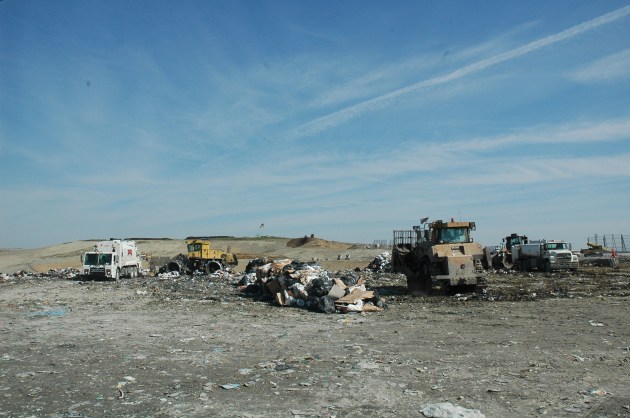
Owing to the sheer amount of garbage delivered every day, a landfill has to think years in advance about where to store the unimaginable accumulation. When I visited the Rumpke landfill in April, the earthmovers seen from atop the mountain were preparing the next area on the property scheduled accept garbage. The site starts as a 13-acre, 200-foot deep pit, which isn’t expected to be full for eleven years. At the bottom is three feet of impermeable clay that acts as a natural barrier against leaks. The clay is followed by a plastic liner and then a geotextile cushion liner, which prevents the plastic liner from being torn or punctured by the layer of rock that comes next.

Trash dumping can start once these layers are in place. Garbage is trucked in and dumped in the assigned spot. Rumpke has a fleet of 400 of its own vehicles, some of whose routes include 400 stops. The trucks can hold 14 tons of garbage, or that of around 800 homes. Dozens of other trucks, private and commercial, visit the site daily. Waste haulers, construction crews, and homeowners pay by the pound to dump at the site. Big machines and bulldozers roam the piles, crushing down the trash with spiked metal tires. One of these machines can weigh up to 50 tons, and has the power to compact 1400 pounds of garbage into one cubic yard of space.

Trucks don’t dump wherever they feel like it. Trucks are directed to the “working face,” or the area where garbage is currently being dumped. Governmental regulations require that the working face be compacted and covered with a layer of dirt, partly to reduce odor and blowing trash, and partly to limit the amount of animals drawn to it. The layer or soil is around six inches deep, and is typically applied within 24 to 48 hours after the garbage is dumped. (Immediate soil coverage is often prescribed for food and plant waste.) As a result, there is more dirt but less visible garbage than one might expect in the landfill. A lot of the Rumpke facility looks simply an immense field of dirt, with patches of garbage here and there hinting at what’s below. But there are also the classic rolling hills of refuse: those surreal, grotesque piles that are repellent and fascinating in equal measure. Animals inhabit the calmer areas of the landfill while scavenging the garbage open to the world, taking advantage of the area’s bounty and the social opportunities afforded by the strange environment.

When a dumping area reaches capacity, layers of impermeable plastic are laid on top to seal it, sometimes including an odor control blanket, which uses odor-eating technology found in tennis shoes and trash bags. Broadwater, pointing out a five-acre expanse covered with such a blanket, said that a landfill is ideally a self-contained, leak-proof facility that should stay that way for decades. The leak-proof facility is then covered with a layer of rocks to prevent animals from burrowing, especially in the gas reclamation sites, which could introduce air and disrupt the process. Next comes a few feet of soil seeded with grass and other vegetation. (No trees are present, however, as mandated by state law. A toppled tree could rupture the top liner.) A finished, capped landfill looks at first glance like a park. The whole idea is that a landfill be “invisible at the property line,” disguising the garbage and minimizing its odor by burying it, and by employing a property-wide network of misters that vape out a vegetable-based perfume. And voila! The makings of the average landfill.

(The article that follows uses these kinds of tightly-regulated landfills as the basis for the landfills discussed herein. Many areas do not have infrastructure in place to construct landfills of this magnitude and relative self-containment. The unregulated landfills that exist elsewhere in the world (and which would certainly meet Broadwater’s definition of a dump) are vastly more open and dangerous, to organisms both inside and out. There you have a true sea of garbage. More animals would likely be drawn to these sites due to their openness, and so the populations and distribution would be a little different than what is described below. However, the basic processes of bacterial decomposition and foraging behaviors, for example, are similar enough to paint a general picture of the relationships between organisms that inhabit a landfill.)

The Rumpke family has called the Colerain Township landfill home since 1946, as has the extended family of countless organisms that likewise reside there. Just as old William F. Rumpke seized an opportunity to collect garbage where nobody yet had a monopoly[1], the creatures in a landfill are able to exploit its resources for their own livelihood. A society has been established in the landfill in deference to the natural order, and to the natural course of life.

Into the microbial depths (of garbage)
DSC_2134.JPG

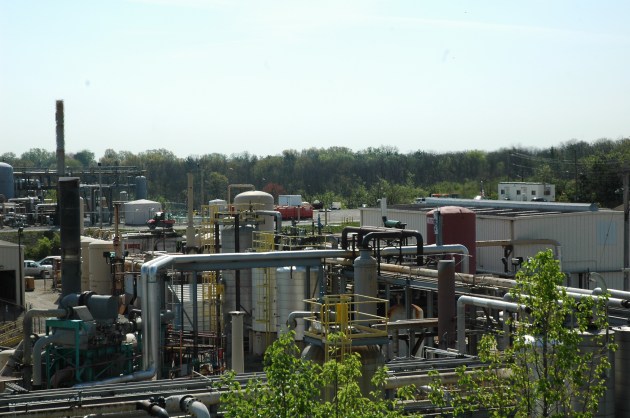
The odor of a landfill is a distinct indicator of the presence of the bacteria and fungi within it, as my aunt and uncle came to understand very well. A few years ago, they bought a house less than two miles from a major landfill. Either they were not aware of its location or were not told, but when the weather got warm, the gnarly odor of the dump came rolling down the surrounding hills and permeated their neighborhood. While the smell smelled partly like garbage, a very distinct component of the stench was sulfur, a compound present in the gas produced as garbage decomposes. The smallest layer of life in a landfill — a “robust set” of microscopic bacteria, fungus, yeast, and protozoa — consumes and digests organic materials in garbage, breaking it down like an enormous compost pile and producing huge amounts of methane gas as a byproduct of their activities.

An estimated 10,000 species of bacteria and fungi live in a gram of soil. Approximately 25,000 aerobic bacteria laid end to end would measure an inch. Bacteria, like pretty much any organism that wants to operate at optimum efficiency and comfort, are pretty picky about the conditions in which they live. Bacteria and fungi cannot grow if the temperature is too low, and they need waste with sufficient nitrogen content to make the proteins that allow them to grow. Fortunately, landfills are often porous enough to allow for the dispersion of rainwater and leachate. Leachate, shown to have a “unique geochemical composition” of highly toxic compounds[2], also contains high levels of phosphorus and nitrogen, which are crucial to bacterial growth.

A host of other microscopic organisms like nematodes, protozoa, and archea feed on bacteria and fungi, and process the organic components of garbage into a product more nutritious and easily digestible by other creatures. Nematodes contribute greatly to the decomposition of organic material because of high food consumption and nutrient recycling rates. The microscopic nematodes — numbering at 106 individuals per square meter — are also known as roundworms and make up an estimated 80 percent of all of the animals on Earth, and live in almost every possible climate and location. Scientists estimate that there may be up to one million species of nematodes, while a full half of the known species are parasitic. Protozoa are single-celled organisms that are capable of propelling themselves around and feeding, while archea are microscopic organisms that exists as single-celled beings or clusters. The landfill is not an unusual environment for archea, as they are “extremophiles,” the creatures one often hears about living in deep sea vents, gorging on volcanic sulfur, or in areas with extreme salinity or extreme heat.

But it is the bacteria and fungi that are the most crucial decomposers. Imagine a pile of garbage cross-sectioned from top to bottom. The cross-section would show layers of garbage in different stages of decomposition, with different kinds of bacteria responsible for each phase. The first stage of decomposition involves aerobic bacteria, or bacteria that need oxygen to survive. They consume oxygen as they consume organic waste, effectively melting it on a cellular level. When the oxygen is depleted, anaerobic bacteria pick up the decomposition process, as they do not need oxygen to function. They get to work digesting the compounds created by the first bacterial phalanx. These are digested into acids and alcohols, making the landfill highly acidic. Nutrients dissolve as the acids mix with any moisture present, and are dispersed throughout the landfill.

The landfill becomes a more neutral environment as other anaerobic bacteria eat the acids they’ve created, allowing methane-producing bacteria to prosper. These bacteria produce methane as a waste product of the items they are digesting. Once methanogenic bacteria establish themselves, they steadily produce gas for at least 20 years, and sometimes even as long as 50. Generally, the composition of the gas produced by these organisms is 45-60 percent methane and 40–60 percent carbon dioxide. Other gasses, such as ammonia and oxygen, are present in small amounts. Weird little capped pipes come out of the ground near active garbage sites and in the otherwise nondescript grass hills and fields. These are vents that help outgas the methane. Most of the gas, however, is harvested and processed by the on-site refinery, or burned off via flares. (Towers with what appear to be everlasting flames are a common site at landfills.) The gas is sold to energy companies, and garbage gas is even used to power some of the Rumpke’s trucks. Methane is only about half as efficient as natural gas, but according to Rumpke, who has over 200 gas wells on the Colerain property, the landfill produces enough methane to power 25,000 area homes.

Aside from the pungent aroma of decomposing garbage, landfills are stinky because of sulfides present in the gas, which are produced by anaerobic bacteria. Comprising only around one percent of its volume, sulfides are nonetheless responsible for the garbage gas’s rotten-egg odor, which is why driving by a landfill often smells like weird gas instead of trash. All of the other gasses present are odorless and tasteless; the tiny percentage of sulfides is responsible for the smell that induced my aunt and uncle to move, and for the slap they likely delivered to their real estate agent for not telling them their house was near the county tip. Though in reality, they kind of lucked out it wasn’t worse — anaerobic bacteria also produce cadaverine and putrescine, which smell exactly as their names suggest.

The establishment of bacteria in the first place depends on the contents of the landfill. Organic waste is crucial to the process, introducing bacteria into the dump as well as nutrients like magnesium, calcium, and potassium, which help bacteria flourish[3]. Organic waste is abundant in the average landfill. According to industry figures, approximately half of the landfill’s contents are some kind of organic waste — restaurant food scraps, wood and paper, textiles, etc. According to one author, “fungi and bacteria are not restricted to decomposing leaves and other plant materials. They will decompose any dead organic matter, whether it is a cardboard box, paint, glue, pair of jeans, a leather jacket or jet fuel…made from petroleum, which is made of decomposed microscopic creatures from the oceans of the Mesozoic Era.” Bacteria and fungi are also introduced into the landfill via the soil dumped on the garbage at the end of every day.

Revoltingly, industry figures show that soiled diapers make up four percent of any landfill’s intake, providing their own pungent breeding ground for bacteria. (Remember, Rumpke takes in 6000 tons of garbage per day — four percent of 6000 tons is 240 tons of dirty diapers — every fuckin’ day!) Moreover, landfills are generally able to accept carcasses and other animal waste from slaughter plants. Thus, while not common, it wouldn’t be impossible for animal remains to be mixed in with municipal solid waste, which would certainly introduce bacteria of its own. The Franklin County Sanitary Landfill, serving Columbus, Ohio and its surroundings, “will accept animal carcasses for disposal,” provided the attendant is notified and the carcasses are “disease free and in heavy bags, if possible.”[4] These remains would be dumped in the current working face of the landfill.[5] Medical waste, with its attendant bacteria, is often present as well.

The microscopic organisms create heat as they do their dirty work. Bacteria are the organisms most responsible for the entire decomposition process. They energize themselves with carbon and grow by consuming nitrogen. Their activities are powered by oxidizing organic material, and this oxidization is what causes the heat. Signs of biological activity are temperatures between 90 and 150 degrees — high temperatures facilitate the breakdown of proteins and complex carbohydrates like cellulose, the most abundant compound in modern refuse. Bacteria can withstand the surprisingly high temperatures reached by composting garbage. In fact, thermus bacteria has been found in decomposing waste: thermus has also been found in hot springs in Yellowstone National Park and deep sea thermal vents.

Coupled with the flammable methane gas coursing through the landfill, Broadwater said that one area of the Rumpke landfill was decomposing at such high temperatures that a massive fire broke out and burned for at least a week. This is roughly equivalent to your compost pile churning with such vigor that it spontaneously bursts into flames. Rumpke was unable to figure out why this area was decomposing at an elevated temperature, and the section continues to be mysteriously hot to this day. Coupled with the presence of the methane, the combustible garbage is a strange hazard to all denizens of the dump.

Worms, Roaches, “Filth Flies” and other insects
Screen shot 2016-10-23 at 1.20.02 PM.png

Insects are important to the decomposition of garbage because they eat a lot of trash and tunnel their way through it, which mixes and aerates it. They tear up material into smaller pieces, which is readily eaten by microorganisms. Bacteria often digest their feces. Insects are of course also food for other insects and larger creatures. Rove beetles feed on the maggots of flies, for example, while centipedes often eat worms. Further afield, the garbage grasslands contain the insects one might expect in grassland — grasshoppers, crickets, butterflies.

Some insects find their way to the trash, while some are inadvertently brought to it. Infrequent collection, loose lids, and holey containers are the prime culprits when it comes to infestation from the outside. An estimated 60 percent of city garbage containers are infested with fly larvae; fruit flies can fit through openings a millimeter wide. In another interesting case of filth in reverse, cockroaches are often found in landfills, as they hitch a ride in the belongings humans have discarded. And to make matters more unpleasant, there are mosquitoes. Standing water often found in containers or used rubber tires is an ideal breeding ground.

Insects that eat wood can also carve out a niche in the landfill, given the high percentage of organic material in the dump. Microscopic organisms and termites process the wood into a product more nutritious to other wood-eating insects, such as tree borers and beetles. The presence of termites depends on the relative moisture and nutritional content of wood, which, contrary to cartoons that show termites devouring everything in their path, they are quite selective about. (Good wood is high in both.) Like cockroaches, the presence of wood-eating insects in waste sites likely stems from the introduction of wood already infested more so than independently relocating to it.

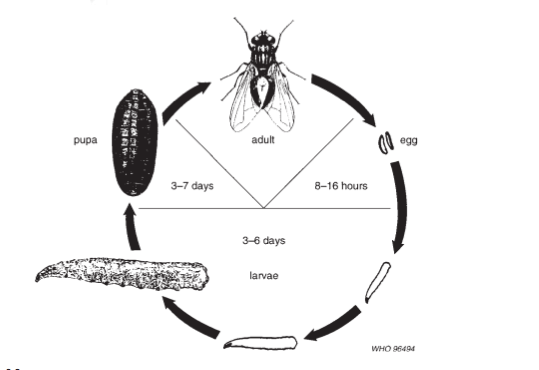
In one Calvin and Hobbes strip, Calvin relishes being a fly at a picnic table, much to the chagrin of his parents. “Filth! Pestilence! Contamination!” he says with glee (and accuracy). Flies are a ubiquitous presence in areas with any kind of decay. The whine of thousands of flies generally augurs something gross, which acres of wet, stinky trash certainly is. The common housefly is the most abundant insect in landfills around the world. Flies eat decomposing garbage, sucking up liquid waste and spitting saliva on solid items so they can be digested. Flies lay their eggs in garbage too, and are capable of reproducing up to five times over the course of their life, laying over 100 eggs each time. The emerging maggots burrow into garbage and eat it, and a few days later pupate into adult flies, where they live for a matter of weeks. Flies can also breed in cesspools and sewage sludge, environments that can probably be likened to cousins of a landfill.

As mentioned, the soil placed on top of the garbage at the end of every day is in part a pest control measure; only a serious application of soil can help reduce the amount of flies, as they need sufficient oxygen to live. However, emergent houseflies are capable of making their way to the surface through over nine inches of soil, while flesh flies and blowflies can emerge through double that. Dr. John Wenzel, an entomologist and Director of Powder Mill Nature Reserve, said that flies have a “punching bag” on their faces when they emerge from their cocoon. They use this to punch out into the world, and then head-butt their way through layers of soil and debris. Upon busting their way out of their confines, the punching bag hardens into a proper head, allowing the flies to go about their normal fly business. Flies can travel almost two miles from the trash site, and like birds and other organisms that exist in abundance at landfills, are considered pests to neighboring areas.

Also existing in abundance, to the tune of 10,000 to 100,000 individuals per square meter, are springtails, insect-seeming creatures that aren’t really insects but exist as a class of their own. Their class Entognatha includes a few other groups of creatures, though it seems almost like a catch-all for otherwise unclassifiable creatures. Some scientists maintain that the members of this group are as genetically far removed from each other as they from are insects. Their name comes from the coiled and wound apparatus that allows the insect to launch itself away when in danger. They are omnivores and microbivores that tunnel through organic material, furthering its decomposition by breaking it up and transporting nutrients and other microorganisms through the waste. Springtails are often food for other insects, like millipedes.

The hardiness of insects is in part what makes them such obnoxious pests. Insects would be more bothered by the constant disturbances of a landfill — the trucks, dumped trash, etc. — than by the potentially toxic environment of a leachate-drenched food supply, Wenzel said. Studies of gun ranges and other environments pregnant with similarly harmful heavy metals have shown that the metal-loding of lead-infused soils didn’t seem to have any effect on the insects’ day-to-day life. However, flies can pick up PCBs in the landfill and transmit them to other parts of the environment. While the environment wouldn’t necessarily be toxic to the entomofauna themselves, they could be to other animals that eat insects romping around in what is essentially toxic waste.

Living in garbage has been shown to have some odd behavioral effects. I’m not one to question anyone (or anything’s) sexual proclivities, but thanks to the ubiquity of garbage, a strange romance developed between a species of beetles and beer bottles. The Australian jewel beetle finds mates by feeling for small bumps on their paramour’s rear-end. The bumps on a certain beer bottle were so similar to what the beetles were looking for that they began trying to mate with bottles. Fortunately, however, once this phenomenon was discovered and its implications for species survival were realized, the beer company changed the design of the bottles, and the jewel beetle went back to feeling the bumps of other beetles, not something man-made.

Loafing, foraging, socially interacting: Birds
Birds-over-landfill_I-467-0168-912x516.jpg

Kestrels, sandpipers, killdeer, and doves flutter and glide majestically overtop the acres of landfill — those are some of the bird species that call the Rumpke grasslands home. Birdsong mixes with the rattle and hum of machinery to create a cyborg symphony that represents the in/organic mix that is the landfill itself. The small rodents and reptiles that live in the garbage grasslands make for a good meal, and the landfill itself provides abundant resources for creatures to consume. Kestrels, the continent’s smallest falcon, can see ultraviolent light, which means it can see things like the urine trails left by small mammals, which live in abundance on a landfill’s grounds. Kestrels hide their prey in small cavities like grass clumps, bushes, or crevices in man-made structures, which likewise exist in abundance on landfill properties.

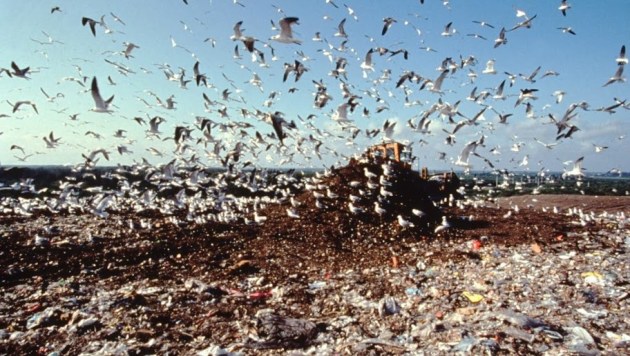
Birds flock to the landfill to eat and socialize with their brethren. Their acute senses and fearlessness allow them to eat as the humans and machines work, excavating waste not buried deep enough. A landfill in Virginia reported that it attracted 25,000 birds per day, and its daily take was only 900 tons of garbage (vs. Rumpke’s 6,000). “Loafing or social interacting” among herring gulls nesting near landfills near the Great Lakes was found to be the most prevalent activity in areas other than exposed refuse, though “aggression” was common too. Foraging was (understandably) the most frequent activity in areas with open garbage.

Landfills can provide a stable and food source for birds. As we’ve seen, organic waste makes up approximately half of the midden’s contents. One study found that a landfill in Vancouver might have contributed to the survival of bald eagle populations over winter (or at least sustaining more eagles than could normally be expected) due to the food available in the landfill. The study noted that the overall number of eagles peaked during rough weather because the landfill is protected from the wind, is slightly warmer thanks to decomposing garbage, and has fairly minimal human activity.

But the victuals in a landfill are significantly less nutritious than the food that a bird might naturally consume. Food from a landfill is literally junk food. The trade-off is its convenience, but this also means any other creature feasting on a landfill has to consume more to get the nutrition they require. This is especially true for birds, whose energy expenditures require a relatively high food consumption per unit weight. Needing to eat more means more time in the landfill, which means more exposure to predators and dangers like machinery. And more activity overall means a greater expenditure of energy, which necessitates more nutritious food. Foraging at landfills can also significantly affect birds’ health and reproduction, considering the likelihood that birds will consume non-food items or items and contamination by toxins. Sadly, young birds have often been found starved to death in landfills, with stomachs full of plastic and other inedible/indigestible items. Eagles have died after eating euthanized animals that were improperly wrapped at landfills on Vancouver Island. Dozens of Glaucous-winged gulls died after ingesting chocolate at another landfill in Vancouver.

To get a more detailed understanding of the role the landfill played in the dietary habits of the birds that flocked there, researchers collected food remains and food pellets from colonies of herring gulls. They also took samples of the stomach contents (boli) of the gull chicks. “If a chick did not regurgitate upon capture,” the study says, “we inserted a finger into its proventriculus and removed the contents.”[6] The authors found that fish was the most common food during incubation and chick-rearing, likely because it is significantly more nutritious. Adult herring gulls that specialized on garbage fledged fewer chicks than did adults that specialized on other foods. After fledging, the gulls were shown to eat more garbage, when their bodies are better able to maximize nutrients.

Eagles are primarily avivores, and the researchers who conducted another study expected that eagles would feed primarily on the gulls at the landfill. Ultimately, almost all of what the eagles ate was household food waste, and in particular red meat waste and bones. “Although some meat was identifiable, most was identifiable and clearly putrid or decomposing,” researchers wrote. Garbage made up 6.6 percent of the eagles diet, including paper towels and plastic bags. Overall, landfill refuse accounted for only around ten percent of the energy intake of the eagles that frequented the landfill. Younger eagles were apparently the refuse specialists, likely because younger eagles are less efficient hunters than adults. Eagles were also able to snatch food from other unwitting birds feeding at the site.

Despite their questionable offerings, landfills are so convenient to feeding that they’ve disrupted migratory patterns. Researchers observed white storks staying in landfills year-round in Portugal and Spain instead of their annual winter migration to Africa. The storks began staying in dumps the 1980s, in an area where they had never been seen before. The number of storks wintering in the landfills increased from around 1,200 to 14,000 between 1995 and 2015. Over several years, Birds were fitted with GPS devices, which revealed that the storks were eating, breeding, and permanently living in the landfill, as well as guarding “desirable locations” in the landfills. “We think these landfill sites facilitated the storks staying in their breeding sites all year because they now have a fantastic, reliable food source all year round,” said one researcher, though the impact of dwindling amounts of birds on the ecosystems they abandoned is yet to be seen.

Overall, bird populations are more closely controlled than those of other creatures living on the landfill. Birds at landfills are considered especially irritating to landfill managers and the surrounding homes and businesses, as well as a cause of concern to nearby airports. “The county abandoned recreational ballfields at the landfill to avoid the excessive bird droppings, and paint on nearby vehicles and buildings were damaged by the steady rain of fecal material,” reported one study. As such, one of a landfill’s pest-control directives is to reduce the amount of birds on site. Rumpke contracts with a US Department of Agriculture wildlife specialist that focuses on monitoring the bird population.

Mammalian abundance
bear

Confession time: when I visited the Rumpke landfill and stared out at its considerable acreage, I envisioned animals living within the garbage itself — a civilization burrowing through alien waste, living in a maze of tunnels running through the picturesque mountains of trash. I pictured a community not unlike something from The Borrowers, in which insect and animals take what they need and return home to a burrow tastefully decorated with scavenged ephemera. Unfortunately (for the purposes of my own imagination at least), the reality of creatures in a landfill is not quite like this. Aside from the thriving microbial community, not much can live in the bowels of a trash mountain because its insides largely devoid of oxygen. The garbage is so compacted that it lacks significant “void space” where oxygen could collect, while most oxygen that does remain is converted to methane gas by the microbial process described above. “There’s no air there,” said Dr. Jean Bogren, a emeritus research professor at the University of Illinois in Chicago. “There’s no advantage to living in garbage.” My trash burrow fantasy realm was cruelly compacted by reality.

But this isn’t to say that animals aren’t attracted to garbage, they may just not live directly in the piles. Many mammals inhabiting the Rumpke’s property prefer to reside in the grassy areas surrounding landfills. Studies have shown that the areas around landfills are typically populated by various species of mice, voles, shrews[7], rats, chipmunks, and possums. Skunks and foxes are also present, as are feral cats and dogs. Raccoons are sometimes brought to the landfill when dumpsters are dumped in the back of garbage trucks. Omnivorous species generally fare better in dumps, as opposed to strictly carnivorous or herbivorous species, whose specific diets don’t allow them to take full advantage of the smorgasbord.[8] The most populous mammal tends to be the white-footed mouse.

Some mammals travel to and from the landfill for food and supplies. White-footed mice, for example, have a range of over 1000 feet, while woodland voles have a 600 foot range. One study observed that mice made nests made of shredded paper and leaves in bottles, cans, and other containers from the dump.[9] Burrows on the peripheries of a landfill tended to be deep enough — from 10 to 36 cm deep — to provide cover from owls and hawks, which are their main predators. Predation by raptors and other animals discourages daytime feeding or foraging. The greenspace created on covered landfills features the predator-prey relationships one can assume. It is a grassland-like environment that often draws animals such as coyotes, foxes, and snakes that prey on other mammals. One landfill worker even reported that sometimes they’ll shoot and eat a deer or turkey that wanders onto the grassland.

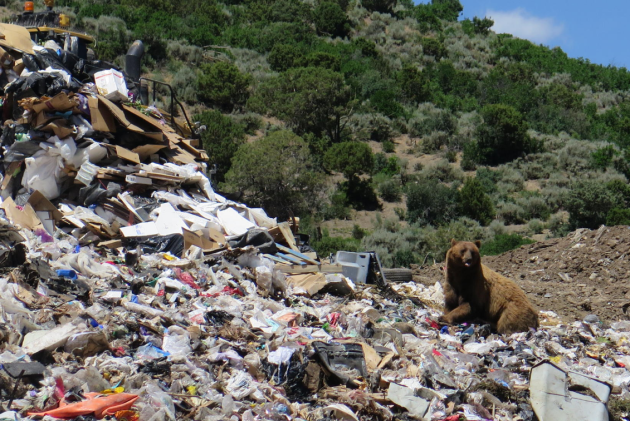
Landfills have been shown to attract grizzlies, baboons, and other upper echelon predators in areas where these creatures have become habituated to landfill use. Bears have been reported in landfills in Alaska and New York, and have even fed while trucks dump their haul. Grizzlies are capable of digging seven feet deep, and have excavated buried livestock. In one strange case, the fallout from eating garbage inadvertently helped temper the temper of a baboon troop. Baboons were dining on the scraps thrown in the bushes outside of a tourist lodge in Kenya and contracted tuberculosis from spoiled meat. These baboons were the alpha-male type who previously wouldn’t let anyone else get close to the meat. Incredibly, and this speaks for the innate benefits of the “can’t we all just get along” sentiment, when these baboons died from contracting tuberculosis, they weren’t replaced by the next-most aggressive males. The rest of the troop realized they didn’t have to fight for food, and were able to live communally and happily, replacing gestures of aggression with ones of affection, and having no problem welcoming new members into the fold.

Mammals, like birds, have to weigh the options of eating at a dump. Rats, for example, a frequent resident of landfills, need to eat around 35% of their body weight per day. Do they go for overall less nutritionally sound meals from the midden, or do they expend more energy travelling further for healthier meals? Does the convenience of ready food outweigh the presence of animals that would happily eat them? What about the danger posed by the garbage itself?

While the threat of a hungry coyote or possessive baboon is serious, the toxic composition of a landfill poses a grave threat to any creature that trudges through it. Leachate, that noxious juice that flows like lifeblood throughout the entirety of the landfill, is no less harmful to animals than it is to humans. Studies show exactly what happens when animals are exposed to it: an increase in cancerous legions and organ failure.[10]

In a typically cruel study, rats were injected for thirty days with different concentrations of a leachate concoction, comprised of leachate from twenty leachate wells in Nigeria. Within 24 hours of exposure, the rats showed discolored skin, un-groomed hair, and had difficulty breathing. During the second and third weeks, the rats were sluggish and ate less. Frequent sneezing, hair loss, and diarrhea occurred throughout the fourth week of the study. One rat had its eyeball bulge out of the socket, while others developed abscesses. Three rats died from the exposure during the tests, and another died a day after the tests were stopped. The pollution likely causes “direct chemical disruption of the organs.”

The study concluded that livers and kidneys are the organs most prominently affected by landfill pollution. Increased organ weight as body weight decreases, which the mice demonstrated, is a sign of toxicity, reflecting attempts to “sequester” these contaminants. Mice taken from landfills in Spain were shown to have heavier kidneys than mice from non-landfill sites, indicating their bodies’ attempts to flush out the accumulated toxins. Overall, kidneys fare a little better than most organs, reaching a “degree of tolerance or adaptation” to harsh substances, thanks to the kidneys’ deft detoxification process. Juvenile mice had elements such as lead in greater abundance, owing to higher energy requirements and the greater consumption of food this necessitates. Interestingly, shrews from the same landfills did not show an increase in some elements, highlighting differences in reaction to these elements in different species. Overall, carnivores are usually more exposed to metals and therefore accumulate more of these elements than omnivores and herbivores.

But perhaps the most pathos-inducing danger to mammals in a landfill is being accidently injured or trapped in the garbage. One Florida veterinarian and wildlife rehabilitator described “skunks with yogurt containers stuck on their heads…Plastic items become intestinal blockages; baited fishing lines entangle limbs, hindering movement and causing dismemberment; and aluminum cans with leftover soda or beer turn into razor-sharp traps.” The most heartbreaking injury was a raccoon whose paws were stuck in beer cans. “The cans had been on his limbs for so long that he had tried to learn to walk with them, and both front limbs were completely damaged,” she said. She sedated the raccoon and took the cans off of his hands, which had no fur and no skin on them.

Humans, too, have been thrust into the ecosystem of a landfill. Economic and political conditions have pushed an estimated 15 million people into this strange new world. Many landfills in developing countries offer a form of refuge and employment, allowing people support themselves and their families by scavenging useful items. In some cases, selling plastics and metals to recycling companies, for example, can provide some semblance of income. Tens of thousands of people live inside individual landfills. Communities in landfills in countries such as Indonesia, Guatemala, Russia, and Senegal have their own schools, neighborhoods, and societies.

Living in landfills, humans have taken their customary place at the top of the ecological hierarchy, but this is obviously a pyrrhic victory. Humans are subject to the same diseases, toxins, and dangers that afflict any creature that searches its way through a dump. Birth defects, tuberculosis, tapeworm, malnutrition, and fatal garbage landslides are a few of the many ubiquitous concerns. One man, who lives and works in a landfill in India, said that, due to the stench, he didn’t eat for over a week when he arrived, and vomited every day. But for better or worse, he has slowly become acclimated to life there, just as one might take to living in an unfamiliar area out of necessity. There are dangers inherent in any ecosystem, and hazards that creatures of every variety take into consideration. It’s all part of the game of life, and as we’ve seen above, millions of organisms are making it work for them.

What does this all mean?

345102c99e80f5dd0716ced2a35216204c508f98827f00e39535755ddf5d9de8_large.jpg

Humanity’s current landfill practices are likely rooted in the path of our evolution. Humans were semi-arboreal as they evolved further from primates, and then finally walked away from trees. In the process, they were able to leave garbage behind and not have to think about it. Since then, garbage has, of course, been a chronic problem throughout civilization. The Middle Ages were famously mired in the excreta running through the streets, barrels of toxic waste currently impregnate mountains, and studies have shown that certain serious diseases often afflict people who live and work near a landfill. (Even the question of what to do with our own remains is also problematic. At one point, Paris had to relocate a million buried skeletons because they were leaching arsenic into the water.) Natural areas and habitats near landfills have been disrupted by the facilities’ expansion, or are at least nominally relocated. “For example, at our Brown County, Ohio, landfill,” Broadwater wrote in an email, “We built a 4-acre highly engineered wetlands to offset the destruction of smaller wetlands when we expanded the site. This wetland now houses many of the native species of plants and animals that call Brown County home.”

An appreciation for the dangers of the trash problem has become a more present part of the common consciousness. There were almost 8000 dumps in existence 30 years ago, but governments began consolidating dumps into much more regulated super-dumps in an effort to more tightly control the collection of trash and curtail its attendant hazards. There are currently around 2000 landfills in the United States. We still operate with the same sort of “out of sight, out of mind” sense of comfort that at least the trash is going somewhere, but officially, at least, we are legally bound to care about that somewhere for 30 years. Federal law requires that landfill owners have to set aside money to close the landfill and to care for the grounds for the succeeding three decades, during which they also are required to “pump the leachate, test the groundwater, inspect the cap, repair any erosion, fill low areas due to settlement, maintain vegetation and prevent trees from growing.” And in the US, opening a new landfill is a tightly controlled process involving a panoply of federal, state, and local agencies, and the undertaking of numerous impact studies. Rumpke staff said that in some cases it has taken over seven years to even get the permits that would allow them to even begin thinking about opening a new landfill. But despite the increasingly regulated process and the greater understanding of the dangers of excess garbage, our trash and what to do with it is a problematic phenomenon that is only growing. Rumpke, will its 300 acres of landfill, is eleven years away from capacity. The company is currently suing the surrounding township to expand its operations, but that will only facilitate more collection, not address the creation of so much garbage in the first place.

The average person in a developed country is responsible for generating about 2.6 pounds of garbage a day. Every three months, the average American man produces his weight in garbage. Researchers found that people threw away 289 million tons of municipal solid waste in 2012, a figure more than twice the 135 million tons that the EPA estimated for the same year, and a figure that is close to one ton per person per year in the US. By the year 2025, 4.3 billion urban residents are projected to generate approximately 6.1 million metric tons per day. Scientists estimate that 11 million tons of garbage will be produced daily by 2100. And the industriousness of the microbial process in a landfill is no laughing matter. Thanks to the methane produced by decomposition, garbage is an even faster growing pollutant than greenhouse gases. The EPA showed that greenhouse gas emitted by landfills that traps heat in the atmosphere 25 times more effectively than does carbon dioxide.

Well into the last century, New York City simply dumped all of its garbage straight into the ocean .One study found that plastics currently pollute no less than 88 percent of the world’s ocean surface. There are five major concentrations of plastic in the world’s oceans, with the largest, the infamous Great Garbage Patch of the Pacific Ocean, estimated to be twice the size of Texas. Trash is apparently even colonizing terrestrial space – there are currently almost 18,000 manmade objects orbiting Earth, with no doubt more on the way as the human races breaks free of its terran confines.

The animals at landfills currently have a tentative relationship to landfills, in that they are able to choose landfills when it is advantageous or convenient. They are still affected by the toxicity of its contents, and can’t quite establish a home in which they are as comfortable as they would be in their natural habitats. But as the amount of garbage grows and we develop new places to stash it, making a home in landfilled areas will become less of an option and more a species survival imperative. The growing patches of trash in the ocean and garbage biomes on land and the trash belt orbiting the planet will become the new frontiers of life, maybe even altering the course of evolution. Maybe ever-growing landfills will force rat’s kidneys to better accommodate heavy metal loding, or will help birds derive maximum nutritional value from the pickings they scavenge. Perhaps beetles will be able to consume Styrofoam, or maybe skunks will develop a coat of such incredible density that chemicals can’t penetrate it, or creatures will be able to nest in a mound of diapers. Claws will become refined to dig through piles of old appliances, proboscises will puncture through old batteries, and eyesight will evolve to see around the corners of old couches. Maybe new creatures entirely will develop, boasting an agglomeration of appendages especially suited for living in a landfill. Maybe new forms of bacteria will spring up that can metabolize circuit boards, bridging the gap between carbon-based life forms and virtual intelligence.

These changes will happen at evolution’s grindingly slow pace, but by the time these creatures have adapted to life in vast ecosystems of garbage, future researchers will marvel at how readily and how ingeniously these creatures have adapted, and continue to adapt, to their befouled environs. Studying the creatures from generations ago, marveling at its ability to survive in the mire before their specialized adaptations, the researchers will perhaps look out their window and gaze out at the world in awe at the workings of nature, their musings accompanied by birds mimicking the chime of enormous trash-crushing machines. High up in a building built among reclaimed trash piles, looking over the trash mountain range and the lovers paddling canoes down leachate rivers, a scientist smiles, pushing his triclops glasses up a nose evolved to selectively filter smells.

“Our world is a landfill,” he says. “A fascinating ecosystem unto itself!”

Notes:

[1] The Rumpke landfill started as junkyard and coal delivery business sometime in the 1930s. A customer traded founder William F. Rumpke six pigs for his services, and he refurbished an old truck to bring garbage back to feed the pigs. Rumpke established a facility to take in metal during World War II. People would bring their trash to his property, where it would be dropped on a conveyor belt and sorted by hand. Metal and rags were set aside for the war effort, while the rest remained trash. In the 1950s, the government passed a law mandating that food waste be cooked before it was fed to animals. Finding this too inefficient, Rumpke, who by this time was joined in business by his brother, sold his animals and concentrated on trash. The business grew and grew, and in the 1980s, the company consolidated area trash services by buying over 200 businesses and established outposts of their trash empire all across Ohio and surrounding states. In 1986, Rumpke started harvesting methane gas from its landfills (one of the first such operations in the country), and in 1987, Rumpke purchased a portable toilet business. Rumpke also runs a massive recycling facility (which truly has to be seen – and heard – to be believed) and other related businesses. Rumpke currently employs almost 2500 people, 75 of which are Rumpke family members.

[2] Such as toluene, phenols, benzene, ammonia, dioxins, PCBs, and pesticides.

[3] Dry conditions and high salt concentrations, however, can curtail bacterial growth, as can low nitrogen content and high carbon dioxide content in soil pores.

[4] These remains would be dumped in the current working face of the landfill, as opposed to the elephant that’s buried on the Rumpke site. An elephant that died when a circus passed through town is buried on site, but not near the garbage. Also buried at the Rumpke landfill are the world’s largest chocolate bar and “Touchdown Jesus,” an enormous fiberglass Jesus that faced the highway from the lawn of a church. The figure’s arms were raised in the air, affecting a gesture very similar to that which referees use to declare a touchdown. The statue was struck by lightning, caught on fire, and melted. Rumpke accepted the remains. The church has since rebuilt the statue, this time out of cement.

[5] I can attest to this: once, when I worked for a construction crew, I accompanied my boss to dump our trailer at the dump. We drove out to the working face and got to work preparing the trailer. It was windy, and we laughed that trash was blowing all over us. I saw that there was a lot of medical packaging blowing around. I looked down and saw that I was standing on a fairly large spread of medical waste, including syringes, catheters, and other indistinct but clearly biohazardous items.

[6] Contents were separated into categories – fish, garbage, insects, plant food – and counted. Garbage comprised roughly 11% of the boli’s contents, 17% of the food remains found near nests, and less than one percent of the content of the food pellets.

[7] Special consideration was necessary for counting the short-tailed shrew. “The method of tagging by toe clipping is less reliable than ear tagging because of the possibility of shrews losing their toes to natural causes,” noted the authors of one study.

[8] One landfill in Virginia even attempted to introduce a new mammal to its grounds: goats. But, after a year, “officials realized that using farm animals to cut grass was not the easy solution originally imagined.” The situation did not improve even when sheep were brought in to augment the finicky goats. The final solution: officials acquired two lawn mowers to cut most of the grass on the landfill. “The same city official who initiated the goat project later proposed creating a mulching operation at the landfill. Supervisors rejected the proposal, but he purchased $500,000 of equipment without approval. He resigned in 2015 just before he would have been fired.”

[9] The authors noted that their study was conducted before an outbreak of Hauntavirus, and that they were not conducting a mammal survey at the time the study was published, which was apparently during the outbreak.

[10] Similar dysfunctions of the kidney have been reported in human workers associated with the treatment of industrial waste. A study done by the London School of Hygiene and Tropical Medicine suggests a possible increase in cancers and birth defects in humans who live near landfills.

Report from Roswell, NM

I wasn’t sure how Roswell would feel about it’s UFO legacy – is it an annoying rumor that just won’t die? Does it distract from the other cool things Roswell has to offer? A sign in front of a Valero as you enter the city answered my question: “Official UFO stop!” Roswell is totally UFO’d out, from the more than a dozen kitschy alien-themed shops to the furniture store that has aliens in bridal gear in the window to the offices of the visitor’s center, which have UFOs on them. (That the courthouse has a big stone Ten Commandments out front indicates a different presence as well.) It’s not like I’m opposed to the UFO worship, as I’m here in Roswell in a crusty motel waiting to visit the International UFO Museum and Research Center, possibly the world’s foremost ufology library. I got there too late yesterday to warrant a visit but I was able to check out its impressive library. After that I wandered around and looked in a handful of the aforementioned alien shops, since the only places that are open past five or six are alien places. Later I found myself at a cemetery on the edge of town, where I got covered in flies. Covered in cemetery flies – yikes.

Chaircrushers

May or may not have eaten at this buffet, somewhere on 40W in Oklahoma

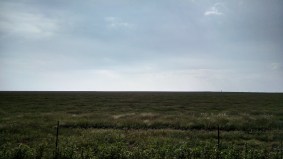
The drive out of Oklahoma a few days ago took me past the birthplaces of Troy Aikman, Carrie Underwood, and Woodie Guthrie. My next destination was in the northern part of Texas. And for hundreds and hundreds of miles it was one of the most desolate areas I’ve ever encountered. You truly do have an unbroken view all the way to the horizon. There are small towns here and there, but most of the evidence of habitation is in the form of oil refineries or large-scale cattle operations, or at the very least, a field full of oil derricks that look like horse skeletons bobbing in the breeze. The miles of piping and tanks and outbuildings of the oil refineries coupled with the general desolation makes these outposts seem like the first attempts at colonization on a new planet. Indeed, a historical marker on the side of the road (of which there are many) explained that a town used to be settled there but after a while the entire town picked up and left, including loading the buildings and houses wholesale onto trains.


Skellytown

Skellytown, TX

I visited Skellytown and Borger in Texas. I had an address for something in Skellytown, but I don’t really know what it was for – it led me to one of the many possibly abandoned houses that make up the town. The Christian bookstore in Borger was kind of a bust (depending on how you look at it), since the bookstore was in fact some shelves in the corner of a beauty salon. I was hoping to at least talk to somebody, but I was totally ignored. There were books for sale like The Bait of Satan, Nuclear Prayers for the Secret Place, and a book by the “ordained prophetess” who wrote Breaking the Threefold Demonic Code. (They also had the “autobiography” of one of those clowns from Duck Dynasty.) There was nowhere to stay in Borger, so I decided to take my chances in nearby Amarillo. As it happened, there was a death metal show going on that night, and I made my way to the far outskirts of town to check it out. I stopped at a restaurant to get something to eat first – when I peeked my head in the door, I saw upturned tables covered in dust and two women sitting on the ground talking, totally surprised when I looked in. The show was nearby, so I went there instead. A little while in, I suddenly get punched in the stomach. I look down and see a little mohawk running away from me – an eight year old was trying to start a mosh pit.

Texas Horizon

Unending north Texas isolation!

The next morning I stopped for breakfast in Texico, NM at a diner in a building that looked like it used to be a municipal building from the 70s. A few groups of people came in for breakfast wearing sweat-stained hats, deeply tanned, and covered in mud/dirt/shit. You could tell they could work. One group had a little kid with them who himself was wearing muddy clothes and boots. He was sitting between two older guys in a miniature imitation of their posture, devouring his meal like the adults were theirs. He answered the waitress with his version of the older guys’ “Yu-up,” though a similar kid behind me was still a kid, ordering as he did a corndog and baked beans.

Speaking of food, that is where I’m headed now. Every day has been totally different from the one that preceded it, and that variety is amazing. I don’t know what I’ll find myself doing, but I like that a lot. Another update in a few days!

Blackwater Draw

Blackwater Draw archaeological site – found this site by chance in NM. It is of inestimable importance for the study of early humans in North America. You are free to walk around the site, though there weren’t any active excavations when I was there. This is a preserved (and covered) site so visitors can see the different layers of soil and their respective artifacts and bones.

Today is Tomorrow: Watching “Groundhog Day” for 24 Hours Straight

That’s right, woodchuck-chuckers! It’s GROUNDHOG DAY!”

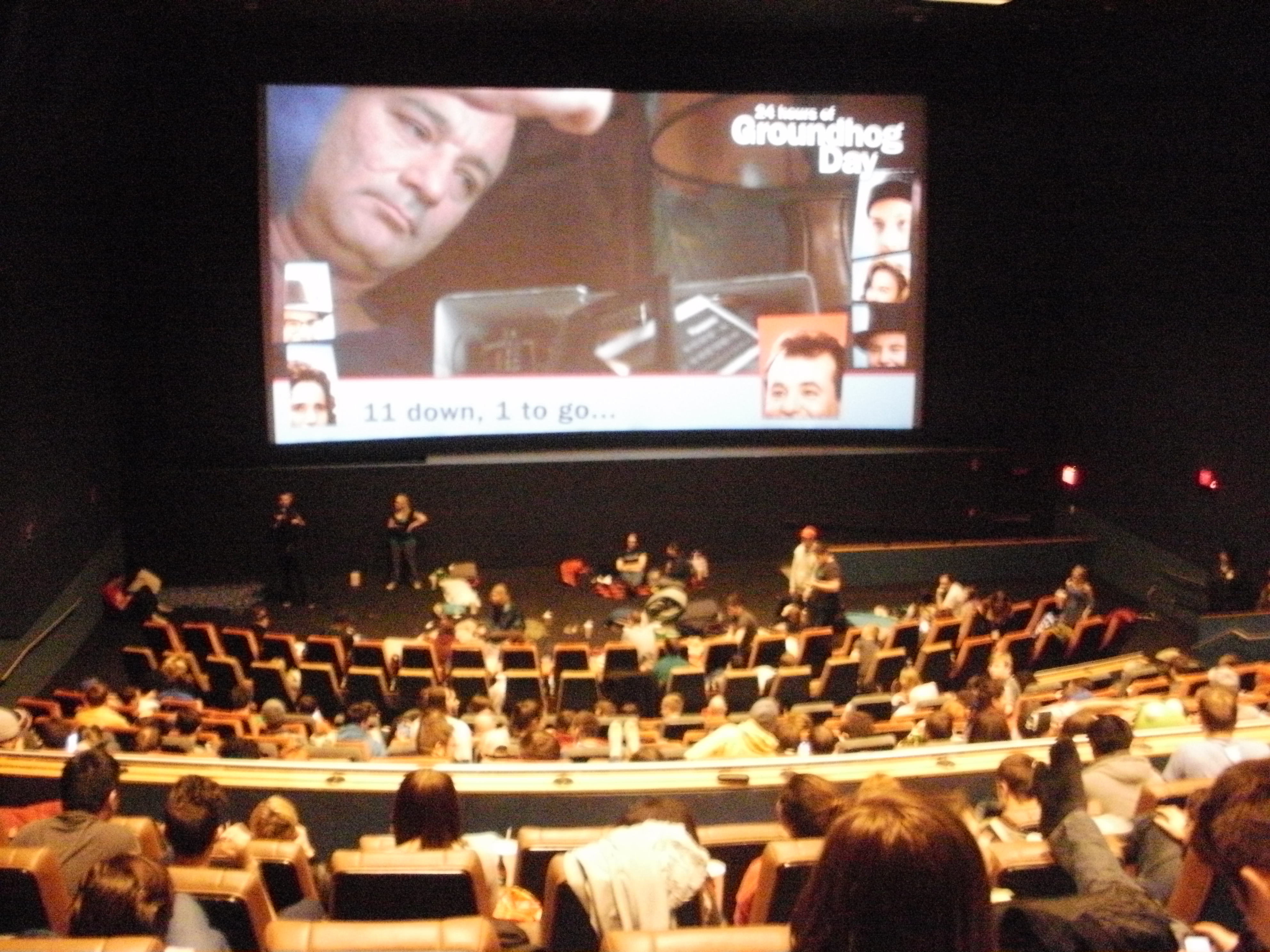
Groundhog Day posterIt is a genius meta-challenge: do you have what it takes to subject yourself to twenty-four hours of a movie in which the protagonist is himself subjected to a horrifying twenty-four hour loop? Would you lose your mind doing it or have a total blast? These are questions posed every February 2nd by the Gateway Film Center in Columbus, Ohio, when they host their annual Groundhog Day viewing party/endurance marathon. The movie in question is of course Groundhog Day, and they challenge you to watch it twelve times in a row. Completing the marathon yields a year’s worth of movie tickets, a very coveted prize considering the average theater’s tragicomic ticket prices. On the contrary, a ticket to the Gateway event is only fifteen bucks, and fifteen bucks for twenty four free movie passes is certainly a gamble worth taking, to say nothing of the singular weirdness of staying in a movie theater all night with three hundred other entranced revelers.

7660 days have passed since Groundhog Day was released on February 12th, 1993. The movie chronicles the surreal hell of Phil Connors, a TV weatherman played by Bill Murray, who learns some important life lessons when he finds himself reliving Groundhog Day in Punxsutawney, PA, over and over and over again. Andie MacDowell plays the sweetheart TV producer who inspires him to be a better man and Chris Elliot plays the unnerving odd guy Chris Elliot is known for. Initially Bill Murray is excited at the surreal turn of events, as he realizes he can steal money and perfect his wooing techniques, but he grows increasingly despondent when it doesn’t seem like the loop will ever end. The only way out seems to be to win Andie’s heart by becoming a good person, and some genuinely warm n’ fuzzy moments makes up the last chunk of the movie as this transformation takes place. But it takes Phil a long time to get to this point, and the movie becomes a bit darker when you realize the enormity of what his character is actually facing. At minimum, it is estimated that he relives Groundhog Day for at least forty years, though Stephen Tobolowsky, the guy who plays Ned the Insurance Salesman, said one of the writers “felt something like 23 days were represented in the movie, [but the total time Murray is trapped lasted] over 10,000 years.”

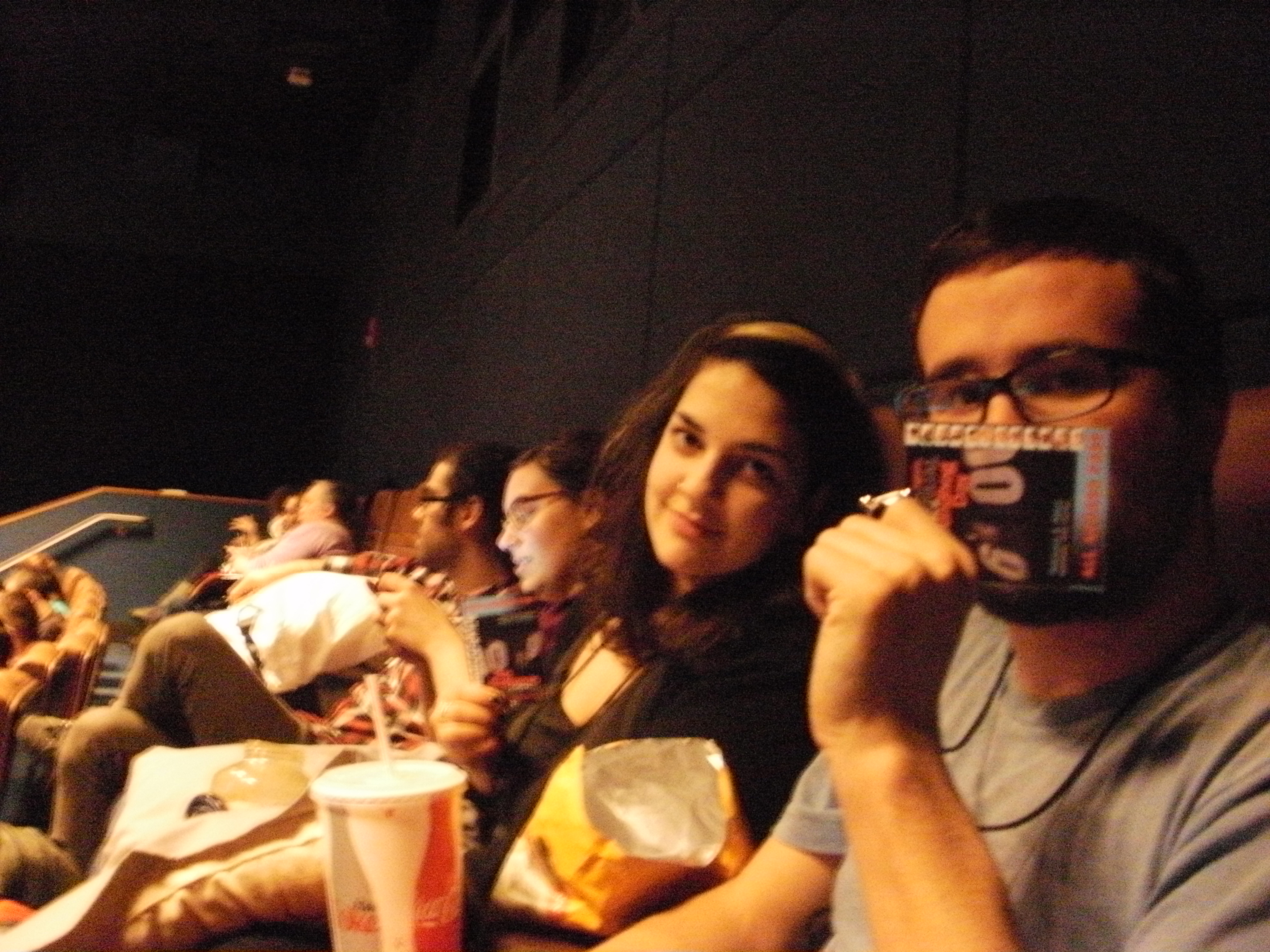
The same day over and over again for 10,000 years – not that my friends and I were worried that watching a movie twelve times in a row would be equally as maddening, but the prospect of watching the same movie twelve times in a row was kind of daunting: an entire day in one place, in the same seats, with hundreds of other people eating, farting, snoring and talking, all of us experiencing the difficulties inherent in doing the same weird thing over and over again. My good chum Pat and I were both new to the contest, but our friends Tess, Afton, and Kevin were old hands and explained that the viewings break down like this:

1-4: You sleep through most of them.
5: “This is a good movie.”
6: “This is the best movie ever made.”
7: “…”
8-10: “I can’t comprehend anything that is happening in this movie.”
11-12: Fun because everyone is going crazy, but also excruciating because you’re almost done.

I figured my point of no return would be 16 hours – I had to stay if I made it that far, and Pat assured me that he would convince me to stay. I legitimately didn’t know what to expect.


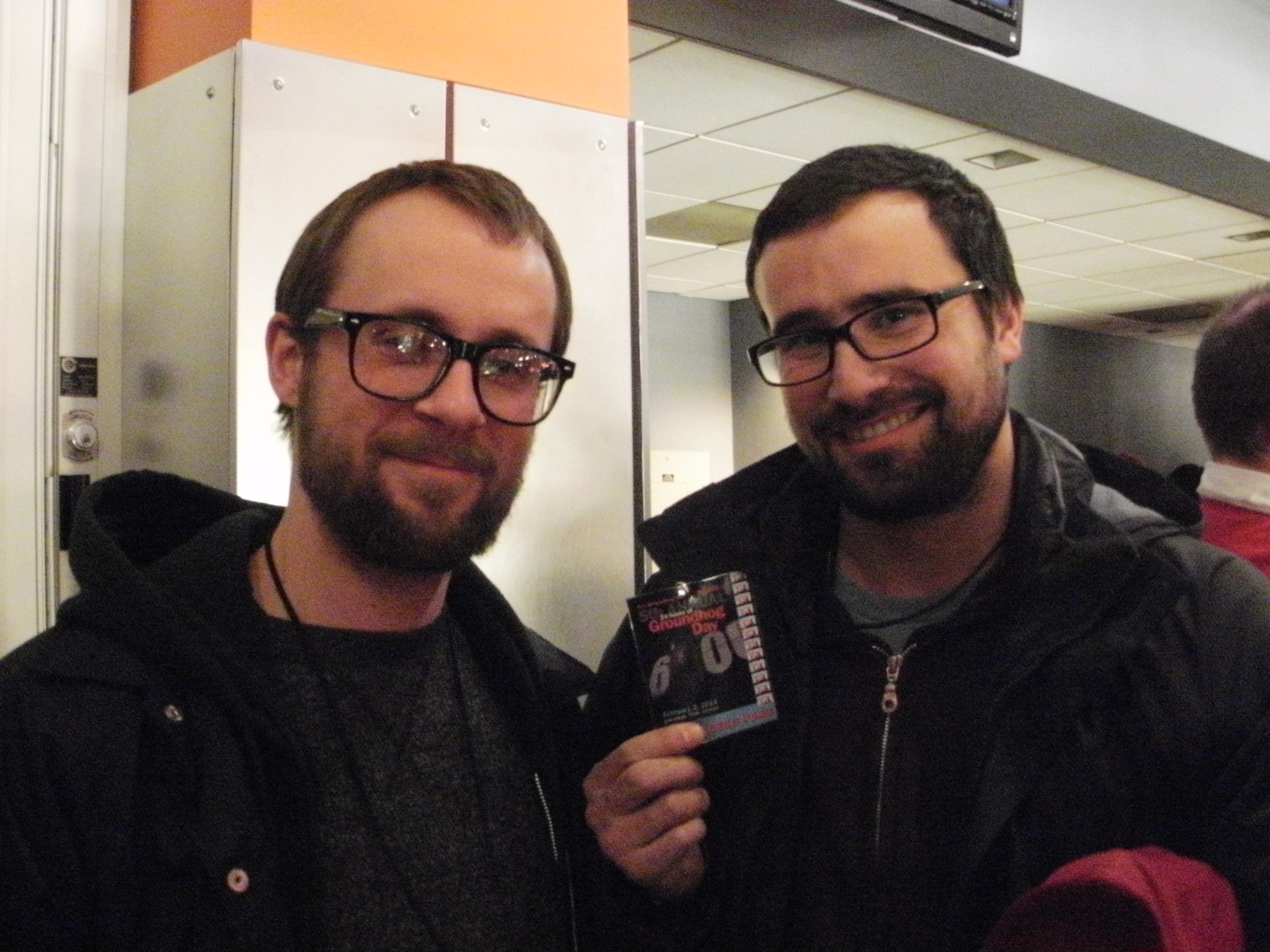
Dylan and Pat in the building

Dylan and Pat in the building

****

The rules of the challenge are as follows:

  • You must be present in the theater for every screening of Groundhog Day in its entirety.
  • Cell phones may be carried into the theater, but must be powered down during the screenings.
  • No laptops, tablets, or other devices are permitted in the theater.
  • Your lanyard must be in your possession at all times during the marathon. This is very important, as the lanyard is punched after every viewing, and you must have all twelve punches to win the tickets.
  • Every time Phil says “Ned”, you must say “Bing!”

“I think it would be funny if they wouldn’t let you socialize, like they make you watch it,” Pat said. “I want them to fucking crack down. I want them to make it a challenge.” I know Pat would fare well in a contest like this, even if it were one of those sinister experiments where you are strapped to a chair and your eyes are pried open as you are bombarded with all kinds of horrible sights and sounds. Pat is up to stuff like that – he has a competitive drive that has made him successful business owner and allows him to be infuriatingly good at every sport. People come to the event in pajamas with pillows and blankets; he firmly considers the people stretched out on sleeping bags in the front of the theater to be cheating. How hard can it be when you are essentially allowed to camp?

A valid point, but I don’t think the theater has psychological trauma in mind when they host the event. The marathon isn’t intended to toughen you up mentally; it’s supposed to be ridiculous fun, and it is. Attendees are encouraged – If not expected – to join in chanting lines, which range from quotable insults to a horrified “UGH!!” when poor Andie MacDowell makes a woodchuck face at Bill Murray. The experience inspires exuberant narration, and attendees yell whatever they want from the anonymity of the theater. A lot of the commentary is genuinely hilarious, but this anonymity also lends itself to some cringe-worthy unfunniness, attempts at humor that make you feel bad for the person who said them. But no worries, you can try again soon – the open invite for audience participation gives everyone a second chance to shine, and indeed, there is nothing quite as affirming as cracking up the people in the rows around you.

****

The first American reference to Groundhog Day comes from a diary entry from 1841, where it is explained that if the groundhog emerges from its burrow and sees its shadow, winter will last another six weeks. This is the same tradition as it stands today. Appropriately, the diary is that of guy from Pennsylvania. The world’s most popular rodent arbiter resides in Punxsutawney, Pennsylvania, where the movie takes place and where real life Groundhog Day crowds have numbered up to 40,000 deep. The tradition seems to come from a mix of ancient weather lore involving prognosticating animals and contrasting calendrical systems. The pagan festival Imbolc celebrated the seasonal turning point on February 1st, but other traditions held that spring did not begin until the Vernal Equinox, about seven weeks after Groundhog Day, the traditional first day of spring for us in the US. A groundhog or hedgehog was used as a way to settle the disparities between the two calendars, and either choice he makes corresponds to one of the calendars’ first day of spring. Groundhog Day organizers say that the Punxsutawney Phil’s forecasts are accurate 75 to 90 percent of the time. Thirty-three percent accuracy could be expected by chance, and a Canadian study unfortunately shows that weather pattern predictions made on Groundhog Day are right only 37% of the time. Buzzkill scientists from the National Climatic Data Center have described the forecasts as “on average, inaccurate,” saying that the groundhog “has shown no talent for predicting the arrival of spring, especially in recent years.” (Spoiler alert: in the movie, Punxsutawney Phil predicts that winter will last another six weeks.)

Our night started off not in Punxsutawney but in a restaurant next to the theater called Mad Mex. Tremendous plates of nachos were necessary to carry us through at least the next couple of hours, and after 10:00pm everything is half-off. The waiter noted that the new margarita flavor was good because “nobody has sent it back yet,” and it was thus ordered and consumed. Not too long into our meal, a guy sat down next to the hostess’s stand, right across from our table, and promptly broke down in tears. “I hate boys,” he said, explaining that his boyfriend puts everyone else before him.

Patrons of Mad Mex soon began getting up and leaving. It was clear where they were going. They were carrying sleeping bags and backpacks and were dressed in sweats and pajamas, and some people even had laundry baskets full of games and enough food for the next 24 hours. We too left in order to claim the perfect spot. The sad guy from Mad Mex was in an impassioned argument with his presumptive boyfriend on the sidewalk when we walked outside, and they too would likely enter a time warp of their own, arguing in endless circles as they tried to sort out the complications of love.

****

The Marathon Begins…

Back row clique
Back row clique!

12:00 – We quickly realized that the undertaking wouldn’t be as big a deal as we thought – we sat in the middle of the topmost row, with nobody on either side of us for at least three seats. We were able to put up armrests and stretch out and sleep as freely as we wanted to. Sitting in the back row seemed crucial to our success since nobody could hang their stinky feet over our heads, and we weren’t in danger (or as much danger, at least) of something like the hurricane-level of puke that annihilated the area behind some seats in the middle of the theater. But I did begin to understand why the challenge might yet be pretty difficult. Stills from the movie that precede each showing tell you how many times you’ve seen the movie and how many you have left. These stills are supplemented by key soundtrack music played on a loop, so not only did you hear the same songs multiple times throughout the course of the movie but you’re stuck listening to them over and over again before the movie even starts. Sonny and Cher’s “I Got You Babe” was followed by a ridiculous number called “the Pennsylvania Polka.” The tradition of clapping along with the latter started as soon as it began playing over the still, and we caught on to that aspect of the event.

Welcomes were given by the staff and the rules were read. The concession stand would be open the entire twenty-four hours and alcohol sales would stop at 2:30am but would begin again at 6am. The first viewing felt more like a normal night out at the theater than the beginning of a ridiculous challenge. I hadn’t seen this movie since 2010 (I remember this specifically because I was housesitting for a guy that had it in his collection) but I pretty quickly fell asleep. I woke up in time to see a surprisingly amazing truck explosion. The truck drives off a cliff and smashes below; its intense smash is satisfying and incredible. The resulting explosion is great too – big, full, multi-layered, good expansion, deep oranges and reds – as is the way the gate bursts open when he drives through it. Note that the grill of the truck breaks when this happens. It became a scene I greatly looked forward to.

2:00am – I was wide awake as the movie began again. On top of the quoted lines and random quips, nonstop talking and settling occur for the first fifteen to twenty minutes of this and every subsequent showing. The atmosphere was that of a giant slumber party.

Pat was lying on the floor resting; he overhears the scene where the local yokel shows Bill Murray a half-full or half-empty glass and says Billy Murray looks like a half-empty kind of guy. “That’s the whole message of the film!” Pat realized. He told me with the sureness of an inebriated philosopher that Groundhog Day is a metaphor for our search for happiness – you could look at the groundhog’s augury like glorious spring is just six weeks away, or that winter will brutally oppress us for six more. In other words, look on the bright side! Life is what you make it! Pat imparted this wisdom and fell back asleep.

4:00am – I was tired and kind of grouchy as the third viewing began. I was worried that perishable food I brought would go bad before I had a chance to eat it but I was too full to keep eating. Nachos were raffled off by theater staff. I noticed that the stunt double used when Bill Murray jumps off the tower looks like Ben Stiller, and that the bath water Murray sits in to electrocute himself is probably ice cold, judging from the cold shower sequence earlier in the movie. I began appreciating the attention to time-related details, like taking into account how doing thing A for a few seconds longer the second time means that subsequent thing B would happen differently the second time around. But sometimes the movie wasn’t as accurate as I’d like in this regard (some events take place in the exact same way regardless of how long Bill Murray takes to do the thing that precedes them), but I realized that I had ten more viewings to obsess over these disparities and so I would be better if I put them out of my mind. It’s just a movie, anyway, right?

Groundhog Day factoid

Groundhog Day factoid

6:00am – I realized I hadn’t even seen the movie all the way through yet. There are scenes that I didn’t remember seeing the first three times around, and there are scenes I saw between naps that I wasn’t sure where/why/how they fit in the narrative. An announcement was made that the concession stand had started serving breakfast burritos. The paper towel dispenser in the men’s bathroom was jammed, but the front had been pried open by attendees desperate to dry their hands.

8:00am – “Now it gets difficult,” a veteran told me, “Most of the sleeping you’ll do has already been done.” I was increasingly annoyed by the peppy song that accompanies the opening credits. The song is called “Weatherman” and was co-written by the film’s director, Harold Ramis. Heard nowadays, the song is totally anachronistic – it is one of those catchy, distinctly American-sounding rock songs that play during the opening credits of comedies from the 80s and 90s. (Which are themselves a very distinct and sorely missed breed.) But I soldiered on. I got an encouraging text from a friend at 8:50: “You can do it!” My parents also cheered me on when the night got started.

10:00am – Somebody nearby started a story that begins with “I didn’t work at PetCo but…” but unfortunately I don’t hear the rest. After five viewings, I still hadn’t seen the movie all the way through, but from this point on, I watched the movie pretty much in its entirety from this viewing until the end of the challenge. The ten o’clock showing was different, as there was markedly more shouting, clapping, and merrymaking, and it increased with every viewing.

Unfortunately this increase in volume also applied to our neighbors and their wellspring of criminally unfunny comments. It was kind of awkward because other unfunny comments fade into the darkness but you are hyper-aware of failed humor when the perpetrators are only a few seats away from you. There is a scene where Bill Murray says he is going to go back to his room and read Hustler; our neighbors yelled “Go read Hustler – everyone likes to see naked ladies!”

12:00pm – I found that I always happened to be looking up at the screen when Andie MacDowell’s name is listed in the opening credits. I also found that the opening sequence of clouds rolling backwards is simple but really cool, and somewhat haunting. I was also able to study McDowell’s distinct mouth, as her twenty-foot visage was on the screen pretty frequently. People in the audience continued chanting at choice moments: each scene with Needlenose Ned the Head is repeated word for word every time. The diss Chris Elliot delivers about the Home Shopping Network is always awarded with a tremendous “OOOOOOoooohhhhh!” Everyone clapped in time with the slaps of the slap sequence and everyone claps sarcastically when the waiter drops his tray. Brian Doyle-Murray’s speech as the mayor is also a beloved moment in the film, as attendees love to help him call Punxsutawney Phil the “Seer of Seers, Prognosticator of Prognosticators.” The increasing dollar amounts are chanted when Bill Murray get auctioned off as a desirable bachelor.

2:00pm – Two young kids were in attendance with their dad. One of the two became a sort of celebrity for the occasion, as he was the first to lead claps and cheers and even yelled a bunch of comments of his own, at the screen and in response to other people who are yelling stuff too. Between showings, everyone around him observed that not only was he having a FaceTime chat with his Grandma but that they were talking in another language. Everyone who saw this looked at each other knowingly, nodding at how hard this kid rules. As the day wore on, the two kids and the dad change seats from time to time, leading one person in the audience to ask “Hey! Where’d that kid go?!” in fear that the family would miss part of the action, or, worst case scenario, that they had left, which would have been a bummer for the kids but also worrisome to the rest of the crowd, for what would it mean for their own endurance if their totemic spirit decided he had finally had enough? Not to worry – his commentary resumed quickly enough, just from different seats.

Pat noted that the scene in which Bill Murray steals the truck/varmint-naps the groundhog occurs almost exactly one hour into the film. We took this into consideration for the rest of the viewings, almost like a breather that the movie is two-thirds of the way over. The coffee served by the movie theater is surprisingly good, and refills are free. Pat noted that Bill Murray gives the finger to the camera – during the second newscast he does on the first day, the 3-2-1 countdown ends with 1 being his middle finger. Lots of details like this are noticed, including the unsettling layer of reverb/creepy frequency placed over top the ‘Pennsylvania Polka’ when Bill Murray gets freaked out.

“Ohhhhhhh…SIX!!!!”

4:00pm – This was the wildest showing yet. The hootin’ and hollerin’ reached a hilarious, exuberant pitch. The audience has taken to yelling “SIX!!!” every time Bill Murray’s alarm clock goes off at 6:00am. A wag in the audience also yelled “3:02!!” when that time was shown on a clock. One of my favorite shots is the giant alarm clock face switching from 5:59 to 6:00. I found myself yelling along with everyone without even intending to.

Our genius neighbors got told for the second time to put away their electronic devices during the showing of the movie. They take huge offense to this despite the rules’ clear prohibition on devices, and the scolding was a topic they discussed with the utmost derision every twenty minutes for the rest of the contest. “We’ll give her an anti-bitch coupon if she’ll let us use our phones,” they snickered. The also took to calling the attendant a “device Nazi.”

The audience’s sense of humor reflected the fact that we’d been there for sixteen hours: “That’s Shia LaBeouf’s stepdad!” someone yells when Production Assistant Alecia LaRue’s name rolls by in the credits.

6:00pm – I began getting kind of antsy. My stomach was weighted down with food, as I’d eaten all my provisions out of fear that they’d go bad. I wondered if I could sneak into a different movie. I wasn’t too bothered by the ethical dilemma of not seeing every single showing, as sometimes self-preservation trumps morality. But just getting up and walking around is good too:

Pressure ulcers, also known as decubitus ulcers or bedsores, are localized injuries to the skin and/or underlying tissue that usually occur over a bony prominence as a result of pressure, or pressure in combination with shear and/or friction. The most common sites are the sacrum, coccyx, heels or the hips, but other sites such as the elbows, buttocks, knees, ankles or the back of the cranium can be affected.

A simple example of a mild pressure sore may be experienced by healthy individuals while sitting in the same position for extended periods of time: the dull ache experienced is indicative of impeded blood flow to affected areas. Within two hours, this shortage of blood supply, called ischemia, may lead to tissue damage and cell death. The sore will initially start as a red, painful area. The other process of pressure ulcer development is seen when pressure is high enough to damage the cell membrane of muscle cells. The muscle cells die as a result and skin fed through blood vessels coming through the muscle die. This is the deep tissue injury form of pressure ulcers and begins as purple intact skin.”

The customary ‘SIX!’ yell started off a ‘7! 8! 9!’ succession. Someone yelled “You can count!” in response, to which the initial yeller yelled “I’m a math major!” This was actually true – the proud math major was observed doing math homework between each showing.

Our neighbors’ choice comment from this showing addressed the motivations of the “creepy” psychiatrist Bill Murray sees: “Mommy touched me when I was little so now I’m going to help people,” they narrated.

In 2012, Bill Murray embarked on a nationwide party tour in which he would come to your house and hang out, provided you call him Keyser Söze and had a banner out front that says “Bill Murray can crash here!” There was some speculation/hope that he (or anyone from the movie, for that matter) would make a surprise appearance at the contest, especially since Murray reportedly has a house in Dublin, a nearby suburb.

(Bill Murray was also said to have this trick where he’d walk up to you and steal your hat [and not return it] just so you could tell your friends that Bill Murray stole your hat. Yes, it would be funny, but reckoned I would also be pretty annoyed if he stole my lucky hat. As he hadn’t shown up, it did not seem that this was in danger of happening.)

8:00pm – I got up and walked around for the last forty-five minutes of this showing. I met Max Vokhgelt in the lobby and he told me that he and his friends were keeping some tallies: “I’ve Got You, Babe” plays ten times in the movie, as does the “Pennsylvania Polka.” I added this to my own list of tallies: Bill Murray is slapped ten times, once because he asks to be slapped, once in the bedroom, and eight times during the sequence showing his repeated failure to woo Andie MacDowell. Fifteen snowballs are thrown during the snowball fight sequence, the last being a particularly (some may say unnecessarily) forceful throw at a kid. There is an uncomfortable scene when Bill Murray tries to get Andie MacDowell to stay with him – she offers ten refusals to his fifteen inducements to stay. He hits himself in the face three times in the psychiatrist’s office. “Strrrriiiiiiike!!” is yelled by the audience when the guy gets a strike at the bowling alley, and someone pointed out that, come the final showing of the movie, the guy will have bowled twelve strikes, a perfect game. Candice at the concession stand said that everyone was cheery and optimistic when the day started but by this point everyone was red-eyed and looked defeated. Alcohol sales were steady. The staff was commendable for the quality of the bathrooms – I was worried about potential hygienic disaster but it had all been managed perfectly. The movie theater itself did not take on the offensive odor one might expect from three hundred people sitting around and eating all day, so that was a relief too. This was the penultimate showing and people seem to be gearing up for an explosive final viewing.

9:00pm – someone in the first row was clearly using a tablet. It was a dark theater, so any source of light was completely noticeable from anywhere in the room. A few people started booing, and a few people yelled warnings at the dude to put it away. Suddenly, the movie stopped and the lights turned on – a staff member walked up to the guy and told him he committed his final error and that he’d have to leave. My neighbors renewed their colorful invectives against the fascist theater staff, as they were beside themselves that such an affront was actually taking place. Not that I encourage submitting to some arbitrary authority, but the rules for the marathon were very clear, not to mention the offending party had been repeatedly warned that devices are verboten any time the movie was playing.

10:00pm – the last showing was great and worth the 22 previous hours. Everyone immediately started yelling and cheering when the movie began, and everything yelled throughout the night was repeated again, but much louder and more enthusiastically, if that was even possible. People got up and danced to the opening credit music and the music used to transition between scenes. The warnings for Bill Murray to watch out for a shovel that’s about to hit him reach a fevered pitch, with the awesome kid in the audience noting sadly that “he never heeds our warnings” after Bill Murray gets clocked. Someone yelled ‘HOGROUND DAY!’ and for some reason this was utterly hilarious. The scene where Gobbler’s Knob is named for the first time was an audience favorite: “Wait for it….wait for it…. [‘Gobbler’s Knob’] YEAH!!!!!” “Why is that funny?” someone asked. Uh, what? The place is called Gobbler’s Knob for crying out loud! The last viewing definitely felt like the shortest. I wanted the movie to progress not so I could go home but to hear the new commentary to our favorite parts of the film. But before you knew it, the challenge was over. No more stills or Pennsylvania polka or card-punching once the credits finished scrolling. People gathered their belongings and shuffled out of the theater as easily as if they were leaving a normal night at the movies.

The movie originally ended with Bill Murray and Andie MacDowell waking on February the 3rd to find that Andie is trapped in her own time loop, and I’m sure there would be more than enough people willing to stay for another twenty-four hours. I’m sure Pat would have been up to it.


11 down, 1 to go!

11 down, 1 to go!

****

As is the case with any fun event, once it is over you can’t believe all of the anticipation and antics have finally come to an end. It is weird experiencing something unusual with hundreds of other people and then leaving as if nothing had happened. It was kind of a bummer to bid goodbye to all these intimate strangers.

Walking home was a little strange because my sense of time was genuinely kind of skewed. Not that I am by any means whatsoever comparing myself to people who have actually experienced some kind of horrible real life imprisonment, but I had the briefest glimpse into what confinement-induced time disorientation must be like. It felt like ages ago that Pat and I walked from my apartment to the movie theater, but it also felt like no time had passed at all. Fortunately I was already wearing sweatpants and comfortable tennis shoes – the discomfort of my compressed ass could be addressed by running a few laps around the block.

Would I do the challenge again? Possibly, as the last couple of viewings are definitely worth experiencing again. Will I do it again? I’m not sure, for right now the idea of seeing a movie in a theater sometime even in the next month is pretty unappealing. But I do have a year’s worth of free tickets, so a night at the movies might be in order to simply to celebrate my dubious accomplishment. Having ate and slept and lived there for a day, the theater almost felt like a home away from home.

(Apparently a musical adaptation of Groundhog Day in the works, which I will absolutely not be seeing once, let alone twelve, times. A musical marathon would be tantamount to torture, even if it is based on a story I have come to know intimately.)


Rebuffed and Disappointed at the Threshold of Sexapalooza 2014

“Sex is like snow – you never know how many inches you’re going to get or how long it’s going to last.”
“Sex without love is mating; love without sex is philosophy.”

Fortunately it is not often that this author experiences significant disappointment. Cancelled dinner plans, rescheduled hangouts, the heater of one’s car not working on a long drive in the middle of winter are all part of being human, and these mild inconveniences can usually be dealt with and forgotten with little difficulty. But a run of relatively painless living made the collapse of a recently scheduled meeting with Liz Lewis all the more of a letdown. Lewis is the proprietrix of Black Kat productions, and she was in town to oversee Columbus’ third annual Sexapalooza, an adult expo offering a “diverse collection of exhibitors, entertainment, educators and non-profit community groups that represent each city’s sexual community.”

I wanted to speak with Liz Lewis for a book I’m working on about the ins-and-outs of a variety of occupations and hobbies: what is done differently do make Sexapalooza a more female-oriented show? The parent company is Canadian, so what kind of international rigmarole do you have to go through to plan things from afar? What kind of sponsors jump at the chance to partner with such an event, aside from the obvious? Was it possible to work in this field without being, ahem, pleasantly distracted all the time?

I initially made a phone call to the marketing and graphic design department of Black Kat productions, the assumption being that the marketing behind a kink convention would be substantially different than that of something a little less edgy. The woman responsible for this department said she was too new to give a comprehensive overview of working for Black Kat, and she said that Liz Lewis, the president and founder, would be the person to talk to since Sexapalooza is her brainchild. She offered to try to set up a meeting with Lewis on Sunday at noon, as early Sunday is the calmest time of the event and there would likely be plenty of time to talk. I got confirmation the next day that the meeting was set up, and I immediately got to work researching the event.

Lewis was originally in the magazine business, publishing Touch, a magazine for the swinger community, and then Whiplash, a magazine for the BDSM community. As the internet made print BDSM community-building increasingly obsolescent, Lewis ended her run as a print publisher and started Black Kat Enterprises, a company that distributes adult toys and novelties. This side of the business led her to exhibiting at the Western Canada Taboo shows and various other sexpos, which in turn led her to start her own adult consumer show. Thus Sexapalooza was founded in 2007. Sexapalooza is now an international affair, with events held yearly in Canada and the US. According to Men’s Health magazine, Columbus has the honor of being the third most sexually active city in the country. And because of its statistical averageness, it is also a city known as a reliable test market for various new products and foods. The city’s refreshing openness yet familiar consumer values make Columbus the ideal place for an upscale adult expo.

Unfortunately, the questions I wanted to ask were to remain largely unanswered. The parking lot monitors were typically unpleasant (seriously, try to talk to them) and their gnarliness augured nothing good for the interview. The $7 parking fee didn’t help, and neither did getting yelled at by the same people for trying the wrong door. Lewis was located by the staff and we were introduced, but I was told immediately that she wasn’t going to be available. Her time was very valuable, as was made clear by repeated mid-conversation bids for me to Hold on just a minute! while she addressed the concerns of whoever was on the other end of her earpiece. (Though it should be noted that the stress inherent in running a major adult expo can be assumed, and it is absolutely understandable that my ideal, hours-long, conversation couldn’t realistically take place.)

The look of disappointment that greeted this author when he was introduced to the interviewee was enormous, as the lack of major press credentials was clearly a letdown:

“Who are you with?”
“Uh…myself?”
*Sigh*

All further interactions involved trying to impress someone who doesn’t respect you professionally in the least. I was told to come back in half an hour. Agreement on my end was assumed, as Lewis was already walking away before the initial sound of the word ‘yes’ was even completed.
Sexapalooza 2014 was held January 17th-19th at the Vets Memorial building in downtown Columbus, a building worth noting for its historical status/impending implosion and for the larger than life statue of Arnold Schwarzenegger that flexes out front. (Arnold and Columbus go way back – a promoter named Jim Lorimer set up the first Arnold Sports Festival in 1989 and it has been a mainstay in the city ever since.) The building’s foyer is stripped of all accoutrements; the interior is a strange light blue and the color is punctuated almost exclusively by homemade signs that direct people to the main hall or parking payment machines. Maybe the paucity of décor is deliberate in order to accommodate the maximum variety of events, but the near total lack of signage can also be confusing, as was the case when a mom walked in with her two children. People collectively held their breath as she strode in confidently and looked for the ticket booth. Was she actually trying to bring kids into the sex show? There is a wall of dildos right inside – you can see it from here! Regardless of the intensity of one’s sexual proclivities, everyone else in the foyer looked ready to break out in protest had the lady tried to argue that her kids should be admitted. But it was an honest mistake – it turned out she was looking for the AAA Great Vacations Travel Expo, which was to be held at the same place the following weekend. They promptly left, and it was unclear if the mom even registered what she and her kids accidently almost walked into.

That scene of confusion was witnessed while waiting next to the drinking fountains for the rescheduled interview with Mrs. Lewis. The incident had just finished when Mrs. Lewis came striding back across the room to talk to a paunchy middle-aged guy who was asking for a refund, since he had only stayed for a couple of minutes and didn’t think he should have to pay full price for only a few minutes’ worth of admission. He had time to buy a few things, judging from the heft of the bag he was carrying, but wanted his money back since he didn’t have time to check out any of the product demonstrations or hang around until the “Intro to Burlesque” seminar started at 1:30. (There was a “second-generation professional magician” scheduled to perform as well.)

Lewis listened to the guy’s request politely but with the look of someone who is utterly repulsed by not only the tackiness of such a request but that a person would even think to ask such a lowly thing in the first place. True, the refund request was odd and tacky, and the patron was promptly denied a refund. She then spotted me and rushed over to see what this interview was all about.

Lewis is slightly taller than average, 40s, with long blond hair. She has a small overbite and was clad in an all-black pants suit. The author’s spiel about getting a “comprehensive understanding of what she does and how she does it” didn’t do much to change the low esteem in which he was already held, and his attempted investigations may have furthered her annoyance that she had not only agreed to speak with someone but that that someone was poised to ask multiple pages’ worth of questions. A tacit glance at the stack of papers held aloft made her eyes narrow; she suggested email instead. A hesitant email agreement was struck, and a further attempt to (politely) stress that the project was all about thoroughness resulted only in the comment that she would be answering the questions with one sentence replies only.

There was one last plea to be made: would it be possible to talk about just a few key things, since both author and interviewee are both present? Yes, she sighed, fine, and powerwalked over to a set of stairs in the foyer, where the following conversation occurred. The exchange lasted exactly five minutes and ten seconds:

Did you make a conscious choice to work in the adult industry?

No, I just kind of fell into it because I met somebody and started selling advertising for a magazine. Then I started my own fetish magazine and distributing a line of products and started exhibiting at consumer shows and then I started my own consumer show.

Are the rules that govern this event markedly different than any other event?

The only difference is the by-laws, whatever the local by-laws are regarding nudity. Because I’m in a number of different cities, I have to make sure that were not breaking any of the local by-laws.

Are there any venues for advertising that balk at advertising Sexapalooza?

Oh sure, not in Canada but definitely in the States. The first year we were here, they wouldn’t do billboards. There were a few radio stations that turned me down, some of the entertainment weeklies put me in the back with the prostitutes and escorts and the strip clubs and whatnot. This is the third year now and we’re in the front [of the weeklies]. All of the radio stations want my ads and we’re on billboards and digital boards.

And this event is intended to be a little classier and female-oriented than your average adult trade show?

Definitely. It’s not a porn show. There are other consumer shows that are similar to this that bring all the porn stars in; we don’t. We are more the burlesque, pole dancing, belly dancing, product demonstrations, seminars. There’s more education here, I think.

Taking that into consideration, do you have to turn down certain advertisers that want to take part in Sexapalooza?

Not at all, but we don’t really go after the porn stars or porn producers, so that hasn’t really been a problem. They haven’t come to me, so no.

I understand that you are a devoted Rotarian. How does Sexapalooza and Rotarianism overlap?

I just try to run my business following the beliefs of being a Rotarian, which is being honest, trusting people, trying to be fair, and I try to make sure that when I do business with somebody it’s beneficial to both of us.

Is there any consternation on their part about what you do?

Nope. When I joined the club in Peterborough, everybody knew what I did for a living. There are two clubs in Peterborough – I did join the younger club because I thought they would be more accepting, and there was no problem.

Why did you publish a fetish magazine in particular?

I enjoyed the people, I like the fashion, I like the parties. They were cerebral, they were artsy.

Is there still a misunderstanding about what this event is about, or are people starting to understand it a little bit better?

I think it takes a few years. This is our third year here in Columbus and definitely people know what to expect now. Other cities where I’ve been for six, seven, eight years, yeah, no problem. In Ottawa, for instance, that was my first show, everybody considers it a fun night out, they’re gonna go out and buy some toys and have a good time.

Is the publicity that these events receive fairly accurate in representing what it is supposed to be about?

I think the media is pretty fair with me.

Is there an “average” attendee?

No, not at all. It runs everywhere from whatever the age limit is to get in – back in Ontario it’s 19, in Quebec it’s 18, here it’s 21 – right up to people in their 70s. I started a Sexy Senior discount program a few years ago and we get a lot of seniors coming to the show now.

Is it distracting to work with subject matter like this?

All in all, it’s a business like any other. I get up, I go the office, I get on my computer. I think it’s more fun than selling, I don’t know, office supplies or something boring. It’s more fun because of the subject matter and the people I get to interact with.

Do you see yourself doing this for the foreseeable future?

Probably ‘til I retire, yeah.

The internal debate about whether or not to pay twenty dollars to walk around inside for a little while didn’t last very long. Sexapalooza ultimately was not attended by this author despite the promise of a bondage bed demo and a G-Spot and Female Ejaculation how-to video. (And I certainly didn’t want to commit the same faux pas the refund-attempting guy did in asking for my money back.) The Vets Memorial employees who had helped track down Liz Lewis gave me a card that waived my parking fee, as they had looked on sympathetically as I was rebuffed and dismissed by the organizer. It’s ok though; I’ve never organized a major expo of any kind and so the amount of running around required shouldn’t be underestimated, and I don’t blame her for not wanting to sit down for a leisurely chat. If nothing else, the brief insight I had into Sexapalooza demonstrated that despite the sexiness of an event, the logistical necessities that govern it are the same as those which goes into organizing the Dilbertian insurance company expo that takes place every year at a hotel conference center where I used to work.