The complex world of a Staples copy clerk

Interview conducted on 8/17/12 and 9/3/12

I’ve been at Staples for about six months. I was working full time but I’m down to 20-25 hours now. When I applied, I just wanted to be a cashier. I wanted a dumb position; I didn’t want to be a supervisor; I didn’t want any sort of responsibility at all because I was going back to school. Then they found out I went to CCAD (Columbus College of Art and Design) and am studying engineering and told me there was an opening in the copy center. They thought I would be better suited there. It’s really hard to find people that have the skillset that they can throw in there and be successful in a short amount of time. Like standing at a counter for long periods of time, knowing how to work equipment (that’s my background in engineering), and my art background. A lot of times customers prints things for presentation purposes, so they’re supposed to look really good. You have to deal with turnaround times and that can be a little more stressful than scanning a barcode. You have to have an eye to spot errors and know how to set things up. I do at least maintain my bottom-tier status, though. (Laughs) I live close, it’s the right number of hours, school is just down the street – so the job’s more convenient than anything else.

In part, I took this job because I was sick of being full time at Target. Target doesn’t seem like it would be that bad, but it really sucks the life out of you. In part it’s because of the people, although I feel like I had fewer assholes to deal with at Target than I did [when I worked] at Michael’s [a hobby store] or Staples. If someone has a problem at a register and you’re a cashier, the interaction usually only lasts about five minutes because then you call a manager. At Michael’s in the frame shop, I would have to stand there, sometimes up to two hours, with the same person. I couldn’t walk away. It’s the same at the copy center. I had to be pleasant and nice – you put on a happy face and do your little dance. I really, really hate customer service jobs but I’ve in customer service for over ten years, so I guess it speaks for my ability to do that.

At Target, everybody was a ‘team member.’ We didn’t have ‘employees’ or ‘coworkers,’ we were ‘team members;’ everything was ‘team’-oriented. I’m surprised they don’t have more of that at Staples. Their focus is customer service. They really drill you about sales, which is really annoying because I’m not a pushy salesperson. I hate that. The way I’ve been able to handle the pressure about selling to customers is that I will inform them [about a sale or upgrade] and that’s it. I’m not going to try to convince them. I’m not going to argue, I’m going to say “We have this” and that’s it, end of conversation. I hate trying to sell something that isn’t necessary. I can’t stand trying to push or force something on somebody.

Unfortunately, even working in the copy center, we’re not supposed to copy anything aside from our schedules. We have to pay for everything else. They have cameras; I don’t know how often they check them but it’s often enough that they’ll page someone over the intercom and tell them to get back to work. There is a little bit of discretion – some coworkers won’t charge me for scanning when I have to – but still…

You just kind of learn where you can break the rules and where you can’t. [When I’m working on my personal projects] at least I can try until it is right. I don’t have to worry about waste because they would work with a project until it was perfect for any other customer. That’s one good thing I guess. If you do that at home, you’re screwed because you’re wasting your own materials. At least there I can lighten the contrast or whatever as much as I want. They assume there will be some amount of fudging on that.

But it’s really, really hard to get fired. They have to want you to be gone and then they’ll find something really small to fire you for. If they need you and you’re experienced and they don’t want to train anyone else, then you have to work really, really hard to get fired. My guess is they’ll just write you up and say “Don’t do it again.”

To the best of my knowledge, there are no hazards to my physical health. Maybe a paper cut. (Laughs) Though we do have a kid there who is on blood-thinners – he recently had surgery and he’s not allowed to cut anything. (Laughs) It’s more work for me when we’re working together but whatever. I did cut myself down to the bone at Michael’s on a piece of glass – it was pretty disgusting and I almost passed out.

In retail, the employees are actually the worst part. They’re gossips. Whenever you work that closely with people, gossip is going to happen but it’s particularly bad in places like a sales floor where you are allowed to just wander around and don’t have someone listening or watching you all the time. People stop working and walk over to the copy center or people call my extension to gossip. That’s something I really hate about the retail jobs I’ve had. At Target, I had to work with up to fifteen people. And a lot of them were eighteen, nineteen, twenty year-old girls, and they were much more concerned with gossip than they were with working. It got really old. I had one employee throw a hanger at another employee and bitch her out in the middle of the floor, which was nice. Another one had a complete and total mental breakdown; she started sobbing and locked herself in a fitting room. There was another girl in a different department that cussed out my friend. It sounded like she made a death threat. Even though they stress teamwork at Target, there was probably the least amount of that out of anywhere I’ve worked. The kids at Target really didn’t give a shit at all.

At the copy center, you only have five people working in a small space. There is a lot of personality going around for that little area. The people here are just as immature. Everybody makes sophomoric comments but they’re a little less emotionally charged. It’s usually gossip about stuff outside of work because that’s more entertaining than talking about work. I don’t divulge much of my personal life because I know people talk. As with any gossip, there’s no way to keep misinterpretation from happening, even if you’re specific or vague. People are really paranoid and false; it’s really, really frustrating and I don’t want to be a part of it. But to be somewhat social and not to seem like you’re a total asshole, you kind of have to play the politics. Sometimes you do get sucked in. It’s really difficult to avoid it. You probably spend more time with the people you work with than your family.

As far as Staples is concerned, I can’t see myself hanging out with anyone there. I tried twice to hang out with people outside of work. I tried twice and I realized it was a mistake. There were a couple of people I thought were decent, but when we went out it was more of the same, it was just “this person this” or “this person that.” It was nothing positive or interesting. Maybe I’m just not calloused and bitter enough yet. (Laughs) When we have the freedom to talk about whatever we want when there aren’t customers around and I still don’t click with coworkers, I don’t see the point of seeing them after work. (Laughs)

Theoretically, if I meet someone who is actually cool and I do hang out with them after work, I don’t see anything wrong with dating coworkers. Technically, if you aren’t the same rank, you aren’t supposed to be dating. But I’m not swayed one way or the other about keeping it professional or not. Whatever happens is fine.

I did date my manager at Target, though. We went six or eight months without anyone even knowing we went on a date. Once they found out, they were worried that he was going to give me preferential treatment. He didn’t treat me any differently. It wasn’t like we were banging in the bathroom or utility closet or anything. I think I probably had less of a problem than he did in terms of worrying about getting in trouble. It would have been much bigger of a problem for him that it would for me. In fact, he was probably harder on me than other people. He raised his voice at me once and told me to calm down and actually brought the store manager back because I was in quite a mood. But I calmed down after that. (Laughs)

There was a friend of mine, “Kate,” who was dating a supervisor who was in a different department, and he and Kate and this other girl that worked with us – another supervisor – all got together; Kate ended up having a threesome with the two other managers. She had two supervisors she broke the rules with. (Laughs) Her boyfriend made some remark about my ass, so Kate asked me if I wanted to join them. (Laughs)

I guess I have learned a little bit working here that has been useful, but not a whole lot. I’ve learned a little bit about printing in general, but I know someone who is a professional printer so if I really have questions, I can just ask him. It kind of sucks because we’re not allowed to design anything, we’re not allowed to do anything like that. We’re not even supposed to edit anything, even if someone puts a comma in the wrong place. I understand why because it can get out of hand and take a lot of time. It’s frustrating if I have ten people in line and someone says they just need to fix this, this, and this, and everyone in line wants to do something like that.

You can get sucked into a hole with that, doing it over and over and over again. So that doesn’t really bother me at all that we’re not allowed to fix anything. It’s just is frustrating to tell someone “Sorry, I can’t fix it.”

The amount of stuff we can do is hard to learn. There is still shit I don’t know how to do. We have to guess how much time a project is going to take. There is no way to figure it out unless you’ve done it. If you are the only person there, something that might take fifteen minutes can take as much as two hours if you get stopped by five people. Turnaround time is hard to judge. If something is late, people get pissed. There’s a lot of procrastination on the customers’ side, and they come in and say ‘I need this yesterday’ and I say ‘I can’t do it’ and they don’t like that answer. Of the people that come in with things they need done immediately, 90% of them get mad when you say you can’t do it right away. We can’t tell them it’s their fault for procrastinating, even if it is.

It’s also frustrating when a customer is completely lost, like they have no idea what is going on. I try to empathize with them, because if you’ve never had to do any printing you don’t specifically know what you need. People expect miracles to happen. If they bring something in that’s marked up or that the formatting is completely wrong, they expect that we’re just going to be able to fix everything. I have to had their flash drive back to them and say “I can’t do this.” I don’t really have a problem with that if I tell them what they have to do and they say they’ll do it, but other people just stand there and stare at you for five minutes like you’re going to come up with another answer.

Sometimes people surprise me with their ideas, and that’s one of the benefits of working here. There was a woman in the other day that was an artist. She had really great, beautiful work but she had it on construction paper, which is a paper full of acid which means the [artwork] is going to be destroyed in ten years. She had me copy it on this iridescent paper and it made it look ten times better. There was one woman that came in that had quotes set up three to a page and had them printed on color cardstock. She turned them into bookmarks for graduation gifts for some kids in a class of hers or a church group or something. It was kind of neat. She went to Target and bought ribbons and was punched holes in them and was putting ribbons all over them. It was neat to see someone doing that. Other than that, it’s all pretty run of them mill, not very exciting. It’s a copy center. There is nothing earth-shattering there.

It’s mainly businesses, dissertations. I do enjoy when people bring in dissertations to be bound or printed because I’ll sit there and read them. I’ve been tempted a couple times to keep files but we’re not allowed. There was a dissertation on mathematics education that I was incredibly interested in. I had As and Bs in all my calculus classes but when I got to upper-division linear algebra, I hit a brick wall. The dissertation was specifically about different ways to teach math, so I was really tempted to keep that one but I restrained myself. Staples takes privacy very seriously. They’re pretty good at grooming for applicants they expect won’t [keep customers’ files]. I think that’s part of why the overall age of the people in the copy center is higher than the people on sales floor. They figure more mature people might not take things…?

It’s nice – sometimes – to be able to interact with people for longer. I had one guy come in who looked at my hair clipped back. He stopped in the middle of what he was doing and looked at my hair and said “I’m sorry… my wife has so much hair, just like yours, and it’s always in the way and I was wondering where you got your hair clip so I can get her one.” I thought it was sweet and really sentimental that he stopped and noticed a small detail like that. It’s interesting the people who pass through there, their comments…sometimes it’s kind of weird. But I don’t get upset at peoples’ comments until they step behind the counter and stand like two inches away from me. [It’s common to look over the employee’s shoulder at the computer when getting an order ready to point out the specifics of what needs to be done.] It’s obvious to me when someone is intentionally trying to stand close to me. Their intention is not to see the computer screen. I had a guy that leaned in a little close and asked if I smelled caramels. (Laughs)

There was a guy in the other day that was a World War II vet. There have been a couple of veterans in there that have photos, documentation of their time, their discharge papers…that’s always something that’s very personal to me. It can be very hard. I have a number of family members who are in the military and I dated a guy for a while who was in the Army, in the infantry. He was deployed twice. I heard some of what he went through but didn’t ask a lot of questions because it was obvious he didn’t want to talk about it.

A lawyer came in with a case where a woman who was a fitness competitor was suing the Red Cross. It was a huge, huge case; he had binders and exhibits. It was some sort of medical malpractice suit against Red Cross. Like a blood transfusion they didn’t check…something went bad. That was hard for me to see because I considered competitive fitness for a while – I did competitive bench-press – so to see someone’s goals and everything tied to that taken away… though I don’t know if it’s worth suing Red Cross over.

There are rules about what we’re allowed to copy and we do have the option not to print something if we are personally offended by it. There was one copy job I would have refused, but that’s only happened to me one time. I had another employee working with me who didn’t have a problem with printing it, so we printed it. But if it was just me, I wouldn’t have done it. I think if it had been different people wanting it done, I wouldn’t have had a problem with it. They were these two creepy, seedy looking characters who wanted to make a copy of what could have been the cover of a snuff film. There was a woman with normal flesh color from the neck down. She was blue and grey from the neck up. The image cut off above the eyes. There were two lines that came down kind of like a vest but went under her breasts, with a zipper. There were two sets of men’s hands; one of them was unzipping the vest thing and the other had a wire wrapped around both hands and around her neck. Both of them had gloves on. It was a photograph – I don’t know if it was Photoshopped or if they set it up that way; it wasn’t a genuine, actual act, I hope.

But that’s the worst I’ve seen in there. That one in particular… I was just (long pause, punctuated by the beginnings of sentences)… A while ago, I might have just swept it into the category of pornography and would not have made a distinction between printing that or something else [in terms of it violating the rules against printing generally obscene material]. If someone would have come in with a photograph that was revealing, with little more room for interpretation, something more explicit without that aspect of violence associated with it, I would print it. I do have some problems with anything that represents a man, woman, or child as not fully human, the implication that they just have a use – it’s a matter of utility, not that this person has unique qualities, that there’s something about them… as soon as you remove that element of personhood, people just become a thing. And you don’t have much respect for things. It makes it much easier to kill or act violently when you don’t have to associate your action with a person dying. If you are actually in their physical space, you can be removed from them by cultural differences, race differences, whatever that makes it seem like you’re not killing a person. There is no part of me that would reproduce anything that conveys that message. The more an idea permeates into a culture, the more it’s made acceptable, and the more it’s accepted and the more frequently it’s going to happen.

There is a guy I work with who has worked at Staples for seven years. If they’re not doing it to be a kiss-ass, I have a lot of respect for that [longevity]. If you value your job that way, if it’s something you’ve built up a lot of knowledge about, if it something you’ve taken ownership of, I certainly respect that. The fact that he has his accolades [evidenced by pins on his nametag] and has worked there for a while does not faze me in the least. What bothers me about him is that he has been there so long that he forgets what he used to not know. Everything is common sense to him, so if you don’t know something, you’re unintelligent. I’ve worked a bunch of part-time jobs and there hasn’t been one where I haven’t been treated like a complete idiot, simply because long-time employees think something I have no idea about – if only because I haven’t been there long – is common sense. But I understand that being in that same position in retail for that long…there’s no way to not be apathetic or have an attitude about it.

Right now, this job is just a means to an end. Just a paycheck. If I had a job where more was expected of me and I had to have a higher degree of professionalism I might feel differently about it, but where I am now, I really don’t care. The only reason that I’ve put more effort into this job is simply because I don’t want to look like an idiot to people who walk up to the counter, even though there are some things that I don’t know and I’m going to look like an idiot regardless. There are some employees who know more than I do, so when a customer walks up and asks for something that someone else has done for them that I don’t know how to do, it’s frustrating. I get bitched at, called “retarded,” whatever. I guess that’s been my biggest motivation to do well, that and I’m generally a curious person, so if I have questions I’m going to ask them. But regarding particular goals to climb the ladder, I really couldn’t care less. I’ll work here until I’m done with school.

Eventually, work for me will not be just “What bullshit can I put up with?” There are only 2% women in mechanical engineering, so I’ll probably have a job in that field if I want.

If I get into engineering and I decide I hate it and I want to go paint, I can devote time to being an artist and work at Staples or a coffee shop and earn my money that way…if I’m ever really in a rut, I can say, I have this degree and I need a paycheck. It’s kind of an assurance. The piece of paper (i.e. my eventual college diploma) is my backup. I can always do art. I can do art without a degree but I can’t be an engineer without a degree. Even if I get an engineering job and I want to take a class on intaglio or something like that, I can go and pay for the class on intaglio and I won’t have to take out loans.

If I ever decide I want to have kids, it’s a matter of not wanting to put them in a position where we’d be struggling financially. What do I teach my kids? Do I teach them to do what makes them happy but have them constantly feel like the floor is going to drop out from underneath them, or do I tell them to go to school so they never have to worry about that?

“Don’t Squeeze the Juice!”: Translating the Untranslatable, Expressing the Inexpressible.

(Note: The weird piece below is for my friend Martin Hugo‘s art exhibit “Not Guilty?”. He is showing a collection of twenty different shirts that were once for sale outside of the courtroom where OJ Simpson was on trial for murder in 1994 and 1995. This is the introduction(?) to a book he will have for sale that features photos of the shirts and an interview with Hugo and fellow designer Shawn K. about their impressions of the shirts and the shirts’ deserved though unrecognized place in fashion. Below is the postcard for the show and a few pics of some of the shirts (which obviously don’t do them any justice). The show is Friday, August 31st at Skylab, 57 East Gay Street, 5th Floor, Columbus, OH.)

On August 31st at Skylab Gallery, Martin Hugo will be displaying his collection of O.J. Simpson-themed T-shirts that were made and sold before and during Simpson’s criminal trial for the murder of Nicole Brown Simpson and Ronald Goldman.  Hugo has been searching these T-shirts out over the past few years, shirts that were originally sold on the street by unlicensed merchants, which have now become collectible commodities that often demand high prices on resale sites like eBay. The collection captures an array of aesthetically intriguing “naive” graphic design choices while serving as an inlet to the larger political and social narratives of 1990s America - an era that is currently mythologized as a time of peace and prosperity, which, in reality, was a time typified by bitter, fractious domestic politics. From Simpson’s trial to the Unabomber, Oklahoma City to Waco, the Michigan militia to the Rodney King riots, the Amadou Diallo shooting to David Duke, 1990s America was a cauldron of social paranoia and racial hatred. Hugo’s T-shirt collection perfectly articulates the role of the Simpson trial as an avatar for America’s deep racial divisions and prompts insoluble questions about the nature of commerce and justice in the United States of America.The exhibition will be accompanied by a print publication. C.J. Townsend will be DJing during the opening.http://en.wikipedia.org/wiki/O._J._Simpson_murder_casehttp://martinthings.com/

The article that follows uses some pretty bombastic language and freely makes some fairly lofty claims. What may seem at first like facetious praise (or worse, ad copy) is in actuality written with the utmost sincerity and a total lack of pretense, for so rarely does something come along that truly deserves to be called ‘genius’ that anything less than the most profound magniloquence won’t do it justice.

The OJ Simpson shirts Martin Hugo has collected are truly examples of unbalanced genius. They are products without branding, capitalism without commercialism, true examples of art by way of what appears to be the mind of a deranged but entrepreneurial eight year-old. Today they go unrecognized by tastemakers and are too impolitic to be worn as any other vintage shirt would, even by the most impressively ironic dresser. Nose rings and tattoos are passé, shock rock is a lame relic, and shirts with witty, virility-trumpeting double entendres only succeed in classifying the wearer as a moron. Indeed, the OJ shirts are beyond such infantile concerns. Their genius lies in their appeal as outsider art and their simultaneous social commentary; all of the complexities of the Simpson trial are codified into stunningly simple, stunningly brilliant designs. Not many things are this complex while still remaining overtly grotesque (in the best way possible). The shirts bring joy to those who celebrate their baroque strangeness and play an important, almost metaphysical role in keeping society as we’ve established it sane.

As is evident by the abundance of designs, regardless of the fact that two people were brutally stabbed to death, the crime is not universally reviled. The trial was an extremely polarizing affair; like guilt or innocence, the Simpson trial was a black and white issue. The Rodney King beating and the LA riots were contemporaneous manifestations of racial tension, the signs of a turbulent time ushered in by the terrifying thrum and thump of the increasingly popular gangster rap. For OJ supporters, his guilt or innocence was almost irrelevant. On trial was another black man, presumed guilty by overtly racist cops, pilloried by “normal” society as a way to get back at the black community for the terror they inspired in the preceding years. And in the same way that someone supporting OJ was also rooting for the victim(s) of a system already biased against him, fervently professing his guilt was a way for people to root for the other side without directly coming out and saying so.

For this reason, the shirts are immediately shocking because of the way they turn the person wearing them into an intimidating political presence. The wearer is associating him/herself with all that the shirts represent – their statements transcend the cheap, single-minded thrill of the “offensive” slogan to make a statement that directly attacks the values of the status quo. You can never tell if someone is wearing one simply because it’s exuberantly outrageous or to start a serious debate.

As everyone knows, there was enough doubt about his guilt to make the successful case for his innocence. From the beginning, he was innocent until proven guilty, which, in the most official capacity possible, he ultimately wasn’t. Two people were murdered, a tragedy that needs to be treated with the utmost respect, but so do the workings of our hallowed legal system. In a roundabout way, whether intended or not, the shirts celebrate the beauty of the justice system: OJ was found not guilty and therefore he legally has no blood on his hands. The shirts are a raucous and warranted ‘fuck you, assholes!!!!’ to a society whose prejudices usually influence how it operates.

(Or, if some doubt about his innocence still remained, then the not guilty verdict was at least a sort of vindication of a less ethical kind, an example of a minority finally getting to buy his way through the legal system in the same way that rich, white businessmen have for years.)

It is not easy to write a bombastic, inspiring phrase that nonetheless carries the philosophical and socio-political weight of the issue it represents, as you run the risk cheapening the ideology for the sake of brevity. You need a phrase that turns oniony layers of social commentary into something you can yell at opponents without sounding like you are just repeating catchphrases. ‘Genius’ can be applied to those that do it correctly, and needless to say, these shirts do it correctly.

But the shirts are complex for more than just their clever sloganeering. In a certain light, they aren’t even that outrageous. The politics they represent are certainly divisive but are at the same time fairly mainstream. Not to trivialize poverty, crooked cops, racism, and murder, but you aren’t necessarily going to be considered an extremist for debating these issues. They are a common theme in politics. OJ Simpson’s status as a full-fledged criminal is dubious, anyway: because he was found not guilty, he doesn’t carry the same infamy as a mass murderer or pedophile[1]. For example, it would be highly, probably incontrovertibly “inappropriate” to wear FREE TIMOTHY MCVEIGH or JARED LOUGHNER FOR PRESIDENT shirts because the motivations for their respective crimes are hardly sympathetic; the secessionist politics of the former are far too abstruse and weird to be given any mind, and the senseless violence of the latter is just that, not to mention that his psychotic visage brings to mind Jason Voorhees without a mask. Wearing a shirt like this would be extreme but would inspire universal condemnation without the benefit of having made a coherent statement, and it would be hard to make a case for the corrupt politics behind their respective prosecutions.

Conversely, the wearer of the OJ shirts could yet be considered extreme because the pledge to support a controversial cause takes conscious effort to maintain, a position much more serious than offering an uninformed opinion on something in the news. Everyone is expected to weigh in on moral controversies. Reacting to the crime of the week is an essentially harmless pastime, as our opinions on these affairs are only matters of social obligation. We are supposed to pick one side or the other. Our opinions don’t really matter to the people we discuss them with, as they are merely something to talk about. What do Casey Anthony or Mary Kay Letourneau ultimately mean? Nothing, because they had no bearing on society other than to inspire its moralistic indignation for a few weeks. But wearing one of these shirts says that the wearer actively believes that OJ Simpson is innocent, is proud of it, and identifies with the righteous anger associated with it. Wearing a shirt moves the issue from the realm of office cooler small talk and into the face of society at large.

Granted, wearing a shirt may make the wearer feel like he or she is doing a greater duty than he or she actually is, but there is an admirable sincerity on display. The wearer is not driven by notions of being trendy but by the street corner zeitgeist, by a sense of affinity with those directly affected by the outcome of the trial. Thus the shirts offer a more legitimate appraisal of the situation than any example of reportorial gravitas ever could. Why should you trust news anchors, people who are in essence hired to present themselves as trustworthy? Punditry is inauthentic precisely because it presents itself as authentic – the acting is done consciously. We believe them because they know we believe we are supposed to believe them, and both sides act accordingly. These shirts are a loud blast of truth disrupting such broadcasts. No distillation and totally unapologetic. These shirts are authentically, unpretentiously, and directly communicating what so many feel without pandering to commercial sponsors.

From a purely design standpoint, the shirts almost satirize their own brutality. The shirts are arresting in their amateurishness but much more powerful because of it. They are made with an uncalculated approach to design, avoiding the rules (and thus the sterility) of mainstream design because the creator is aloof to the fact that these rules exist. The same aesthetic that makes a cut and paste kidnapper’s ransom note eerily appealing is shared by these shirts. The maker just wants to express something, and he or she does it in a way that he or she thinks looks cool. And it totally does. For whatever reason, these shirts possess an intrinsic brilliance that some things simply don’t. The shirts are a rare example of the kind of utterly groundbreaking success that comes from an inexperienced person saying, “I can do that!”, who then does it in his or her own way and succeeds for reasons that can’t be taught, planned, or even envisioned.

That’s why these shirts are so weird. They are direct representations of what is going on in someone’s brain – unadulterated and replete with charming imperfections borne from urgency. (The urgency coming being the need to get them designed, printed, and sold as quickly as possible at stalls outside of the courthouse.)

The design world doesn’t seem especially impressed by these artifacts, despite their evident genius. There isn’t a huge market for these shirts; Martin paid at most forty dollars for a shirt, and this had more to do with their vintage status than their status as oddball works of art. Despite the lack of official recognition of the shirts’ achievements, the fact that they have an underground following (which may, in fact, only be Martin) heightens their grubby mystique, like illicit goods you have to know someone who knows someone to access, or, in an even more unsettling sense, like the collection of someone who obsessively collects something relatively mundane yet the very act of collecting it (and the numbers in their collection) makes it seem like a perverse hobby. Seeing all of these shirts in one place is an amazing, disconcerting experience.

Taking all of the above into account, the shirts still function as more than just wacky old clothes or vehicles for political expression. They are so perfectly strange that they actually improve our lives. The casual existence of small yet utterly deranged things is a kind of necessary iconoclasm; it’s not large scale miracles that we need but weird little blips here and there on our radar to remind us things aren’t as predictable as we imagine. We don’t expect to see Bigfoot, but we couldn’t handle it if we did. These shirts fill the void between a glimpse of the incomprehensible and something equivalent to the strangeness of déjà vu. Seeing one of these shirts is weird because you don’t know if you saw what you think you saw. They get your brain working and you find yourself thinking deeply about things that don’t have anything to do with the shirts, to use the example at hand, all because you experienced something a little off. These mildly incongruous things upset the complacency and groupthink that society instills in us by reminding us that there is more to life than the examples of it we see in commercials. Life isn’t as squeaky clean as corporations, the church, and the Man wants, and neither is the human experience. Try as it might, capital-S Society can never claim dominion over peoples’ surprising, interesting, and hilarious minds. These reminders don’t have to be strange t-shirts, but in this case they are. These anomalous things keep things from getting too ordinary, even if we barely notice them.

OJ is not around to appreciate the by proxy support offered by Martin’s show. He is in prison for thirty years for the armed re-robbery of what he claimed was sports memorabilia stolen from him, an insane thing for a man so closely scrutinized by society to do. It was a dumb, unsympathetic crime, and it seems that most people feel the same way. His recent incarceration was only a minor scandal, eliciting not protest from the public but rolled eyes and annoyed sighs. There is nothing especially political or controversial about his new charges, just the logical result of some rich prick blowing his third chance at life. Indeed: a search for current OJ-related shirts yields designs where he is only the butt of jokes. (“I Told You OJ Did It – Again;” What Happens in Las Vegas Stays in Las Vegas” (where the recent robbery occurred).) The impact of the original trial and its verdict may have lessened over time, but that moment in time when OJ stood for much more than even he could imagine is carried on through these shirts, as are the raucous spirits of DIY designers, trials by media, and artless art. Thank you Martin Hugo for maintaining this collection and preserving for us an outrageous chapter of human history.


[1] This isn’t taking into account the documented evidence that he abused Nicole Brown for years. Horrible photos abound showing the wounds he inflicted, and at one point she called the police afraid that he was going to kill her. Nobody seems to take this into consideration when weighing in on the outcome of his trial, and it unfortunately doesn’t seem to matter. When discussing this here, his history of domestic violence isn’t being overlooked intentionally but it isn’t being raised because it doesn’t factor, for better or for worse, in affecting the opinions of those that support him and how they are expressed.

Events coordinator with the American Arthritis Group

(Note: this is the first installment of what will hopefully be a fairly regular feature. Modelled after those in the oft-mentioned books by Studs Terkel, I want to provide an unbiased and wholly human accounts of various professions, as told by the people that work them. The following is that of an event coordinator for the American Arthritis Group, as told to me while she was setting up for an event that started the next day. She is in her mid-twenties and has been working at her current job for less than a year.)

         When I was looking for a job when I got out of college, I knew I really wanted to work for a nonprofit because I wanted to make sure I was doing my best to do something good.
         My position is primarily event coordination, and we fundraise a lot through events. This event [where the interview took place] brings in a couple hundred thousand dollars gross. We do a lot of events like this, where, you know, you spend money to make money and we also work with donors for charitable gifts and things like that.
         I went to school and got a degree in public relations, and it was always in the back of my mind that I’d kind of like to do events at some point, and so I’ve been working the past several years towards a true event coordinator type of position. Some of the events I’ve done in the past have been minor events with other tasks, but as it is at this job, my position is primarily event coordination and I’m really happy that I found it when I did.
         I’ve worked for a few nonprofits and this one is my favorite so far. It’s got a lot to do with my coworkers. I think that when you’re working with someone who doesn’t feel passionate about what they’re working on, the job is a lot more difficult. A lot of people, as with any job, only have the job because they need a paycheck. People who are apathetic or who come to work unhappy or who choose to be unhappy every day are just really tough people to be around. I think that’s true no matter where you are, but in the nonprofit sector it’s a little bit easier to identify when someone is just coming to work because it’s something they have to do.
         But even on days where I was working with coworkers who had this outlook, I could look at the mission and at least say that I was serving a higher purpose. It’s a workday no matter what, but working for a nonprofit does make it a little more palatable and it makes it easier to focus when you’re having a stressful day.
         I think that the mission we are serving is underserved. Arthritis is the number one disability in theUnited States. It causes the most insurance issues with workers comp and it affects nearly everyone by the time you die. And kids get arthritis too. Arthritis isn’t taken seriously because most people think it’s an old person’s disease, like “that won’t happen to me until I’m old.” But the fact of the matter is that it happens to people at all stages of life. There are different kinds of arthritis, and depending on the kind that you have, it can be really debilitating. People that can’t get out of bed, who are really, truly disabled…it’s just as painful and tragic as cancer or heart disease. People just don’t think arthritis is a big deal, that it’s not something they have to worry about. And that’s just not true.
         I think that it’s really important to spread American Arthritis Group’s message, and I get excited to share the message because I think other illnesses get tons of press but arthritis doesn’t. And I like being part of something where the message I’m spreading is a message that needs to be spread. I feel like there is a need and that makes it better.
         There is plenty of paperwork and plenty of desk time, but the thing that makes it worth it is that it all culminates in big events, which are exciting and a lot of fun. The best part for me is the excitement and when you get done with an event and you’re like, “Oh my gosh – that went great!” or, “That didn’t go so well; what do we need to do next time?” Or when it’s finished and you feel that sense of accomplishment and you look around and think “I did this!” and you look around and it’s a success and people feel good about it. Paperwork kind of sucks, and the worst part about the job I’m in now is changes in leadership. When leadership changes over, in any place, it’s kind of a challenge to figure out what comes next. But pretty much I really like going to work.
         There isn’t another nonprofit I’d specifically like to work for. Working for nonprofit after nonprofit, you kind of take on that mission and it becomes your main focus. And a lot of times they’re like ‘non-compete’ type things, so they don’t want you to donate your money to a fund that isn’t the one you’re working for. For example, we have an event, a 5k walk. I have a friend who works at a hospital in town, and she wasn’t allowed to walk in our walk because [the hospital where she works] sponsored some other nonprofit’s walk. It was kind of weird to me, because it’s like, why does it matter if we’re all trying to do something good?
         Due to the economic downturn it’s been harder over the last couple of years to get bigger donations, but in my experience, it hasn’t been harder to find positions at nonprofits. It’s a matter of looking the right places. And being confident and having a good resume; I haven’t had any trouble finding positions when I wanted them. I have friends who have had trouble, however I don’t think they have the same search methods that I have and maybe they’re not thinking outside the box. Personally I haven’t had any issues with [employment], but I’m sure every sector is affected in some way.
          I think with this job in particular I’ll stay for a while. I would never turn away from a really good opportunity, but at the same time, I really enjoy what I’m doing right now and I’m not looking for any changes. I think I’ll likely be in this position for something more like a career. I’ve only been here for a little more than a few months and I feel like there is a lot of opportunity for me at this point to move up, to see what’s going on within the organization. So yeah, this is my career for now.

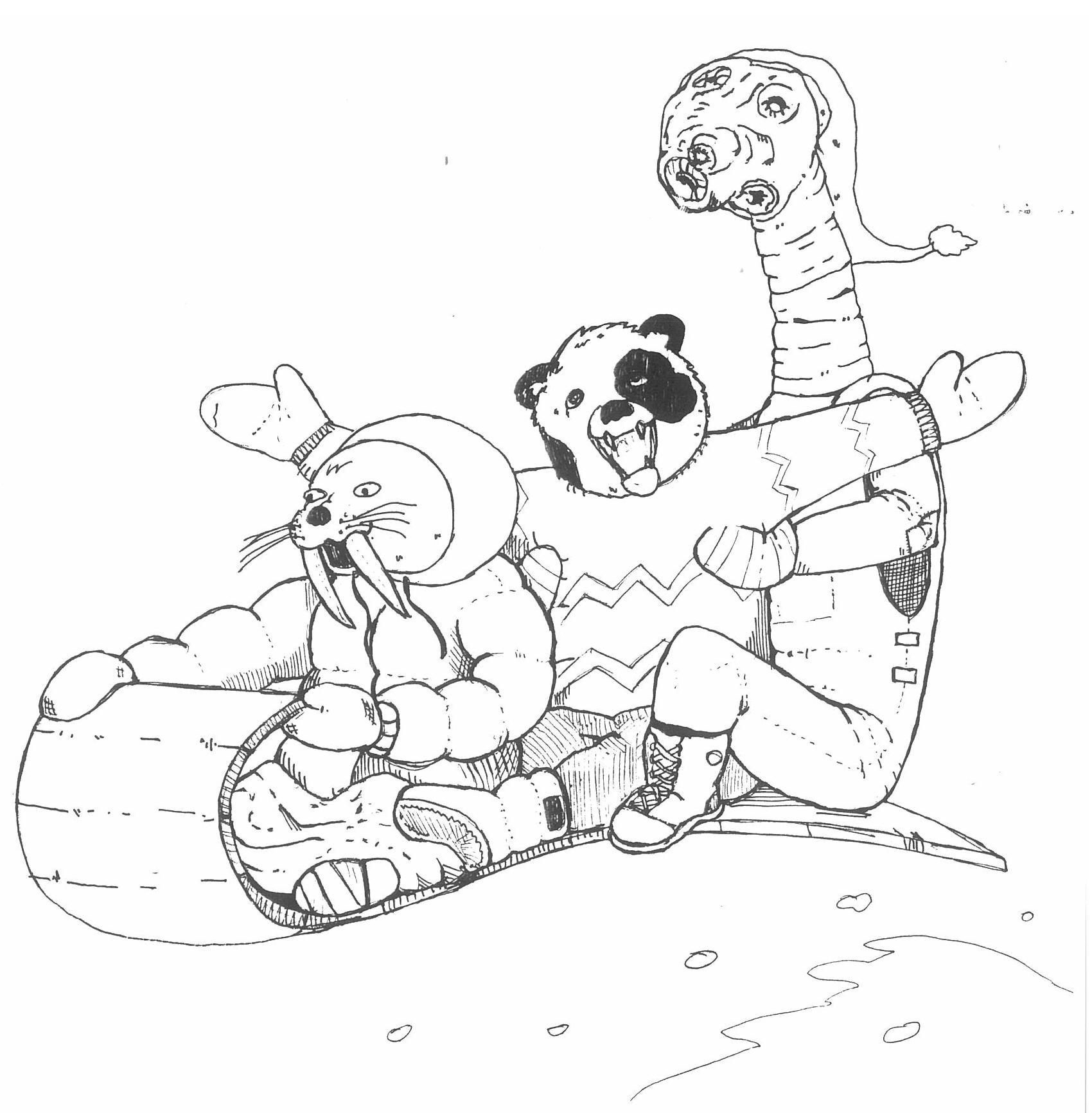
Intended Holiday card – ‘Three Friends’

I drew this in late 2010, when I was especially feeling the holiday spirit. My parents said that they would use the drawing as the card that they send around. For no good reason, I didnt act on this opportunity. Maybe next year my relatives and parents’ friends will get some weird image in their mail.

Postcard for My Mom’s Upcoming Exhibition

Postcard for My Mom's Upcoming Exhibition

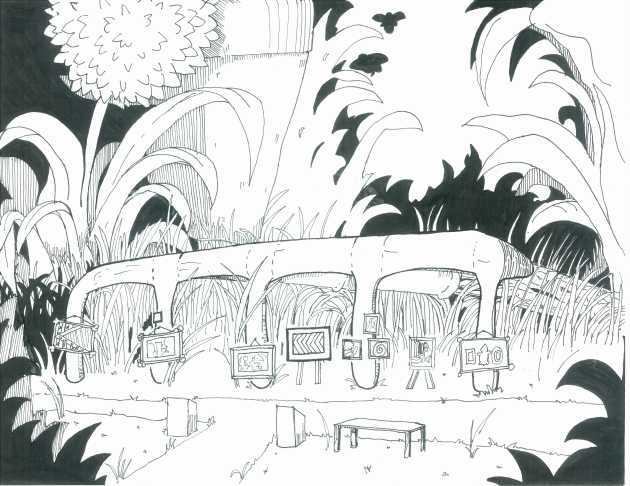
This is a promo postcard I drew for my mom’s upcoming show. A lot of her pieces are garden-oriented, hence the display in a garden. I know the perspective is a bit off, but I’m used to drawing monsters and musclemen haha!

Info:

Friday, June 1st, 2012
5:00pm – 8:00pm
Studio 202 and Gallery
(as part of Zanesville’s First Friday Art Walk, which takes place all over downtown Zanesville)

Bear vs. Triceratops

Bear vs Triceratops

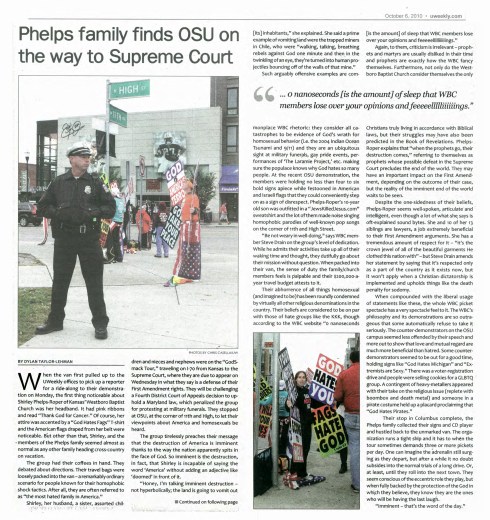
Phelps family finds OSU on the way to Supreme Court

UWeekly - Phelps Phamily

Originally published in UWeekly (now 1870 Magazine) on Oct. 6, 2010.

When the van first pulled up to the UWeekly offices to pick up a reporter for a ride-along to their demonstration Monday, the first thing noticeable about Shirley Phelps-Roper of Kansas’ Westboro Baptist Church was her headband. It had pink ribbons and read “Thank God for cancer.” Of course, her attire was accented by a “God Hates Fags” T-shirt and the American flags draped from her belt were noticeable. But other than that, Shirley, and the members of the Phelps family seemed almost as normal as any other family heading cross-country on vacation.

The group had their coffees In hand. They debated about directions. Their travel bags were loosely packed into the van – a remarkably ordinary scenario for people known for their homophobic shock tactics. After all, they are often referred to as “the most hated family in America.”

Shirley, her husband, a sister, assorted children and nieces and nephews were on the “GodSmack Tour,” traveling on 1-70 from Kansas to the Supreme Court, where they are due to appear on Wednesday In what they say is a defense of their First Amendment rights. They will be challenging a Fourth District Court of Appeals decision to uphold a Maryland law, which penalized the group for protesting at military funerals. They stopped at OSU, at the corner of 11th and High, to let their viewpoints about America and homosexuals be heard.

The group tirelessly preaches their message that the destruction of America is imminent thanks to the way the nation apparently spits in the face of God. So imminent is the destruction, in fact, that Shirley is incapable of saying the word ‘America’ without adding an adjective like ‘doomed’ in front of it.

“Honey, I’m talking imminent destruction – not hyperbolically; the land is going to vomit out [its] inhabitants,” she explained. She said a prime example of vomiting land were the trapped miners in Chile, who were “walking, talking, breathing rebels against God one minute and then. In the twinkling of an eye, they’re turned Into human projectiles bouncing off of the walls of that mine.”

Such arguably offensive examples are commonplace WBC rhetoric: they consider all catastrophes to be evidence of God’s wrath for homosexual behavior (i.e. the 2004 Indian Ocean Tsunami and 9/11) and they are a ubiquitous sight at military funerals, gay pride events, performances of  “The Laramie Project,” etc. making sure the populace knows why God hates so many people. At the recent OSU demonstration, the members were holding no less than four to six bold signs apiece while festooned In American and Israeli flags that they could conveniently step on as a sign of disrespect. Phelps-Roper’s 10-year old son was outfitted in a” JewsKiIledJesus.com” sweatshirt and the lot of them made noise singing homophobic parodies of well-known pop songs on the comer of 11th and High Street.

“Be not weary in well-doing.” says WBC member Steve Drain on the group’s level of dedication. While he admits their activities take up all of their waking time and thought, they dutifully go about their mission without question. When packed into their van, the sense of duty the family/church members feels is palpable and their $200,000 a year travel budget attests to it.

Their abhorrence of all things homosexual (and Imagined to be) has been roundly condemned by virtually all other religious denominations in the country. Their beliefs are considered to be on par with those of hate groups like the KKK, though according to the WSC website “0 nanoseconds [is the amount] of sleep that WBC members lose over your opinions and feeeeellllliiiiiings.”

Again, to them, criticism is irrelevant – prophets and martyrs are usually disliked in their time and prophets are exactly how the WSC fancy themselves. Furthermore, not only do the Westboro Baptist Church consider themselves the only Christians truly living in accordance with Biblical laws, but their struggles may have also been predicted in the Book of Revelations. Phelps-Roper explains that “when the prophets go, their destruction comes,” referring to themselves as prophets whose possible defeat in the Supreme Court precludes the end of the world. They may have an important impact on the First Amendment, depending on the outcome of their case, but the reality of the imminent end of the world waits to be seen.

Despite the one-sidedness of their beliefs, Phelps-Roper seems well-spoken, articulate and intelligent, even though a lot of what she says is oft-explained sound bytes. She and 10 of her 13 siblings are lawyers, a job extremely beneficial to their First Amendment arguments. She has a tremendous amount of respect for it – “It’s the crown jewel of all of the beautiful garments He clothed this nation with” – but Steve Drain amends her statement by saying that it’s respected only as a part of the country as it exists now, but it won’t apply when a Christian dictatorship is implemented and upholds things like the death penalty for sodomy.

When compounded with the liberal usage of statements like these, the whole WBC picket spectacle has a very spectacle feel to it. The WBC’s philosophy and its demonstrations are so outrageous that some automatically refuse to take it seriously. The counter-demonstrators on the OSU campus seemed less offended by their speech and more out to show that love and mutual regard are much more beneficial than hatred. Some counter-demonstrators seemed to be out for a good time, holding signs like “God Hates Michigan” and “Extremists are Sexy.” There was a voter-registration drive and people were selling cookies for a GLBTQ group. A contingent of heavy-metallers appeared with their take on the religious issue (replete with boombox and death metal) and someone in a pirate costume held up a placard proclaiming that “God Hates Pirates.”

Their stop in Columbus complete, the Phelps family collected their signs and CD player and hustled back to the unmarked van. The organization runs a tight ship and it has to when the tour sometimes demands three or more pickets per day. One can imagine the adrenalin still surging as they depart, but after a while It no doubt subsides Into the normal tr1als of a long drive. Or, at least, until they roll into the next town. They seem conscious of the eccentric role they play, but when fully backed by the protection of the God in which they believe, they know they are the ones who will be having the last laugh.

“Imminent – that’s the word of the day.”