Cows, combs, fast food at the Greene County fair

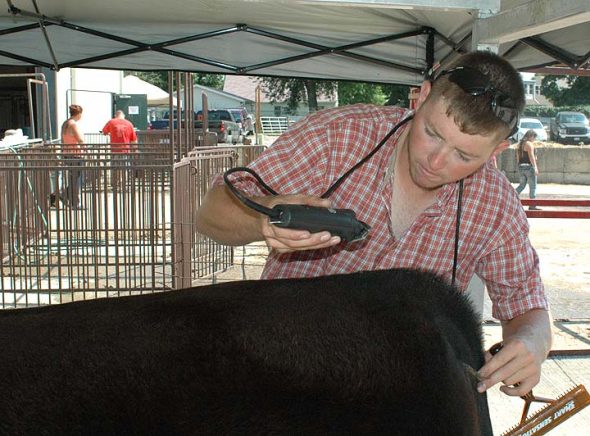
Yellow Springs resident Austin Pence did some last minute primping and preening of the heifer that he and friend Jordin Snider showed in the Greene County Fair last week. Pence has been showing cattle for 13 years, and said that heifers should be big-boned and have a wide chest. Not too spread out, but not too close together. “You want the heifers to look effeminate,” he said, “like they can carry a baby.”

Originally published in the Yellow Springs News on Aug. 18, 2016.

A blog post I wrote about the fair’s strongman contest can be found here.

Xenia hosted the Greene County Fair last week, a full seven days of animals, rides, demolition derbies, country music and the uniquely American cuisine known as “fair food.”

The fair boasts an annual attendance of 65,000 people, including daily guests, season pass holders, exhibitors and vendors, according to fair board treasurer Dennis Nagle. Many of these people stayed inside the fairgrounds in order to be close to their duties for the week. Dozens of RVs and campers formed a small village alongside the fairway and rides.

Arriving at 10 a.m. on Thursday, this reporter was able to see the fair get up and running. People emerged from their campers, squinting in the sun, stretching, toiletry bags in hand as they made their way to the nearby restrooms. The rides were shut up for the next few hours, until families started arriving later in the afternoon.

The heat certainly inspired a certain lassitude, and the food vendors and exhibitors took time folding back plastic tarps or firing up their deep fryers. Nagle said attendance was slightly down this year due to the high temperatures. A group of food workers sat in a circle smoking cigarettes and trading stories about rude customers. Nobody seemed to sympathize with how hot it is inside a stand selling corndogs or deep-fried vegetables.

The rides may have been on pause and the food vendors just starting up, but elsewhere the grounds were full of activity. Various livestock competitions were well underway by 10 a.m. Roosters crowed from inside livestock barns, and cows were being walked between buildings, their caretakers pausing a moment as a cow lifted her tail on the fairway. The owner waited and then cleaned it up, patiently tending to a future prize-winner or literal cash cow, as many of the animals were for sale.

Outside of one of the barns was Austin Pence, 22, from Yellow Springs. He was standing with his cow under what looked like a carport. Pence was hovering over the cow’s hindquarters with a set of hair clippers, primping one spot with a hairbrush while the clippers shaved off the slightest bit of extra fuzz. Next to the cow was a cart with a number of tools of the trade, including some scissors and a canister of spray adhesive.

Pence had been showing cattle for 13 years, he said, and the pre-show primping is part of the daily routine. His cow is given a daily bath before her hair is blown out. The idea is to train the hair to stand up, he said. The spray adhesive is used to dip and shape the hair. And the cow is fed and watered not long before competition so she looks filled out. The cow should be big-boned and have a wide chest, he explained. Not too spread out, but not too close together.

“You want the heifers to look effeminate,” he said, “like they can carry a baby.”

The right feed is important to getting this look, he said. The right feed fills her in where she needs it and takes away where she doesn’t. Show steers, on the other hand, “should be as fat as you can get them. They judge for what an animal will look like butchered and on a meat hook.”

He took a step back and assessed his styling, and then dove back in to trim a few more errant hairs. A few minutes later, after some almost imperceptible trichological adjustments, the heifer was ready.

“I don’t mean to be rude,” he said. “But I’ve got to go show this cow now.”

The Junior Dairy competition took place in Building 3. In the center of the building was a show area surrounded by bleachers and animal pens, where cows rested between rounds in the show ring. Families and caretakers lounged about in fold-out chairs by the pens holding their animals. Each pen had a placard hanging over the doorway indicating the people responsible for raising the cow and the names of the people and businesses scheduled to buy it. The ring was bedded with mulch, and three officials sat at an elevated table on one edge. The official responsible for the judgements, the overjudge, was on his feet in the middle of the ring.

Pence’s animal was being shown by his friend Jordin Snider. The two had been working on the as-of-yet unnamed heifer for the past year and a half, Pence said. He had previously showed her as a baby.

Cattle were walked into the ring by their caretakers. Young men and women alike were decked in their finest show flannel and denim, which almost uniformly included fancy embroidering on the seat of the pants. A special cow comb jutted out of contestants’ back pockets. Once in the ring, the humans and animals walked a few laps and then stopped in a semi-circle. A long metal pole with a small hook on one end was employed to get the animals into show position. The hook was lightly used to position the animals as though they were paused mid-trot. The caretakers stood behind them, shifting from one foot to another and running the comb through the cows’ hair.

The official made his way slowly around the contestants, taking a few steps before adopting a look of scrutiny and then taking a few more steps. After his deliberations, he picked up a microphone and announced his opinion about all of the contests, running through all of their qualities and faults in rapid succession.

“She has some depth about her,” he said about one cow. “But more angularity than what I’d prefer to see. You might want to make her a little more three-dimensional.”

He made his way around to each contestant. Eventually he made his way to Pence’s cow.

“Really sound,” he said. “You want one built for functionality, one built to last forever. You’ve got that in this cow. The only thing I don’t like about her is that she’s going home to your pasture and not mine.”

With that, he pronounced Pence’s cow the winner. An expression of relief came over Snider’s face while Pence pumped his fist and did a small victory hop outside the ring. He walked over to meet Snider and the cow by the entrance. An official handed them a small trophy. The cow was the “Champion Cross Breed.”

There were a number of rounds before and after Pence and Snider competed. The final round determined the overall best in show, with the winner crowned “Supreme Female.”

Pence walked over to consult with Snider about the next round. As Champion Cross Breed, their heifer was going to compete in the championship round. Some last minute primping was completed as quickly as they could, as the final round was scheduled to start only a few minutes later.

“Don’t let her get dirty!” he called after Snider as they lined up to enter the ring.

One contestant had had two cattle win so far. He walked one cow in, while a friend walked in the other. One contestant looked around nervously as a cow resisted being led and stepped slightly out of line. The hooked pole was run gently over the cow’s underside, and the cow settled down.

Pence gestured at Snider from outside the ring. He acted like he was propping up oversized ears. “The ears!” he mouthed. “The ears!” Snider nodded.

The judge was silent with characteristic scrutiny.

“It’s little bit of apples and oranges here. No two are alike,” he said. “But there’s a nice give and take with each one of them.”

He praised one cow’s “structural design” and walked over to another.

“This is the least conditioned of the bunch. It makes me question how deep of a cow she’ll be down the road, but it really comes down to personal preference.”

After some deliberation, the overjudge decided on the best in show. Pence and Snider’s heifer had to be content with the win in her own division. The barn’s royalty walked over to the winner and the runner up and presented them with the prizes: a translucent, dark blue lamp embossed with the silhouette of a cow. Written next to it was “Reserve Heifer — 2016 Junior County Fair.” Friends and family alike ran over to the winners, patting the humans and animals on their heads in victory.

Part III: “A Quarter-Inch of Chaos” – at the 2015 APWA Southwestern Ohio Snow and Ice Removal Conference


Snow and Ice - Plows

Section 4 on the Sept. 9 agenda was a partial list of the correspondence and email the trustees had received since the last meeting. Most items – like the Ohio Township News magazine – were glossed over, but Chris Mucher paused to note the email confirming the township’s registration for the 2015 APWA Southwestern Ohio Snow and Ice Removal conference. The conference is a biannual affair designed to help local governments manage the inevitable hazards of winter.

“Put on your best snow boots,” Mucher said.

The 2015 conference, hosted by the American Public Works Association and held in Sharonville, Ohio, 50 miles away, was to feature speakers from road departments from all around the state. The showroom would feature over a dozen shiny new plow trucks and pieces of equipment, as well as a number of other vendors plying relevant trades, such as custom municipal sign-making and pipe repair, offered by a company which applies a proprietary sealant to the inside of busted pipes. (“We only do what the pipe tells us it needs,” says the company’s slogan.) The keynote speaker of the conference was Diana Clonch, a thirty-year public works veteran who is now a successful freelance winterization consultant.

“Any questions, Mark?” Mucher asked.
“Nope,” Crockett said.

The other trustees quietly avoided comment when registration was confirmed, lest they be roped into going as well.

It was Mucher who typically made the trip to the conference, and Dan Gochenouer, the cemetery sexton and a road crewman, usually went with him. Neither Gochenouer nor Mucher were particularly excited about attending. It wasn’t that the conference was totally boring, Gochenouer said, but that it wasn’t especially helpful. Attendees usually have to sit through a few hours of presentations to get a few minutes’ worth of usable information, he said. The presentations usually consisted of guys from around the state talking about how they solved a problem or adapted equipment to the needs of their jurisdiction. While Gochenouer could appreciate their ingenuity from a professional standpoint, the lessons didn’t always apply to the needs of Miami Township. A speaker from Franklin County (which includes Ohio’s capital Columbus) discussed strategies needed to deal with its 770 miles of roads: around two million gallons of anti-winter liquids annually and the use of semi-trucks to spray. Miami Township, on the other hand, has less than fourteen miles of roads and three trucks, a fleet occasionally augmented by citizens who attach plows to their personal vehicles.
The first official road in Miami Township was laid out on March 3, 1822, though there were several “so-called roads” before then. Michael A. Broadstone writes that the roads improved year by year, and most were “at least graveled” when he penned his History of Greene County, Ohio in 1918. By 2015, the township had exactly 13.43 miles of roads, almost all of them paved.

Road maintenance is within the purview of the trustees, a duty that includes everything from filling potholes to maintaining culverts to full-scale winterization. Each spring the township develops a road budget based on the work anticipated for the year, prioritizing repairs on the worst roads and any new equipment that needs to be purchased. The township fleet was three trucks (two of which have dumping capabilities), one 26 year-old panel van, and a handful of tractors and lawnmowers.

Road maintenance is an ongoing project, and one that occasionally requires help. Trustee Chris Mucher said that sometimes neighboring Bath Township, which has a paving machine, will do a little work in Miami Township in trade for help with their needs in the future. Once in a while the county will determine that part of a road now lies in Miami Township, which may add to their mileage-based clout but also means that the township is responsible for maintaining that much more road.

Road repair requiring equipment the township doesn’t possess is contracted out to the county. Miami Township works with neighboring municipalities work together to make what is called a “collective bid” for their collective asphalting or resurfacing needs. Participating jurisdictions add up what needs to be done – a half-mile stretch here, a few hundred square yards there – and submit a report to the county, who contracts the work to a company as one job. Doing it this way allows municipalities to save money, as everyone getting work done at the same time splits the cost of mixing asphalt and dispatching trucks and police.

Miami Township also has the dubious distinction of hosting the first vehicular accident in Greene County. Lodrick Austin, a stagecoach driver, was killed when his coach overturned on Clifton Gorge Road in 1836. Austin is buried in Clifton Cemetery, and his tombstone features a horse and a coach, which honestly seems a little insulting.

Though vehicular accidents are of course a fact of life in Miami Township, the fact that none of the township’s roads permit speeds over 35 mph means the severity of an accident is usually pretty low. However, low speed limits or high, cars are no match for the wiles of nature. Like everywhere else in Ohio and across the United States, accidents occur in Miami Township with greater frequency in the winter. Snow and ice are indiscriminate perils, and all it takes is a small amount of snow, “a quarter inch of chaos,” according to a presenter at the AWPA conference, to throw a city into bedlam.

As little as a quarter inch of snow means erratic drivers, slick roads, and asphalt breaking apart as water freezes and expands. The prospect of this quarter inch of chaos also means a significant amount of preparation by the township. Salt has to be stockpiled, and later mixed with beet juice or turned into slurry to be more easily spread on roads. The township’s trucks, with their spreaders, sprayers, and dump buckets, almost certainly require maintenance. Potholes need to be filled, and bridges need to be inspected.

Regardless of season, road maintenance is a complex obligation. Though Mucher and Gochenouer were seasoned township veterans, there was always something to learn, couched as it may be in a day’s worth of presentations. It is because of this potential for helpful information that the two attended the 2015 AWPA Snow and Ice Removal Conference.
Gochenouer and Mucher met at the Township’s fleet garage to leave for the conference at 7am on September 29. They were both early.

They didn’t get into one of the township’s work pickups but into Mucher’s golden Chrysler minivan. “The Muchmobile,” as Gochenouer called it. Mucher said his van was frequently the de facto work vehicle as most of the township’s vehicles only have two seats. The Muchmobile crunched on the gravel and wound its way through the township to the highway.

Mucher didn’t have much experience winterizing cities when he became a trustee in 1996. He ran a video rental and film development business in Yellow Springs for over twenty years, before digital film and video streaming proved the “ultimate fatality” for his career. However, when he was still in business, he struck up a friendship with the guy who ran the hardware store across the street. The two would have coffee every morning, and they developed a mentor-mentee friendship. Mucher was interested in becoming more involved in the community, and the hardware store owner encouraged him to apply for a recently vacated trustee seat. Mucher submitted an application, had a few interviews, and was offered the position. It proved to be just what he was looking for, a “low impact political job” that carried a lot of responsibility but still left him time to run his own business and spend time with his wife and three kids. Once in office he read “every page of meeting minutes since 1934,” attended conventions and seminars, and read the Ohio Revised Code front to back. Mucher has been reelected every four years since then. Now he is able to talk about winterization both fluently yet dispassionately, the hallmark of an experienced professional.

Gochenouer has a perpetually sunburned neck, a moustache, and a Leatherman on his belt that he could readily employ in many different ways. He exuded hands-on experience of the kind that only a lifetime of fixing things can foster. Gochenouer’s tenure working for the township preceded Mucher’s. He was working part time until a long-time employee retired, allowing him to become the number two road crewman.

On the way to Sharonville, the two discussed other trade shows conferences they’d been to and whether or not free lunch was included. It wasn’t always. Registration for the 2015 Snow and Ice conference cost $35 per person but at least included lunch. The topic settled, the two lapsed into a short silence. The day was grey, chilly, with a steady rain. The heater hummed and the windshield wipers squeaked.

Conversation picked back up again a few minutes later.

“You working on that dandelion quote?” Mucher asked.
The abundance of dandelions in the township had to be dealt with.
“Some people eat them,” Gochenouer said.
True, Mucher said. And some people make wine out of them too. Then both admitted they weren’t sure which part of the dandelion was used for the winemaking process.

A little while later, Mucher indicated a passing belonging to Jurgenson Asphalt Co.
“There are your friends,” he said.
Gochenouer nodded.
“They’re the best,” he said, nodding with sincerity.

He would know. Gochenouer said he came from an asphalt background. For one, he has spent a lot of time driving on it, he joked. But more seriously, he said, he started working on an asphalt crew right after high school, one of the many labor and construction jobs he’s had from an early age. His dad always made sure he was working on different projects and was comfortable around all kinds of machines. The idea was that his skills and experience would ensure he was always employable. “If you’re not working, it’s because you don’t want to,” Gochenouer said.

A truck driving erratically on the highway prompted the mention that he’d also been a truck driver. He’d driven for twelve years, five of which were long-haul and required him to spend up to seven weeks on the road at a time. He lived in his truck, thousands of miles away from his family and home.

“You’d sit in a waiting room and they’d call your number when a shower was ready,” he said, recalling old truck stops. “The shower was free but you’d have to rent the towel.”

But it wasn’t all bad, he said. Sometimes he’d be on a layover for a few days before linking up with a series of deliveries that would take him back towards home. On these furloughs he and his fellow truckers would go out and explore whatever city they were waiting in. Gochenouer recalled the beauty of California in particular, and the fun of sitting behind the Hollywood sign drinking beer. He’d been run out of Beverly Hills once, he said, for not looking the part. A cop came up to him and asked him what he was doing. “I said I was just looking,” Gochenouer recalled, “and the cop said, ‘Well, you looked yet?’”

Snow and Ice - trucks
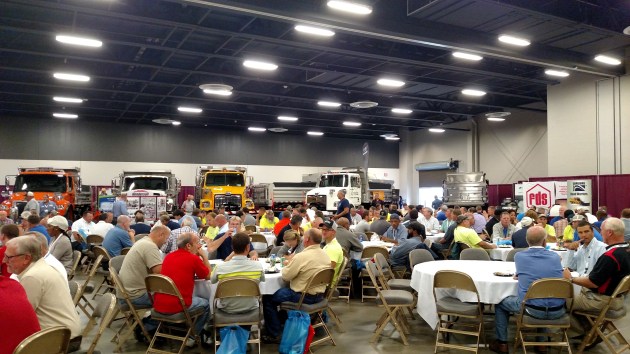
Forty minutes later, the Muchmobile pulled into the conference center parking lot. It was the lone minivan among rows of work trucks with maintenance department insignias. Inside the conference center were the trucks’ drivers, approximately three hundred men with closely cropped hair and goatees. Cellphones were universally clipped to belts, and neon t-shirts were worn in numbers rivaled only by those at an actual construction site. Sixty-five municipalities were represented at the conference, making it “pretty sizable for a local AWPA conference,” according to one organizer.

The conference was only one day long. The morning was divided into four 45-minute sessions. One of the sessions was earmarked for attendees to check out the showroom, but the other three sessions were presentations. Attendees were divided into four groups and rotated through the sessions. Mucher and Gochenouer were in Group 2, meaning that they went to the showroom first.

The conference organizers set out donuts and coffee. Both men took a donut and looked at the trucks. They were shiny and gigantic, but ultimately outside the needs of Miami Township. The township’s road budget for 2015 was approximately $50,000, and one of the middle-grade trucks cost at least twice that.

One company offered their services quantifying idle time. A rep said she did a study of one muncipality and found the time its vehicles spent idling cost the city around $50,000 each year. Plow-route optimization would lead to less idle time, and she could figure out how to optimize plow routes.

Mucher and Gochenouer made their rounds. Despite the entreaties of the sales reps, they left empty-handed.

The next two hours and fifteen minutes were dedicated to presentations. Mucher and Gochenouer sat in these sessions, polite but expressionless, casually listening for those few minutes of valuable information. Though a cell phone would occasionally go off (one ringtone was a very loud duck-quack) and at least one sleeping attendee could be spotted during each discussion, attendees were privy to much information, as a county’s snow and ice removal concerns are many:

Plows tend to throw snow onto the front of trucks, obscuring visibility and blocking air intakes, which can lead to overheating. Excess salt can cause to ‘salt burn,’ which damages agriculture and kills trees and leads to a ‘brown out’ when spring comes. Plow routes are based on continuous right hand turns, which is why a representative from Centerville maligned the town’s many cul-de-sacs. Plow teams are often on call for grueling twelve-hour shifts, though this is better than working for sixteen hours at a stretch, a schedule that employees “can’t really plan their lives around.” Sometimes, the ground will be so cold that even after the air temperature rises, rain will freeze shortly after impact. What is the proper mix of chemicals, salt, and water for slurry? Is salt brine or beet juice more effective? When and where are belly plows most useful? Is chloride-treated sand the best deicer for gravel roads? Are the township’s trucks calibrated properly, and are they actually putting out what their gauges say? “One thing we’ve been wrestling with for years are standard truck plugs,” said a guy from the Ohio Department of Transportation. Everyone in the audience laughed and nodded. “How many of you have replaced mailboxes?” another speaker asked. Almost everyone raised their hands.

The application of liquid deicers vs. solid salt is an ongoing debate. Liquids are better at getting roads bare but solid salt is more effective in warmer temperatures. (Both methods are said to have problematic environmental impacts.) A guy attending from Michigan related how he came back from his first conference with all of these crazy ideas about liquid spray. “My coworkers thought I was stoned or high,” he said. “They wanted to send me to get a drug test!” Rob Crimm from Morgan Township said his department “was just now getting into liquids.” They realized that mixing liquids or sometimes even sand with salt will help stretch their resources.

As Gochenouer predicted, the discussions didn’t offer universal solutions for these problems but presented the clever ways in which winter emergencies were addressed. Auglaise County faced the problem of equipment not mixing rock salt – “grit,” as the presenter called it – well enough into brine. There would still be large patches of ice on the road after it was dispersed, so he and his team retrofitted an asphalt hopper to mix it. The upgrade cost Auglaise County about $31,000 but now they mix 40,000 tons of salt brine per year and even rent out their salt mixing services, charging neighboring counties and agencies $13 per ton. (A fairly standard amount, he said.) The speaker also showed pictures of the custom beet juice tanks his department built for $600 each.

Diana Clonch’s roundtable was one of the four sessions, and she’d spent the morning spitballing with employees. She applauded the imagination she’d seen at the conference. “The more we learn, the more we know how to step outside the box,” she said. “If you always do what you’ve always done, you’ll always get what you’ve always got.”

Clonch was tall and broad-shouldered, and her long black hair was draped over her shoulder in a thick plait, like a military sash. (She was the past president of the OPWA Board.) She spoke simply but animatedly, like someone used to public speaking. She seemed friendly and successful, the likely demeanor of someone with degrees in civil engineering and business.

“Do not be ashamed to steal your neighbor’s ideas,” Clonch advised. “We’re all working together in the snow and ice community.”

Sometimes friendly rivalry between neighboring counties was a good thing, she said. Plowing a road cleanly all the way to the county line awards bragging rights when you can see the neighboring county hadn’t gotten to it yet. But more seriously, she said, working with other jurisdictions can be very beneficial because collaboration increases efficiency and saves money. After all, at the heart of it, it’s all for the benefit of the people that live there.

Snow and Ice - lunch

Clonch’s session was the last of the four for Group 2. The attendees walked straight into the two long lines of the lunch buffet. Hamburgers, baked beans, chicken, and macaroni and cheese. Plates full, they filed back into the showroom and sat around large folding tables. The tables were in turn surrounded by the trucks on display. It was like eating in a garage on the job.

Mucher and Gochenouer sat with a half-dozen guys, exchanging small talk. Not much more could be said. Anything they could say to each other on the topic of snow removal had likely already been covered in one of the earlier sessions, or had been part of the pitch rattled off by a sales rep. At this point, the conference was about as exciting as eating lunch in a garage that looked like the garage they spent time in every day. The Miami Township contingent decided to cut out after lunch, skipping Clonch’s keynote speech (“Doing the right thing at the right time”) and the recognition of the 2015 Excellence in Snow and Ice Control Award winner. They’d seen enough throughout the years in Miami Township to have a handle on what they had to do in the coming months.

They walked back to the Muchmobile silently, Gochenouer carrying a can of soda. They knew that, should some surprise crisis pop up, each could be counted on to address it with the professionalism that is an evident part of their bearing. Gochenouer was scrappy and smart; Mucher was thorough and direct. They’d been through two meetings’ worth of irate neighbors – what was a quarter inch of snow?

Update, Spring 2016: the winter of 2015-16 proved not to be that bad. Mucher said the township used about 25% the amount of salt normally used, they didn’t have to pay for outside plow help, and there were no significant vehicle repairs.

I produce 9,000 pounds of bean sprouts each week

IMG_20150818_165826600.jpg

In 1982 I was just getting out of the Peace Corps. My dad had bought a farm wanted to do something with property. So we decided to go into business together. He bought the farm originally to grow grapes but that didn’t pan out. At the time, we thought that to really promote your wines you had to have a festival, and that would mean you had to bring thousands of people here for a wine tasting. It was a major thing that we didn’t want to do. So we built a greenhouse and started growing herbs, tomatoes, watercress, European cucumbers. There was an emerging market for hydroponic lettuce so we started growing lettuce hydroponically. Every year we added a greenhouse and pretty soon we had 20,000 square feet of produce.

We sold produce wholesale. There’s a big produce market around, especially in Cincinnati because of the river. There’s an established warehouse district there. We knocked on doors and did cold calls. We were supplying the Meijer chain for a while. And then one of our alfalfa sprout growers lost their supplier and wanted a replacement and asked if we knew how to grow alfalfa sprouts. We didn’t but of course we said yes anyway. (Laughs)

We tried to build our own equipment and grow sprouts in the greenhouse, but it just didn’t work out. Months later we bought the right equipment and did it the way it really needs to be done. The alfalfa sprouts are grown in a large rotating drum. You add water and light, and they green up after a few hours. You load in about 80 pounds per drum, and you get about a 10- 15:1 ratio after about five days. They were used primarily for salad bars, sandwich shops.

The green sprouts (alfalfa) business declined. A lot of the chain grocery stores dropped green sprouts – the green alfalfa sprout has an inherent problem with salmonella and E.coli. The structure of the seed has more crevices for bacteria to hide. We got out of alfalfa ten years ago but alfalfa sprouts led to us see the market for bean sprouts. The bean sprout market is pretty good – a lot of Asian markets and grocery stores.

Bean sprouts are a highly perishable product so there aren’t a lot of growers around. They can’t bring a decent bean sprout in from another state without paying huge shipping costs, so it favors the local grower. You want to get them sold within two days of harvest, and they need to be consumed within 10 to 14 days. I think the distributors we use ship in some sprouts from Chicago and I know there’s a grower in Columbus, but he only has a few sales in Dayton.

The process we use is unique to bean sprouts. The equipment we have is specifically for growing them. We’ll load up 110 pounds of seeds in a 3’ x 4’ x 4’ bin. The bean seeds themselves come from China. I don’t know why – maybe they grow the best beans? The bins are in a dark room and we spray them with water every two hours. We do a test and send it to a lab in Cincinnati twice a week to test for E.coli and salmonella to make sure the product is safe. We have a recycling system that cleans 80 percent of the water we use. The beans sprout on the bottom and push successive layers to the top. Kind of like they’re in dirt. On the sixth day of the process, we process them, package them, and put them in a cooler. We ship them on Mondays, Wednesdays, and Thursdays. We sell about 9000 pounds per week. It’s an amazingly big market. (Laughs) And that’s just the Dayton and Cincinnati area.


(Let me interject and say that a bin full of fully sprouted sprouts is totally surreal – the bins are four feet tall and are completely, completely packed with sprouts. You can reach your hand in and it’s this weird tangle of dense but loose sprouts with seemingly no end. They are so dense that you could probably walk on them. The bins are in a dark, damp room, and standing on a bucket and peering over the top into a bin and seeing an ocean of yellow-green fibers makes for a really odd sight. Not to mention that if you opened the vertical door on one of the bins, a few hundred pounds of sprouts would avalanche out and cover you in their watery, earthy essence. Maybe I’m just used to seeing them in small cartons in grocery stores, so the sheer amount of sprouts in one place is hard to process, not to mention that this is just one of seven bins.)

It’s been a nice business. It’s profitable, the market’s consistent, and it grows. But it takes a lot of commitment. Someone has to be here every day to check on them. We have alarms for malfunctioning pumps In fact, the most catastrophic event we experienced was when the computer that controls the watering cycle broke down last winter. I had to come in every two hours for a whole week and push the watering server bar over the bins by hand. I had help doing it during the day but I had to stay overnight every night and get up every two hours to do it. That’s the thing about small businesses – you make enough to survive, but a lot of times you don’t make enough to pay a manager to take responsibility for things. (Laughs) The responsibility comes back to me.

I graduated from college with a degree in Zoology. I had never even tasted sprouts before we started. In the Peace Corps I was raising fish – it was a kind of farming, but I really had no experience with growing. I learned my business sense along the way. Raising sprouts isn’t something I ever saw myself doing, but isn’t that how most people end up in life – not really doing what they thought they were going to do?


Quaint Vituperations: the Glen House Inn Controversy

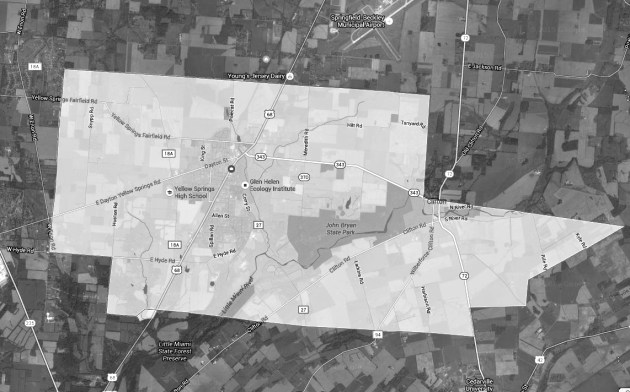
Miami Township map overlay bwBelow is the first section of a forthcoming nonfiction novella that chronicles the goings on of a small township in southwestern Ohio. I was sent to cover a township trustee meeting as a reporter for an area newspaper. Although nobody from the public normally attended those meetings, this was in particular was a hotbed of controversy and drew a dozen or so irate citizens. A rogue bed and breakfast was making waves in a neighborhood, and some neighbors wanted it shut down. The anti-B&B neighbors had a list of complaints against the inn that they said stretched back years.

However, a number of the B&B’s neighbors were friends of the owners and supported what the B&B was doing. The neighborhood was divided into cranky adherents on both sides, and the following trustee meeting was attended by pro-B&B neighbors refuting the points made by the first. To the neighbors, depending on what the trustees decided, the township was either tyrannical or ineffective.

While this may not sound like a riveting thing to write about, it was. The nature of the dispute and the personalities involved are fascinating, and the ways in which they clashed are hilarious, aggravating, serious, and quaint, all at the same time.

And this isn’t even taking into account the rest of the evening’s meeting, which involved everything from unknown remains found in an old cemetery to a visit to the Ohio Snow and Ice Removal Conference. My upcoming novella, logically titled “Dance of the Trustees,” discusses life in the township, from its history of burial mounds and murders to the storied careers of the township trustees who have taken it upon themselves to steer such a multifaceted ship.

Quaint Vituperations: the Glen House Inn Controversy

Trustee Mark Crockett is a man who speaks deliberately, delivering each phrase with the ponderousness of a court justice who has all the time in the world. He sat in an equivalent posture on the evening of September 9, slightly reclined in his chair behind the table at the head of the room, fingers interlocked over his belly. He looked out on the room with equanimity, observing the proceedings and taking them in.

Crockett, like the other trustees, was in an interesting position. He had lived in the area with his wife for almost 40 years, owned a business, and was otherwise just a man around town. But he, like the other trustees, made decisions on behalf of his fellow residents.

Neither Crockett nor any of the other trustees had previous experience holding political office. Spracklen was a farmer, Mucher used to own the area’s video store, and Crockett is a jeweler and guitar player. (Though Mucher was an in-law to the DeWine family, an Ohio political dynasty.) But civic management skills were picked up on the job, and the public had trusted them enough to reelect each of them multiple times.

However, President of the Miami Township Boards of Trustees Chris Mucher looked around the meeting room warily on September 9. He could sense tempers were a little high, and so the outcome of the evening would likely make some proportionally serious waves. Any decision made is bound to offend someone, and in the case of the first portion of that evening’s meeting, any official position would offend at least half of an entire neighborhood.

The meeting began shortly after 7 p.m.

Mucher stood up and introduced himself and the rest of the people at the table: fellow trustee Mark Crockett, Margaret Silliman, the financial officer, “number one road employee” Dan Gochenouer, Miami Township Zoning Inspector Richard Zopf, and StepIMG_20160505_164722337hanie Hayden, the Greene County assistant prosecutor, who had been called in specifically to give her interpretation of the B&B dispute.

Mucher’s right hand stayed in the pocket of his khakis as he gave a referee-esque preamble to the proceedings.

“In our opinion, the board of trustees is the bedrock of local government,” he said. “It’s the place where the balance begins between the rights of the property owner and the rights of society. Sometimes it gets a little messy, but I assure tonight isn’t going to be messy. It’s going to be polite and dignified.”

The balance between the rights of the property owner and the rights of society were indeed going to be discussed. The meeting was the latest skirmish in an ongoing battle between a bed and breakfast and the neighbors it reportedly annoyed. The anti-Inn neighbors, the Concerned Circle Citizens (CCC), sat in the front row and nodded. Their de facto spokesperson brought with her a folder full of stapled documents to prove the soundness of their position. Nobody in favor of the B&B was there, as pains had been taken to avoid telling them the topic was going to be addressed at the meeting.

On the surface, the debate may seem a bit droll: how often does a quaint B&B drive neighbors mad? But such charming disputes are practically written into the township’s DNA.

An odd bit of Ohio Code allows the average residential homeowner to run a B&B out of her home with little official oversight.[1] In fact, a number of area residents were taking advantage of this allowance. Miami Township encompasses a number of picturesque hamlets, including the village of Yellow Springs, a progressive small town full of art galleries, a tourist destination most appropriately served by quaint B&Bs. A bumper sticker claims the area is “2.2 square miles surrounded by reality,” and the area’s pastoral vistas suggest this may be the case.

However, Crockett said most people who live in Miami Township just want to be left alone. The presence of a B&B in a quiet neighborhood a few miles outside of Yellow Springs was said to be aggressively challenging the desire to live unmolested. The Glen House Inn, located in a quiet neighborhood a few miles outside of Yellow Springs, was accused of hosting dozens of visitors and large-scale events like weddings, self-help workshops, and Solstice vigils, a far cry from the romantic (and manageable) couples who usually patronize B&Bs. The excess noise and people “undermined the quiet integrity of the neighborhood,” as one neighbor put it, and another said he never would have moved to the neighborhood in the first place had he known the Inn would so loud. Negotiations between the sides had deteriorated, if they were ever civil at all. Both sides accused the other of being obstinate and dishonest, and both accused the township of not acting with consistency in enforcing its laws.

As such, on September 9, the parties sought a definitive interpretation of code. Was the Inn operating legally or not? Should the Inn be found in compliance, the neighbors would just have to deal with it; should the Inn be found in violation, the B&B would have to scale back its operations, a change the owner said would ruin him financially.

Prosecutor Hayden was there to give an official interpretation of the law, and to offer suggestions about what steps could be taken to square everything with code. Throughout the meeting, her face held a look of intelligent skepticism, the fiercely judicious look of someone professionally capable of seeing through bullshit.

The crowd murmured, eager to get started. Richard Zopf, the wild-bearded township zoning inspector, tried to look relaxed while knowing that the whole room was eager to blame him for their troubles. Gochenouer, the road crewman and cemetery sexton whose official business didn’t have anything to do with the crowd, folded his hands and smiled faintly.

Genesis of the Dispute


IMG_20160501_185241489

Grinnell Circle, where the Glen House Inn is located, is a ten-minute drive from the MTFR building. Down Corry Street, past a nature preserve and a stable of therapeutic horses, is Grinnell Road. A left turn on Grinnell takes the visitor down a sizable hill and onto a road overlooked by the colorful buildings of a recently revamped wastewater treatment plant. A few miles further south and the visitor will come to a noticeably bucolic setting, a clearing with stone walls and an old mill with water wheel set among hedges and trees. The Glen Circle neighborhood is back in this splendiferous idyll.

Glen Circle is a collection of homesteads grouped around an acre of common area. Some neighbors have gates; some have none; most have a decent amount of money. Eric and Deirdre Owen, the owners of the Inn, spent $700,000 to build a large house on the Circle in 2005, largely because of its regal charm. Both grew up in Yellow Springs, and wanted to return. The house is based on a dream home they sketched on a cocktail napkin in Europe many years before.

Owen is in his late 40s, thickset, unkempt in a way that speaks for consistent productivity in his pursuits. He’s a kind of wheeler-dealer, active in the art world and owner of a few properties, including part of a hotel in small-town Michigan. He was thrust into bed and breakfast ownership when he had a falling out with the partners of a company he founded 25 years before. He took a year’s salary and retired, but quickly recognized the money was not enough to sustain him forever. He knew he had to do something to secure his retirement. A beautiful house was at his disposal, and he decided to turn it into a B&B. The Glen House Inn’s website was up and running within thirty days of his decision. He said it was the only way to save the house.

In the interest of being open about his plans and in order to get a permit to follow through with them, Owen met with the Board of Zoning Appeals in July 2011. The BZA overhears building plans, checks them against zoning code, and questions prospective builders about the effects the construction will have on the surroundings. All BZA meetings are open to the public, and citizens are encouraged to attend and weigh in with their concerns. Anti-Inn neighbors came to the BZA meeting, anticipating the B&B would be trouble, and wanting to register their reservations.

Both sides grant some kind of tenuous agreement was reached regarding the operations of the Inn, but none of the claims about what was said can be proven, as the official record for this meeting has disappeared. Video of any BZA meeting would ordinarily be available through the local cable access station or on a DVD at the library, but the master recording could no longer be found, and the person who took notes at the meeting no longer worked for the Township. Ultimately, Zopf recalled, “there was no reason not to grant Owen a permit,” as Owen’s plans seemed kosher.

With the impression everything was on the up-and-up, the Owens opened the Glen House Inn. Guests lined up to rent its five spacious rooms, lounge on its patio, appreciate the impressive art collection, and swim in its stream-fed pool. The whole Inn is bathed in that tranquil, sunlit green characteristic of 18th century paintings. It’s an objectively beautiful location, and business was steady.

However, perhaps because of the bacchanalia such locations induce, neighbors said their concerns about disturbed peace were immediately proven correct. Catering trucks parked on the berm of the already-narrow road. Fireworks – “nice ones, like you’d see in town” – were said to have almost hit two houses at 12:45 a.m. Guests playing in the pool were too noisy. One resident said he was unhappy with unknown people lurking in the neighborhood, and described a recent occurrence where a car circled around the neighborhood before parking at the Inn.

“Why would they do that?” he asked. “I think it’s a safety concern.”

(The Owens maintain that some of these events happened once and never again, and that the neighbors have been referencing them for years. And people drive on the road, Owen said, because it’s a public road.)

The neighbors maintain they complained to the township and the county, to no avail, for at least four years. But in 2015, action was taken after the Inn’s busted septic system began stinking up the area. The ghastly effluence was definitely coming from the Inn, one neighbor said. “A lot of sniff-testing confirmed it.” The Greene County Health Department investigated – they have jurisdiction over septic systems – and deemed the septic system completely inadequate for the amount of people the Inn hosted.

By this point the Owens had moved back to Michigan and the operations of the Inn were being managed by a live-in caretaker Jody Farrar and her husband Bill. The Owens and Farrars conceded the septic system was not working and fixed it. Other repairs were undertaken and the Inn continued hosting guests and renting out their facilities at a rate of $5,000 per weekend. The noise was alleged to have continued unabated.

The final straw was when neighbors got wind that Owen was talking about reworking the property into a winery. It was a clever power play, as viticulture is exempt from zoning. A winery is considered an agricultural practice, which Ohio Code explicitly states townships have no jurisdiction over, including the zoning of buildings as part of the agricultural operation.[2]

Owen had no qualms using this possibility as leverage. “I’ll convert it to a winery rather than face foreclosure,” he said. “Then there’ll be hundreds of cars per weekend versus just a few.” (When the viticulture possibility was brought up at the meeting on Sept. 9, Stephanie Hayden wasn’t impressed. “We have a lot of people threaten to open a winery to get zoning off their back,” she said.)

Credible threat or not, the neighbors ramped up their efforts to get the township to intervene, hence asking the trustees to invite Hayden and the neighbors’ collective appearance at the meeting.

At the Meeting of September 9, 2015

September 9 was it. Their big meeting, their big chance for an official showdown. The neighbors were sober and ready to go; partners held hands for encouragement. After his brief opening speech, Mucher introduced Hayden.

Hayden was Greene County’s prosecutor, and by statue, the township’s lawyer, she said. She clearly and concisely explained what roles the various boards and commissions played in the drama. She outlined the process of suing someone over zoning concerns, the difference between civil and municipal court, and the possible outcomes of such a suit. ($500 per day per violation, in one instance.) Her elucidations were illustrated with examples of other problematic zoning cases. “One guy was a junk property owner, an outdoor hoarder. We disagree what the definition of ‘junk’ is,” she said.

She then asked the neighbors to present their case.

“When did these problems start?” Hayden asked.
“First of June, 2011,” said the head of the CCC immediately.
Her ready answer prompted laughs.
“We’re on top of this,” the neighbor said.

The CCC enumerated the violations and complaints that plagued the Inn since it had opened. And not only was the Inn hosting many more guests than was legally allowed, the CCC spokesperson argued, but the Owens didn’t even live in Ohio, which meant that the Inn wasn’t owner-occupied, which meant that it wasn’t even technically abiding by the B&B guidelines set out in code.

Hayden listened to the neighbor’s complaints with total concentration, her body involuntarily twitching when she heard a particularly egregious violation. The neighbors were very thorough. “You’re the best witnesses I’ve ever had,” Hayden said. Her assessment was obvious: the parameters of what is officially acceptable, for bed and breakfast and everything else, are plainly spelled out in the Ohio Revised Code, the Ohio Administrative Code, Miami Township Code or any of the other official regulations used by a county or city agency. These laws are indisputable, and she was clearly baffled that the Inn was still in operation at all. Her expression also hinted at her feelings as a human being annoyed by other humans who think they’re special.

All things considered, Hayden said it made sense to convene representatives from all agencies involved in the dispute and file a formal complaint against the Inn. She suggested giving the Inn a “fill-in-the-blanks violation of notice,” a pre-drafted letter the agencies could just fill in with the violations they’d inevitably discover. Hayden and Zopf agreed they would pay the Inn a visit in a few days. The trustees sat back in their chairs with evident relief. A decision had to be made, and it was.

This decision reached, about 98% of the people at the meeting got up and gathered their belongings. “You’re welcome to stay for the rest of the…” Mucher began, but the attendees filed past him and went back outside. Snatches of their conversation could be heard as the door swung open and closed. The first part of the September 9 meeting had taken one hour and fourteen seconds.

A Visit to the Inn

IMG_20160501_185221238

Entering the Grinnel Circle neighborhood. The entrance to the Inn is to the left; straight ahead is the central common area.

The Inn was apparently subject to intimidation in the days following the September 9 meeting. Someone pounded on door in the middle of the night, and guests reported what sounded like guns being shot off right next to the house.

Things did not improve from there. Five days after the trustee meeting, on September 14, a contingent of county and township functionaries paid a visit to the Inn. The Owens travelled down from Michigan to lead the zoning and health code inspectors on what they thought was a “fact-finding mission” to determine what aspects of the Inn needed to be brought up to code. Instead, Owen said, they were surprised to find themselves served with a cease and desist letter, just as Hayden had suggested.

The letter said the Inn had two weeks from that day to scale back its operations or it would be shut down. The inn could have no more than five guests in its current incarnation, nor could it host any events. It also had to stop its activities as an art gallery (or venue of any kind), as it also violated statutes defining what constitutes a home-based business.

Eric Owen promptly called the Yellow Springs News, as he knew a reporter was at the Trustees meeting and wanted to provide the world with this most shocking update. He and Deirdre and the Farrars and his mother Luisa were sitting outside on deck chairs when the reporter arrived, gobsmacked by the morning’s events. Owen related what happened with the impassioned but disjointed cadence of someone thinking aloud. After a few minutes he paused and held out his lit cigarette.

“Look what they have me doing,” he said. “I don’t even smoke.”

The agencies’ letter effectively meant he would have to turn the B&B into a hotel, he said. In order for the Inn to host the number of guests it had been, Owen would have to install steel doors, fire dampeners, hood systems in the kitchen, and a 150,000-gallon cistern for a sprinkler system in his house, an expense he simply could not afford.

The CCC was basically a “lynch mob” that had their “tentacles” in county and township agencies. This was nothing like the community he used to know, he said. He said Greene County were toadies following the regulations created by and directly benefitting the worldwide hotel industry. Owen’s mother compared the Inn’s situation with the policies of the fascist regime she lived through as a young woman in a prison camp in Yugoslavia.

“Where I grew up, they would kill you for speaking up. If that were the case here, I would still speak up about the Inn,” she said.

But the caretakers got to work making two of the five rooms unavailable. They had to remove an illegal downstairs bathroom and take out some beds as a show of good faith that they wouldn’t secretly accommodate more guests than they were allowed. Jody Farrar said she had to call and tell people they couldn’t have their wedding at the Inn. The guests went from angry to devastated, she said, as some people had already ordered decorations specifically to go with the property.

All of this after the largesse the Inn has shown the area, Owen said, like the free use of the Inn for area cultural affairs and “at least 50 meals and $400 in wine purchased in town” by guests of a recent event.

They’d just have to wait and see if the Inn would still be sustainable.

The Second Meeting – September 21, 2015

IMG_20160501_185854460

Looking toward the Glen House Inn across the neighborhood common area.


Tempers ran high at the subsequent trustees meeting two weeks later. If the previous meeting was noteworthy for its attendance, this one was exceptional. Supporters of the Inn said it was their duty to show up and testify on the Inn’s behalf, as they were deliberately excluded from the previous meeting. The CCC was there to advocate again for their position.

The trustees filed in from the corridor. Trustee Lamar Spracklen wasn’t at the previous meeting, but he was this time. He sat down in his chair and stared out at the room. He looked like a grizzled boxing instructor commanding someone to punch a side of meat, and he had a bandage on his face that stretched from his lip to his cheekbone. His eyes scanned the crowd, like he was just waiting for someone to ask what happened. Gochenouer was at the table, and so were Crockett, Silliman, and Zopf.

Chris Mucher stood up, and with little official township preamble addressed the crowd. There was a slight tremble in his voice.

“If anyone thinks they’re in the wrong place, they’re not,” he said. “This is exactly where you want to be. This is a public meeting of the Board of Trustees.”

The Inn’s supporters were ready to go. A neighbor named Dan Rudolf spoke, lauding the operations of the Inn and saying he was not bothered by the occasional noise. His speech was delivered with an eloquence that bespoke serious conviction, or at least a lot of time rehearsing the delivery. Innkeeper Bil Farrar, tall, with a wispy red beard and long red ponytail, stood up and added his piece. He tried to make the difficult argument that the neighbors were being un-neighborly – a subjective characteristic that was hard to objectively prove, and a point that was difficult to understand because his speech was peppered with phrases like “maybe it’s not your job to promote community” and “losing the opportunity to eat potato salad with the Lithgows[3],” on top of referring to the proceedings as a “plot.” By the looks on the faces of the other attendees, the strength of his case was dampened by the profligate use of these rhetorical illustrations. Nevertheless, their abundance spoke for the seriousness of his convictions.

Owen’s eyes were sparkling with a barely-containable desire to speak. He leapt up. Did the Township know the position he and Deirdre were being put in? he asked.

“We’re basically vagabonds,” he said. “We have no house; we sleep when there are free rooms in the bed and breakfast.” He already worked eighteen hours a day, he said, and now he had to deal with this.

“If the neighbors wanted a gated community, why don’t they just create a gated community?” he asked.

He wasn’t inherently opposed to code, he said, and every time he was asked he tried to square his property with it. But the changes the Inn had to make were difficult to understand thanks the unclear information given by the Township and the fact that county and Ohio codes didn’t always line up. It was tough to tell which code took precedence, he said, but either way, he felt the Inn was being ganged up on.

“I don’t know what club you’re part of,” Owen said.

“I don’t have a club,” said Mucher. “This has absolutely nothing to do with any other department or political subdivision.”

“I mean the club we’re being beaten with,” Owen said.

More testimony was heard from Bob Bingenheimer, who had a letter to the editor entitled “Glen House Closing Shows Worst of People and Government” published in the paper earlier that week, though its incendiary title was changed to something less acerbic. Another innkeeper in town offered her take on the issue, arguing against the necessity of strictly following the owner-occupancy requirement for small-scale B&Bs.

Here trustee Spracklen weighed in. He sympathized with the Owens and told of his own troubles running his own B&B. He is the owner-operator of another picturesque area inn, and his B&B necessarily operates under the auspices of the same township code. Spracklen’s establishment had recently come under fire for serving a breakfast far too large for its permit, and he sarcastically explained how the Health Department demanded significant upgrades to the kitchen.[4]

“Don’t make me laugh or my tape’ll fall off,” he said, touching his bandage.

(A few weeks later he would basically be in Owen’s position, pleading his case to the Health Department and visibly trying to stifle his irritation at their inability to understand why he should just be allowed to do what he wants to do.)

The CCC was there and pleaded their case anew, going point-for-counterpoint with Owen’s. The argument got more convoluted as more people weighed in. There was a circuitous discussion of what defines traffic on the circle, and then a discussion on the nature of socializing itself. Mucher stepped in and gave a ten-minute warning, mentioning again that no real or enforceable resolution would be coming from this meeting, or the next one, or any future meetings. A change to the zoning code required advocating for the change before the Zoning Commission, who would render their expert opinion and eventually suggest a change for the trustees to vote on.

The public debate portion of the Sept. 21 meeting ran for the next ten minutes, and the trustees wrapped it up. There was not much more to say, and little that could be done at that moment. The attendees once again got up and left as soon as the debate session was over, the two sides avoiding further interaction and leaving the building to fume together or in private.

Ultimately, the case added up to this: because the Owens had more than five guests, because it was shown that the Owens are registered tax-payers in Michigan, because the property is zoned residential, and because they didn’t have the appropriate health, fire, and food licenses, the Glen House Inn would have to limit its bed and breakfasting operations to those allowed in residentially-zoned properties. The mandates of the letter signed jointly by the Greene County Combined Health District and the Miami Township offices were not up for debate – code was there for a reason, and that reason could not be selectively enforced, no matter how fascistic or unfair it may seem. There had to be some structure, and that structure was outlined in Miami Township Code.

“That’s the most dramatic thing about being a trustee – whether you like it or not, changes happen,” Crockett said. “Our job is to try to make the best decision for the majority of the people in the community.”

A decision had been reached on September 14, and it stood.

Update, Spring 2016: An article about this controversy was published in the Yellow Springs News not long after the second Board of Trustees meeting. The article presented an overview of the debate and reported on the cease and desist letter, suggesting the Inn was shut down as a result. Richard Zopf was quick to point out was not the case. He wrote a letter to the editor that said the article made the Zoning Inspector look bad and misinterpreted the township’s position. The Inn was not closed down, he pointed out, it just had to stop its violations. He maintained that this was his position all along – all of the suggestions he had ever given, all of the leniency he’s shown the Owens – were all in the interest of getting the Inn in compliance with Code. He, in his duty as Zoning Inspector, was simply trying to follow the letter of the law. He admitted he had been lenient in the time he allowed residents to comply, but no more. He had been taken advantage of by both sides, he said, and from that point on was going to be strict in his definitions of what was acceptable and not.

The Inn reduced its operations within the fourteen days demanded by the letter and has stayed at that level ever since. Its available rooms are booked fairly consistently. (It was determined that the Owens did have residency in Ohio, as the Inn was their registered address and Ohio law does not specify a length of time required for residency.)

Jody Farrar said it seemed like the authorities were trying to cover their tracks in going after the Inn. There are five B&Bs in the area, she said, but the Inn got “dissected” because the health department realized they were supposed to be monitoring B&Bs but weren’t, and went after one in order to save face. Bil Farrar, speaking with his customary grandiloquence, said “the shrapnel rained down and gave us all paper cuts; we didn’t die but we were severely injured.” Owen said members of the CCC have called them and pretended to be someone looking to book an event to see if the Inn would slip up.

In late March of 2016, a pro-Inn neighbor wrote a letter to the editor to be published in the Yellow Springs News. It was entitled “Unintended Consequences: An Essay About Community, a Cautionary Tale” and decried the Township’s decision, saying that all semblance of neighborly cooperation had been bulldozed by the CCC’s intractable opposition to the Owens. The letter ran almost 3,000 words, and the editor of the News said it had to be cut down by about 75 percent in order to be published. The author said she couldn’t do this, the argument had to be presented in its entirety, and she said was willing to pay the full $800 to run the essay as a full-page ad. The staff of the News was unsure about this proposition, as a mockup of the full-page version of the essay looked a lot like the screed of a maniac demanding its publication in order prevent further tragedy. The News was unsure if they wanted to open the paper up to that kind of thing.

Ultimately, Owen asked the well-intentioned neighbor not to go through with publishing her lengthy missive. He had a prospective buyer for the property and didn’t want to dredge up problems associated with the house. As of April 2016, the house is en route to be being sold and will revert back to its first incarnation as a private residence. According to Owen, it just wasn’t worth it to keep the Glen House Inn going.

“I’ve dealt with this same provincial shit before with my hotel in Michigan,” Owen said, “but this was something else.”

[1] 5.308 Bed and Breakfast Operations, under the following conditions:

5.3101 All operations hereunder must meet the definition of Bed and Breakfast.
5.3102 Are operated totally within the principal dwelling and not within a garage or accessory building.
5.3103 Does not have exterior evidence of operation other than one (1) square foot wall sign as permitted under Section 2.14
5.3104 Shall contain no additional, separate kitchen facilities for guests.
5.3105 Shall provide one (1) off-street parking space for every guest room in addition to the off-street parking otherwise required for the principal structure as provided in each district.
5.3106 Shall permit access to the guest room only through the principal structure.
5.3107 Shall obtain an occupancy permit from Greene County Building Inspection Department prior to the commencement of operations to ensure compliance with all applicable building and safety standards.

[2] 519.21 Powers not conferred on township zoning commission by chapter: Except as otherwise provided in division (B) of this section, sections 519.02 to 519.25 of the Revised Code confer no power on any township zoning commission, board of township trustees, or board of zoning appeals to prohibit the use of any land for agricultural purposes or the construction or use of buildings or structures incident to the use for agricultural purposes of the land on which such buildings or structures are located, including buildings or structures that are used primarily for vinting and selling wine and that are located on land any part of which is used for viticulture, and no zoning certificate shall be required for any such building or structure.

Section B of the above references includes exceptions such as a parcel of land of five acres or less or one located in a platted subdivision containing 15 or more lots. On a lot that is one acre or smaller, zoning may prohibit or regulate all agricultural activities.

[3] Sometimes the Inn was rented out by Antioch College as a home for its special guests, which once included actor John Lithgow and his family. Lithgow’s father was a theater professor at Antioch, and John Lithgow attended daycare in Yellow Springs.

[4] A few years before, a local woman named Nora Byrnes began serving free breakfasts to the community from her home on a residential street. She’d take custom orders and had an impressive buffet anyone could help themselves to. Everyone was welcome, and donations were tacitly accepted. Breakfasts at Norah’s grew to be so well liked that Norah would have between forty to sixty people eating at her house. Friends volunteered as waitstaff, and the breakfast operations began to look like a professional restaurant, though the community-minded approach (everyone sat family style) was said by her fans to engender a uniquely communal environment. Of course, regularly serving food to sixty people caught the eye of the Health Department, who said she was totally unlicensed and had to shut down. The community was in an uproar that her generosity was being circumscribed, and so Spracklen began letting Byrnes use his B&B to host her breakfasts once a week. These breakfasts likewise drew the attention of the Health Department. Byrnes was forced to stop serving breakfast at Spracklen’s inn, but in a case that may give hope to the Owens, Byrnes later appeared before the BZA to lay out her plans to resume serving breakfasts in her own home, and the reasons why she should be allowed to do it. She gave a persuasive interpretation of code, and a dozen or more citizens from the town testified on her behalf about how wonderful her breakfasts are. While the specifics of the BZA’s decision are too lengthy to address, suffice it to say code was creatively interpreted in such a way that she could resume breakfasts at her home in a limited capacity.

“You’re not going to have GFS semi-trucks delivering to your house this time, are you?” asked one BZA member.
“No,” she said.

Rumpke waste processing facility — Just don’t call it a garbage dump

The Rumpke recycling facility outside of Cincinnati processes up to 55 tons of recyclables per day. The incoming materials are sorted by hand, then sorted further through a series of complicated mechanical processes. Zero Waste Yellow Springs recently organized a tour of the recycling center and landfill. (Photo by Dylan Taylor-Lehman)

Originally published in the Yellow Springs News on May 5, 2016.

Trash is an inevitable part of life. A big part of life, to the tune of almost five pounds per person per day. According to Molly Yeager, senior corporate communications coordinator at the Rumpke landfill, that’s how much garbage the average American produces every day. Those five pounds of garbage have to go somewhere, and for Yellow Springs, that somewhere is the Rumpke landfill.

Rumpke is a Cincinnati-based company contracted by Yellow Springs to collect and store its garbage. The Rumpke landfill is located in Colerain Township and serves most communities within 60 miles, said Yeager. It is the sixth-largest landfill in the United States. Rumpke’s land runs about 1,000 acres — about the size of the Glen — a third of which is specifically earmarked for the landfill. The compound also houses its 400 trucks, compost facilities and a gas refinery, which harvests the natural gas from decomposing garbage.

Vickie Hennessy of Zero Waste Yellow Springs recently organized a tour of the Rumpke landfill, in an attempt to encourage villagers to reduce waste.

“It helps people to see it in person,” she said. “I hoped seeing the massive amounts of waste would inspire people.”

Around nine Yellow Springs residents took the tour in order to see what five pounds of garbage per person per day actually looks like. Following the landfill tour was a trip to Rumpke’s recycling facility, as the company also handles Yellow Springs’ recycling, where people on the tour expressed surprise at the facility’s efficiency but seemed shocked to learn they were going about recycling all wrong.

Atop Mount Rumpke

The tour group left Yellow Springs and carpooled to the landfill. The tour groups met in the landfill’s parking lot, near the weigh station where hundreds of trucks are weighed before they dump their loads. The garbage collected in Yellow Springs is first sent to a transit station in Dayton, where it is then hauled by semi to the landfill. The tour was lead by Yeager, who narrated the workings of the landfill from a small tour bus.

The trucks dump an average of 6,000 tons of garbage per day, she said, less than the 10,000 daily tons allowed by the EPA, which includes both municipal solid waste (MSW) and construction demolition debris (CDD). The amount increases significantly around the holidays, Yeager said, or after a natural disaster. The trucks follow a path to the day’s dumping area, where the trash is pushed around and crushed by bulldozers with spiked metal tires.

An enormous 13-acre, 200-foot deep crater is currently being developed as the next section of the landfill, set to begin taking garbage in July or August, said Yeager. Three feet of impermeable clay lines the bottom of the hole, which is followed by a plastic liner and then a “geotextile cushion liner.” A pump system runs throughout the latter layer to drain leachate, or garbage juice. Garbage is then dumped onto this layer.

When the hole is filled to capacity, layers of plastic are laid on top to seal it, sometimes including an odor control blanket, which uses odor-eating technology found in tennis shoes and trash bags, Yeager said, pointing out a five-acre expanse covered with such a blanket. The company found that this particular pile was decomposing at a faster rate and at a higher temperature, she said. The company wasn’t quite sure why, but the smell it was emitting was proportionally stronger than normal.

The odor control layer is part of Rumpke’s efforts to make the dump “invisible at the property line.” Other methods include a line of misters spraying a vegetable-based deodorizer into the air. The layer of trash and covering is then covered with soil and grass.

A prominent feature of the landfill is a grass-covered garbage hill (popularly known as “Mount Rumpke”), rising to 1,064 feet above sea level, 10 feet shy of the EPA’s 1,074-foot height limit. A flagpole with billowing American flag sits atop this mountain, which doubles as a Christmas tree during the holidays. Citybeat.com says it is the highest point in Hamilton County.

Atop Mount Rumpke, Yeager gave a breakdown of the contents of the average landfill. The statistics she provided reflected GEC’s reasons for the visit, said Hennessy:

  •  40 percent is paper products
  •  17 percent is plastic
  •  15 percent is food waste
  •  6 percent is glass
  •  4 percent is dirty diapers

“And overall, more than half of what is in the dump could be reused,” Yeager said.

Plastic shopping bags are visible in the piles of garbage and hang here and there from trees. Rumpke employs people specifically to capture blowing plastic bags, and they have fences around the perimeter of the dumpsites to try to catch them as well.

Eric Johnson of Yellow Springs was on the tour, filming the visit with the intention of putting together an educational video. He was taken aback by the fact that four percent of the dump is diapers, he said, and he had no idea that managing the amount of loose bags in the dump required its own staff.

Yellow Springs resident and tour member Harvey Paige was likewise taken with the profusion of billowing bags, and said Yellow Springs might want to revisit the notion of banning them.

“You have to see it to comprehend it,” Paige said.

According to Rumpke’s estimates, the space they currently have available to take garbage will be full in 11 years. The company is currently suing Colerain Township, Yeager said, in order to expand its operations.

However, Yeager said, there is an upside to the amount of garbage. As the mountains decompose from the inside, the decomposing garbage releases carbon dioxide and methane gas (along with traces of other gases), which the company is able to harness as an energy source. There are around 200 gas wells on the property, and a garbage-gas refinery, the largest of its kind in the world, she said. Some of Rumpke’s trucks are powered with this natural gas, and the company contracts with Montauk Energy to use this gas to power approximately 25,000 homes.

When sections of the landfill are filled, sealed and covered, they have the potential to be vast green spaces, Yeager said. A number of public places are actually built on landfill land, she said, such as Comiskey Park in Chicago and a golf course in West Jefferson. Moreover, potential for groundwater contamination is not high at the Colerain site because there is no water for 1,000 feet underground, she said, and then it is salt water.

Nevertheless, covered landfills require monitoring for the next 30 years, she said. Less garbage is always the best option.

Single-stream recycling

The small bus shuttling the tour group around the landfill wound its way back to the parking lot. The group left and drove 10 miles to the Rumpke recycling facility in Cincinnati. Rumpke offers single-stream recycling, in which all recyclable items can be put into the same bin and are later sorted at the MRC (“merc”), or Material Recovery Facility.

Anne Grey, an education specialist at Rumpke, led the tour of the facility. Visitors are required to wear helmets and eye protection. The tour was narrated via headset, owing to the enormous din of three floors of machines.

The area’s recycling is brought to the recycling center and dumped in an enormous intake pile. The tour group stood behind windows overlooking the pile, which is loaded onto a series of conveyor belts and machines. The belts zoom past employees who remove items that are obviously not recyclable, such as piping and video game controllers. The items are further separated by humans and machines as the belts move along, until they are finally separated by type.

The process is automated and very fast. A rare earth magnet at the end of one belt system separates cans from non-metals by using magnetic opposition to launch cans into a specific bin; an optical scanner reads the wavelength of incoming plastic jugs, which are then individually hit with a burst of compressed air and launched to their own bin.

The facility processes 55 tons of recyclables per hour, Grey said, or 350,000 tons per year.

The recycling center is always busy, but the amount of material it processes doesn’t mean everything gets recycled. Grey said a lot of people practice what she calls “wish recycling,” in which they throw everything they think can be recycled into the bins. While one common conception is that if it’s plastic, it’s recyclable, that’s not the case, she said.

The items Rumpke accepts at its recycling facilities are based on the market demand for specific kinds of recycled goods. The plastic, paper, glass and metal products Rumpke accepts are processed and compressed into enormous bales, which are then sold to companies that recycle them as part of their own products. (Anheuser-Busch is the country’s biggest buyer of aluminum cans, she said.)

“We have to be able to sell it,” she said, “That determines what we can accept.”

Plastics in the shape of bottles and jugs are the only kinds of plastic the facility accepts. Number 5 plastics, such as yogurt containers, contain an additive that makes them melt at a different temperature, Grey said, and none of Rumpke’s clients have a use for those sorts of plastics.

“You should ignore the numbers on the containers when determining what can be recycled,” Grey said, “The only question you should be asking yourself is, ‘is it in the shape of a bottle or jug?’”

This means that the clamshell cases containing fruit and vegetables, any kind of plastic packaging and hangers are not recyclable, nor are plastic bags, though Whole Foods has a recycling program that accepts clamshells.

Tour participant Johnson said the most surprising aspect of the tour was his corrected misconception about what can and cannot be recycled.

“I was amazed at how many things I was doing wrong,” he said, “and that’s what I’m going to make my film about.”

However, Johnson was pleased to find out that some of his misconceptions were corrected in the direction of more recycling, not less. According to Grey, many people think that lids and caps cannot be recycled, but this isn’t true. Plastic lids can be recycled and even left on the bottle, as can metal lids if they are removed from their glass containers.

Ultimately, items sent to the MRC will be processed and either sorted appropriately or disposed of in the dump. However, tossing items willy-nilly into bins not only makes for more work for the employees but can also be dangerous. The facility does not take scrap metal, for example, but large pieces of jagged metal frequently come down the conveyor belts, as do splintered bits of wood. Even a piece of a motor once appeared, which got caught in one of the machines and had to be pried out.

Whether or not a bottle is rinsed out doesn’t affect its recyclability, but a cursory rinse is a nice thing to do for the employees of the facility, Grey said, as that reduces the likelihood they’ll be spattered with the stagnant contents.

‘A stunning, useful experience’

Although the company didn’t mention the landslide that exposed 15 acres of garbage in 1996, Hennessy said, or the fact that the exposed area was struck by lighting and burned for almost a week, she was impressed with how upfront the company appears to be about the potential dangers of the landfill and what it is doing to address them.

The efficiency of the operation was evident, she said, a far cry from the municipal dumps of yore in which people would just throw things in an open pit.

Nevertheless, five pounds of garbage per person per day is a sobering, motivating sight.

“The sheer volume of stuff going through the dump was quite stunning,” said Paige. “It was a useful experience for me.”

At the Trump rally in Vandalia

Originally published in the Yellow Springs News on Mar. 18, 2016.

Roughly 10,000 tickets were given away for a Trump rally in Vandalia over the weekend, drawing supporters from Columbus and all over southwestern Ohio. Trump was due to arrive at 10 a.m. and some of his supporters had been lining up to see him since 5 a.m.

The rally was held in an airplane hangar on the edge of the Wright Bros Airport, as Trump would be arriving in his own plane and walking straight to the podium. Traffic was backed up from the airport to the highway, and cars were parked willy-nilly along the road for at least a mile. Protestors, from a variety of lefties to Ted Cruz supporters, lined the road as well. Occasionally someone could be seen dashing back to their car with a purse or bag, as such items were banned from the rally.

After parking wherever a spot could be found, hundreds of people walked together towards the hangar. Families walked alongside elderly couples, groups of teenagers, and camo-wearing men. Most attendees seemed to be older than 30. The sky was clear and the weather crisp, which, coupled with the amicable chatting among supporters, the walk to the hangar felt like a stroll down a boardwalk. Indeed, a Trump lookalike was walking around and asking people if they wanted to take a picture with him, and a number of vendors were hawking Trump hats, scarves, and t-shirts from the backs of cars or wagons they pulled through the crowd.

A vendor named Teresa, who was selling large pro-Trump buttons, said she worked for a company that contracted people to follow around the campaign stops. She had come from Illinois the night before and was from St. Louis herself. The money she made did not go to the Trump campaign but to her boss. Her buttons included selections like “Trump 2016: finally a candidate with balls” and “KFC Hillary Special: Two thighs, two small breasts, left wing.”

A number of attendees were speaking with TV and print reporters about why they support Donald Trump’s bid for president. A young man walking to the hangar yelled “Don’t trust the liberal media!” at someone with press credentials hanging from his neck.

Pepe Hasty had come to the rally from Dayton with his wife Alicia. It was Trump’s business experience that really spoke to Pepe.

Trump has his own money, he said, and won’t cost the taxpayers anything. And

Trump’s business acumen won’t bankrupt the country. He’s hired and fired some people, Hasty said, so he’ll get us out of our deficit.

“The country needs management,” he said, “not more crooks with their hands in our pockets.”

Alicia Hasty, Pepe’s wife, took issue with Obamacare, as she said it eliminated all the medical benefits she was getting as a result of being hit by a drunk driver 20 years ago.

“The co-pay went to $2,500,” she said. “I’m not interested just in the wellbeing of my own family but that of the whole country.”

That a celebrity was in the area was another draw to people as well. Going to the event was something entertaining to do, said Robert, who was attending with his ten year-old son and declined to give his last name.

“I’m from Vandalia, I work over there, and Trump is right here,” he said. “Obviously I’m going to come see him.”

But Robert also emphasized the importance of being involved in the political process. He was actually a Ted Cruz supporter, and explained to his son that there were still many Republican candidates because midterm elections hadn’t happened yet. His son, wearing a shirt with the phrase “Cool story babe, now get me a beer,” nodded along.

By 9:45 a.m. admittance to the hangar had long been stopped. According to a police officer on the scene, approximately 9,000 people were inside, and the capacity crowd surrounded the stage on all four sides. Latecomers were diverted to an area outside the fence surrounding the hangar and its tarmac, a significant length of which was topped with barbed wire. Groans echoed through the crowd as news travelled that nobody could get any closer. The only option was to view Trump from approximately 500 feet away and listen to his speech via the crackling speaker system set up around the tarmac.

The start was delayed and the vantage point was disappointing, but the bonding among supporters along the perimeter continued. People swayed easily on their feet, hands resting in their front pockets, chatting about where they were from and how they’d gotten there. Shared or rival sports teams were hailed or derided.

Their demeanor remained more or less unchanged even as a group of anti-Trump demonstrators threaded their way into the crowd. Roughly 150 protestors, including a number of people from Yellow Springs, walked in a tightly packed group into the middle of the crowd gathered along the fence. Most were bearing homemade signs with slogans like “Trump is a terrorist” and “Keep hate out of Ohio.” They came in singing, their eyes moving across the crowd as they took their position.

Some Trump supporters responded with sidelong glances and muttering. Others appeared unbothered by their arrival, and even bid the demonstrators good morning. At one point, two teenage girls broke away from the protestors and wound their way through the crowd arm in arm, looking at each other nervously, holding their signs mid-height. A few Trump supporters looked at them with a twinge of sympathy, surrounded as the girls were.

Protestors have been a fixture at Trump rallies, and there have been widespread reports that they are threatened with and have even faced physical violence. Trump’s rally scheduled in Chicago the night before was cancelled for security reasons. It was the cancellation that made Chip Roberts, who had travelled from Columbus, decide to come to the rally. He said he was “infuriated” that the Chicago rally was cancelled, as “everyone has a right to say what they want.” But Roberts felt “Ohio does it right” when it comes to protesting, as he said the protestors were being civil to supporters.

At 10:35 vehicles started moving on the tarmac and a worker with fluorescent batons took his position on the runway. The crowd pressed in to the fence and craned their necks towards the hangar. Up until this point the music playing over the PA was barely audible, but suddenly the music swelled with newfound volume and clarity to herald the arrival of an airplane lumbering around the corner, the word TRUMP painted front and center in bright red letters.

The sense of idleness dissipated immediately at this powerful sight. The crowd began waving everything from flags to yard signs with the metal legs still attached. When the plane’s door opened, the crowd cheered. When Trump emerged and waved, the crowd’s roar became even louder. Chip Roberts, who dropped our conversation when the airplane door opened, swooned like a fan in those old videos of the Beatles taking the stage.

“Oh BOY!” he said. “Oh my GOD!”

The crowd began chanting “USA! USA!” and the protestors ratcheted up their enthusiasm with a volley of extra-loud anti-Trump sloganeering that continued at top volume for the next fifteen minutes.

Trump was accompanied to the stage by these dueling voices, and began immediately talking about why his rally in Chicago was cancelled the night before. According to Trump, the event was cancelled due to the meddling of “wiseguys,” establishment politicians who want to silence the outsider candidate.

“They’re trying to shut us down, but we can’t let our First Amendment rights be taken away!” he said. “In fact, there’s a group [of protestors] outside right now who want to challenge us. I say, throw them the hell out!”

The crowd roared in approval. Many of those that could see the protestors turned and jeered at them.

“Are we having fun, folks?” Trump asked.

In the speech that followed, Trump touched on jobs lost to overseas competitors and his problems with NAFTA. He noted that he had the support of religious luminaries like Jerry Falwell and Sarah Palin over the openly evangelical candidate Ted Cruz, who, he said, is nothing more than a “liar.” He called ideological enemies “animals” and complained that political correctness prevents effective political action.

“We can’t attack our enemies’ oil reserves because it will go into the environment,” he said. “We can’t attack oil because it will increase our carbon footprint.”

A “build the wall” comment was met with a call and response cheer. The crowd seemed to be waiting for the moment that Trump would discuss his goal of forcing Mexico to build and pay for a border wall. Supporters seemed to know exactly what to yell when prompted.

“We’re going to build the wall, folks.”

“BUILD THE WALL!”

“And who’s going to build it?”

MEXICO!”

At another point in the speech, Trump lingered on the promise that he would do to the country’s enemies something ten times worse than what they are doing to us, whether they be ISIS or foreign manufacturers.

“People say we’re too easy on our enemies,” he said. “I am 100 percent fine with waterboarding. Should we do something that’s worse than waterboarding? That’s OK with me!”

At one point, a man tried to rush the stage and was tackled by the Secret Service and taken across the tarmac to a police vehicle. This was met with enormous applause. The protestor screamed at the crowd as he was led out, and the crowd likewise responded with derision. Trump responded calmly, telling the crowd that they couldn’t let their opponents stop them. It’s us versus them, he said.

The physical distance between supporters and opponents shrank as Trump’s speech continued. Supporters surrounded pockets of protestors, creating small groups engaged in their own debates. Initially people were standing with their arms at their sides or raised in cheer, but now arms were crossed and postures were defensive.

A few people were walking from argument to argument and filming the action close up with their phones. Trump’s voice was drowned out by the numerous debates and chants from both sides. One protestor turned away from a particularly vocal supporter, who stomped from one foot to the other and waved her Trump sign around less than a foot from a group of demonstrators, screaming until she was literally red in the face.

One Trump supporter, Amelia Dluski, was so angry with the protestors that she could barely speak. She walked off to the side and smoked a cigarette, saying she had to calm down. She said their “delivery was all wrong” and that she had to defend some little girls in the crowd from the unruly demonstrators. They were only working to convince people to vote for Trump, she said.

All in all, Trump spoke for about 40 minutes. He lambasted Ohio governor John Kasich for being “too soft on immigration,” and said the country was weak overall.

“The country is soft, the leadership is pathetic, and it’s got to change,” he said.

Due to the faulty speakers, the sound of Trump’s speech gradually decreased in volume and quality, and the last ten minutes of his speech were almost unintelligible. Nevertheless, supporters paced back and forth on the asphalt.

Two large men were clenching and unclenching their fists and discussing what to do next.

“Let’s punch a few protestors on the way out,” one said.

When the speech finally concluded, everyone turned to walk back down the road they came in on. People chatted as they walked, much as they did earlier, but the feeling in the air was different. The crowd, beaming and cracking jokes when they arrived, walked away scowling, heads down, ignoring the vendors and venting to their neighbors.

This final energy accompanied a supporter wearing an ICE (Immigrations and Customs Enforcement) hat, who found herself walking to her car next to some protestors. They were arguing about the merits of Obamacare.

“At least I didn’t grow up on welfare!” she spat.

A brief introduction to my time as a reporter

The articles that follow provide a snapshot of some of the fascinating, perplexing, joyous, and intense subjects I’ve gotten to cover as a full-time reporter for the Yellow Springs News and as a freelancer for various newspapers in Ohio and El Paso, Texas.

My foray into nonfiction can directly be traced to reading Paul Theroux’s Pillars of Hercules, a hefty piece of travel writing that chronicles the notoriously cranky author’s journey across every country that touches the Mediterranean. The notion that someone could travel and simply write about the stuff he sees was astounding to me, as I was living in Spain at the time and certainly fancied myself a cool, intellectual traveler. My first pieces of nonfiction were bits of travel writing that essentially copied what I thought Theroux was doing; as such, they were not very good because I didn’t quite get that such writing had to be more than just describing the people and places I saw. Nevertheless, the feeling of being immersed firsthand in the subjects you wrote about really appealed to me, and I began to read longform nonfiction (of which I’d always been a fan) with a much more perceptive eye. I wrote a piece about my hometown, Zanesville, Ohio, that apes Gay Talese’s New York: a Serendipeter’s Journey, and I found that I really liked doing research and making phone calls and compiling all of this information into (what were hopefully) engaging articles.

Upon my return to the US, I found that UWeekly, in Columbus, Ohio, was looking for freelancers. Bolstered by the high opinion I had of my ex-pat self, I figured that I could pen some articles for them with relative ease. The editor took me under his wing and gave me the green light to write about things that really appealed to me, such as hidden maintenance tunnels, street preachers with outrageous points of view, and the times that OSU’s then-president made culturally insensitive remarks. My abilities and interest were taken to the next level when I was offered the opportunity to cover the appearance of the notorious Phelps family on OSU’s campus. This family is the cult that demonstrates at soldier’s funerals on behalf of their vengeful, homophobic gold, and while I found their worldview completely abhorrent, I immediately jumped at the chance to ride around with them in their van prior to their demonstration. The experience was incredible, the article turned out well, and I decided I wanted to do this kind of thing as often as possible.

Influenced by heavy reading of the New Yorker and narrative nonfiction books on dozens of topics, I attempted some self-directed articles, some of which turned out well and some of which were, lets say, terrible. But I kept at it, gradually shed any interest in writing fiction, and found myself applying for a job at the YS News in June, 2015.

Your dude with a handful of ONA awards, circa Feb. 2017!

Someone I had the interview of my life and was offered the job. While a small weekly paper, the News is very well respected and takes itself quite seriously. The staff are all highly intelligent and skilled, and so the position was not just a job but a sort of writer’s graduate school or bootcamp. Being able to work there was an invaluable experience and gave me the chance to try my hand covering all kinds of topics. I wrote a number of feature pieces that were better versions of the kind of thing I had been trying since I began writing nonfiction, and I learned how to cover school board meetings, high school sports, landfills, and art openings, as well as hyper-serious topics like an overhaul of the police department and the first double homicide in the area in more than a century. I could feel myself becoming a better writer, and I knew I’d found my calling when I won five Ohio Newspaper Awards for articles I’d written during my first year there. I was especially proud of a second place finish for an article I wrote about the Rumpke landfill outside of Cincinnati.

I eventually moved far west to be with my sweetheart, and I have since been freelancing for El Paso Inc. and its series of publications. Being able to poke around a new city and learn about its history, people, and culture has been fascinating, and I have been able to approach these assignments with confidence and (what I think is) an engaging voice.

Nonfiction and journalism is my calling – all I want to write are stories full of adventure and weirdness, and that illuminate aspects of the world that people might not have known about. Thanks to the chances editors have taken me over the years, I’ve gotten to apply my abilities to the stories I want to write and even have a forthcoming book that I am proud to have stand somewhere on the same shelf as the books and authors that inspired me to write this kind of stuff in the first place.

The “deer strike” list: on the people who salvage and eat deer hit by cars

Originally published as “Oh, Deer. Guess what’s for dinner?” in the Yellow Springs News on Feb. 18, 2016.

On Jan. 8, at 2:30 a.m., a motorist struck and killed a deer on Xenia Avenue. The officer who responded attended not only to the frazzled driver but also to the unfortunate deer, which was dead upon impact. The officer moved it from the shoulder to the berm, but what to do with the carcass?

Fortunately, Yellow Springs, like many jurisdictions in the state, has a plan for such circumstances: the deer-strike list, a list of people whom police dispatchers call to retrieve the deer. The retriever gets to keep the deer, and the city benefits from the removal of roadkill. The list was utilized after the collision on Jan. 8, and the deer was claimed and removed within an hour of the accident.

Yellow Springs residents Keith and Barb Swigart are on the deer-strike list. They have retrieved at least five deer through the list since moving back to Yellow Springs in 1996. Calls have come in anywhere from 4:30 p.m. to 3 a.m., Keith said, reflecting the unpredictable times of the collisions. But the couple is always happy to retrieve a deer, even in the middle of the night, he said, because of the esculent windfall such calls portend. The least they’ve ever gotten is 40 pounds of deer meat, Barb said, and the most 90. The only time they turned down a call was because they were already in their church clothes, Keith said.

“If you want the meat, it’s worth the effort to do it,” Barb said.

The list works on a rotating basis, with the person who has most recently collected a deer being moved to the bottom of the list. If a caller doesn’t answer or is already in his church clothes, dispatch will call the next person in line, and so on until the deer is collected.

Anyone in town is able to sign up to be on the list, Hale said. The list currently runs seven people.

After the Swigarts collect a deer, they bring it back to their home, where they process it in their garage. Both Keith and Barb grew up raising animals — pigs and cattle, respectively — and are very familiar with the processing process. And consuming a salvaged deer reflects the way they grew up, Keith said. They had a hands-on involvement with the food they ate, approaching it with the expectation that everything was to be used and nothing was to be wasted.

“My grandpa used every part of a pig,” Keith said. “He would’ve grabbed the squeal if he could.”

Keith said he makes jerky out of salvaged deer and vacuum-seals and freezes other cuts of deer meat. If properly prepared and stored, the meat can last for three to four years, he said. This is not only a decent stockpile, he said, but meat that is free of all the chemicals typically found in industrially raised meat.

Ohio Revised Code anticipates deer struck by motor vehicles. According to code, a driver may take possession of the deer as long as it is reported to law enforcement within 24 hours. If the officer determines the deer died by vehicle, a certificate of ownership will be given to the person who collects it. Post-collision deer do not count towards the two deer allowed hunters annually. (And if the deer is unclaimed, the certificate may be given to a public institution or charity, according to Ohio code.)

Approximately eight deer are collected each year by the folks on the deer-strike list, said police dispatcher Ruth Peterson, who calls people to collect deer. She theorized that deer are aware of the no hunting zones in the area and gather there accordingly, which may account for the deer involved in the accident on Xenia Avenue on Jan. 8.

Overall, the prevalence of deer also depends on the time of the day and year. According to the Ohio Department of Natural resources, most deer strikes occur between October through early January, during deer breeding season, when deer are more active. And deer are generally most active along roadways at dawn and dusk, which corresponds to the occasionally unusual hours of the strike list phone calls. Seventy percent of deer–vehicle collisions occur between 5 p.m. and early morning hours, according to an advisory issued by the Ohio Department of Transportation.

According to the Ohio Department of Natural Resources, the deer population in Ohio currently exceeds 750,000, a number that reflects encroachment on habitat and depletion of natural predators. Barb Swigart said civilization has crowded animals and they’re adapting to the circumstances.

“We’ve encroached on their area and they’re no longer afraid,” she said.

Consequently, Hale said, there are significant numbers of deer in some “seriously populated areas,” such as Xenia Avenue and along Corry Street, which can lead to deer-vehicle collisions. The Greene County Combined Health District reported that there were 11,081 deer-vehicle crashes statewide between Oct. 1 and Jan. 31, 2014, with 405 people injured and two killed.

The relatively low speed limits in the area makes for a lot of injured deer, Hale said, which can lead to what he said was a very unsavory part of the job: putting an injured deer down. Police officers are authorized to shoot the deer if it is suffering, he said, noting that he has personally attended to this task. In such cases, dispatch is alerted about the use of a firearm to let any callers know the source of the shots, with appropriate documentation filled out upon return.

Sometimes civilians are saddled with this grim task, as Keith Swigart knows. He said he could recall two instances over the years where an officer suggested he bring a firearm to take care of it.

But despite the tragedy inherent in any death and the difficulty of sussing out who is encroaching on whose land, Keith Swigart and Hale maintain that the most is being made of an unfortunate circumstance. It seems cruel to leave an animal to suffer and starve in the wild, Hale said, and it seems cruel for a deer to die in vain.

“It’s an old-school mentality,” Hale said, “to respect the wild by not letting anything go to waste.”

How Mayor’s Court works

Originally published in the Yellow Springs News on Feb. 4, 2016.

This is the first in a two-part series on mayor’s courts. This article addresses mayor’s courts in general, and the second will focus on the Yellow Springs court. Part two can be found here.

There was only one defendant at the most recent meeting of the Yellow Springs Mayor’s Court, who had been cited for driving under suspension. Others present were the officer who issued the citation and Mayor Dave Foubert, who heard the case from behind Village Council’s raised platform in Council chambers. There was no jury, prosecutor or transcript of the proceedings; the mayor, and the mayor alone, hears and adjudicates misdemeanor cases during Mayor’s Court.

During the court session Foubert mainly talked with the defendant about his citation. The defendant pled guilty, stating that he was driving without a license because he didn’t have the funds to reinstate it. The police officer weighed in, vouching for the defendant’s cooperation when he was pulled over. The three men discussed the particulars, after which Foubert, clad in a flannel shirt, leaned back in his chair to consider the information he was given. Ultimately, he upheld the citations but reduced the fees in consideration for the defendant’s financial situation. The hearing came to an end, and the three disbanded.

Such is a day in Yellow Springs’ Mayor’s Court. The casual back-and-forth is indicative of the role mayor’s courts are designed to play: mayor’s court offers defendants a quick, personal hearing and in some cases allows towns the ability to resolve cases in a way that reflects their values and needs.

“This is a local court. It’s more informal. Usually it’s the first court anyone comes in front of,” said Foubert in a previous interview. “It’s a little more relaxed, a little less stressful to be in mayor’s court rather than a place where a judge is wearing robes.”

How and why mayor’s court?

Mayor’s courts are an established part of Ohio’s legal landscape, governed by a section of the Ohio Revised Code. They are trial courts, a smaller-scale version of county or municipal courts, and serve towns of more than 200 people where there isn’t already a municipal court serving the jurisdiction. There are currently 310 mayor’s courts across Ohio, with Yellow Springs the only one in Greene County.

A typical mayor’s courts hears cases on dogs at large, drug cases, disorderly conduct, first time DUIs and various traffic offenses, said Christy Thome, clerk of Enon’s mayor’s court. Mayor’s courts do not hear cases involving violence, assault or crimes involving juveniles, even if the charges are misdemeanors. Eighty-three percent of the cases heard in Ohio’s mayor’s courts in 2013 were traffic violations, according to the Ohio Supreme Court.
“We can hear anything that’s not a felony, other than domestic violence and a second DUI,” said Thome.

The punishments imposed in a mayor’s court are as serious as any imposed by a municipal or county court. Ohio code allows the mayor to dispense the maximum sentence, give community service or remand a defendant into custody until a fine is paid. A mayor also has the ability to suspend or revoke someone’s driver’s license.

Defendants are able to plead no contest or guilty and be sentenced on the spot. A defendant can also plead not guilty and make the case for his innocence directly to the mayor. The mayor will hear the arresting officer’s side of the story as well as the defendant’s, and make a judgment about the defendant’s guilt as part of the hearing. Foubert explained that the defendant is effectively given a trial, though the mayor is the only one involved in deciding the outcome.

According to the Ohio Revised Code, mayor’s courts are not courts of record, meaning that the proceedings don’t have to be recorded. Many don’t use court reporters, and are not required to. Those that do record the hearings, such as the Dublin’s mayor’s court outside of Columbus, make the recordings available as part of the public record, according to Lisa Wilson, clerk of the Dublin court.

A defendant unhappy with the mayor’s court ruling can appeal the decision and have a brand new hearing in a municipal or county court, which disregards a mayor’s court ruling completely. This is counterbalance to the ostensibly informal nature of the proceedings, said Susan Cave, director of the Ohio Municipal League, a nonprofit association certified to conduct mayor’s court training.

“People take comfort in knowing they have an automatic appeal,” Cave said.

Ohio and Louisiana are often cited as the only two states in the country that have mayor’s courts, but approximately half of the states have a small-scale court system resembling mayor’s courts, said Karen Sheffer, a Columbus-based court magistrate and mayor’s court training instructor. Such courts are often referred to as “community courts,” a reflection of whom they are designed to serve.

Training required of the mayor
As spelled out in the Ohio Revised Code, a mayor presiding over a mayor’s court does not have to have any legal experience, but the mayor must complete Supreme Court-approved training within 60 days of taking office in order to preside over court, according to Ohio code. Six hours of training are required to be able to hear non-drug and alcohol related cases, and an additional six hours of training are required to hear OVI offenses, a total of 12 hours of training for new mayors. The training covers courtroom procedures and is designed to give the mayor a “basic legal education,” according to the Ohio Municipal League.

Three hours of additional continuing education credits are required each year for both OVI and non-drug related offenses, meaning that a mayor will take up to six hours of continuing-education courses annually. However, if a mayor does not have the training required to oversee a court or simply doesn’t want to, a magistrate is appointed in the mayor’s stead. The magistrate must be a lawyer with at least three years of professional experience.
Pros and cons of mayor’s court

Susan Cave, of the Ohio Municipal League, said the courts are places where minor crimes can be dealt with more conveniently and less expensively than by sending the cases to a higher court located outside of the town issuing the citation. Officers don’t have to travel to other courts and spend time waiting around to testify, nor do defendants have to travel and miss work, she said. Mayor’s court officials from Brunswick and South Zanesville agreed with this assessment of the convenience factor, and Wilson said the Dublin’s mayor’s court proceedings start at 5 p.m. to better accommodate its citizens.

In some towns, mayor’s courts are seen as an antidote to impersonal systemic justice. The relationship between a mayor and a town’s citizens may make for a more individualized justice, taking into account a defendant’s history and tailoring punishment accordingly, said Cave.
Melissa Hartfield, who presides over the mayor’s court in Granville, says that she and many of her colleagues believe that mayor’s courts are more “personable,” helping people maneuver their issues and “steering them away from becoming repeat offenders.” She said the Granville court has an Alternative Plea Program, which allows many first time offenders to have their charges dismissed upon completion of education and community service programs. All applicants have their case thoroughly reviewed by the town’s prosecutor to see if they are eligible for this program, she said, which facilitates a more personal interaction between a defendant and the law.

Lisa Wilson, of Dublin, Ohio’s mayor’s court, said mayor’s courts are often more willing to help defendants understand what is going on, as they generally have the chance to speak with someone about how the legal process works and what their particular case involves.

“You’d be hard-pressed to find someone downtown [Columbus] who would do the same,” Wilson said.

And more generally, by taking on the bulk of the misdemeanor and traffic violations, mayor’s courts minimize the workload of higher courts, said Hartfield.

However, opponents of mayor’s courts say that the courts can be fraught with inherent conflicts of interest.

The fact that a mayor can levy fines that are paid into the budget that he or she controls is an ethically dubious practice, according to Ohio Supreme Court Chief Justice Thomas J. Moyer, quoted in a 2012 investigative report published by the Columbus Dispatch. (In Yellow Springs, Council controls the budget, so the mayor doesn’t have this potential conflict.) The ACLU of Ohio contends that towns can take advantage of the power of a mayor’s court to financially benefit the town, specifically through things like speed traps and issuing excessive traffic citations.

For example, Linndale, Ohio, a town with a population of 179, issued around 3,780 traffic violations in 2011. The mayor’s court in Hanging Rock, Ohio, reported $401,218 in court revenue in 2009, 95 times the amount the village collected in property tax and other local taxes, according to the 2012 Dispatch report.

And some opponents of mayor’s court say that mayor’s court sentences for drunken driving infractions are a point of contention, stating that charges are often reduced in favor of paying a larger fine, according to the Ohio Bar Association website.

The 2012 Dispatch article also stated that while numerous complaints have been filed against mayor’s courts — the state itself has documented numerous misdeeds in record keeping, missing documentation and cash imbalances — investigations or audits of mayor’s courts are rare. Investigation into a mayor’s court is the responsibility of the local prosecutor, said a spokesperson for the state auditor’s office in the Dispatch article, but rarely are mayor’s courts investigated. Former state Senator Kevin Coughlin in the article said that legislators are likewise unwilling to meddle in the affairs of their constituent districts. A Senate bill proposed in 2007 would have eliminated mayor’s courts in cities with fewer than 1,600 people (and would have replaced the mayor or magistrate with an official fully under the supervision of the Supreme Court), but this bill failed in the House.

The second article in this series will address how the Yellow Springs Mayor’s Court operates and the decline in its use in recent years.